
An annulment is a court declaration that a marriage was never validly formed, or is being unmade because of a defect present on the wedding day. A divorce ends a marriage everyone agrees existed. That difference sounds academic until it reaches money, and in Ontario the two routes lead to almost the same place: a person who married in good faith can still claim spousal support, equalization of net family property and matrimonial home rights after a nullity judgment. Elsewhere on the site: Inheritance Tax Canada.
Almost nobody mentions where Ontario’s annulment law comes from. There is no Ontario annulment statute. The governing rule is a federal Act importing the law of England as it stood on 15 July 1870, which is why the grounds are so narrow and why the void and voidable categories still decide so much.
Two currency points matter for 2026. The Family Law Act definition of “spouse”, which is what lets a void or voidable marriage still produce property and support rights, was amended by 2024, c. 28, Sched. 9, s. 1, in force 1 May 2026. And Statistics Canada still publishes no annulment data at all.
Key facts at a glance
| Item | Position in Ontario |
|---|---|
| Governing law | Annulment of Marriages Act (Ontario), s. 2: English annulment law as at 15 July 1870 |
| Court | Superior Court of Justice or its Family Court branch. The Ontario Court of Justice has no annulment jurisdiction |
| Starting document | Form 8 Application (General), claim box 31 |
| Filing fee, application | $214.00, in force since 1 January 2023 |
| Fee to place on the hearing list | $445.00 |
| Time to file an answer | 30 days, or 60 days if served outside Canada and the United States |
| Limitation period, bare declaration of nullity | None: Limitations Act, 2002, s. 16(1)(a) |
| Limitation period, equalization | Earliest of 2 years after the nullity judgment, 6 years after separation, 6 months after a death: Family Law Act s. 7(3) |
| Minimum age to marry in Canada | 16: Civil Marriage Act s. 2.2 |
Why Ontario annulment law is frozen at 15 July 1870
Under the Constitution Act, 1867, s. 91(26) gives Parliament “Marriage and Divorce” while s. 92(12) gives the provinces “The Solemnization of Marriage in the Province”. Capacity to marry is federal; licences, officiants, banns and registration are provincial. Parliament never wrote a modern nullity code. It left the pre-Confederation law in place through the Annulment of Marriages Act (Ontario), chapter A-11.4, current to 21 June 2026.
“The law of England as to the annulment of marriage, as that law existed on the 15th day of July 1870 … is in force in the Province of Ontario.” Annulment of Marriages Act (Ontario), s. 2
Section 3 adds that “The Supreme Court of Ontario has jurisdiction for all purposes of this Act”, that court being the predecessor of today’s Superior Court of Justice. Three things follow. The grounds cannot grow, because the source is fixed on a date. England’s later reforms, notably adding wilful refusal to consummate in 1937, never reached Ontario. And the Act is Ontario-specific: the Justice Laws index carries no equivalent for any other province. Separately, the Divorce Act does not deal with annulment at all, which is why the process differs sharply from the one behind ordinary divorce papers.
Void versus voidable: the split that decides everything else
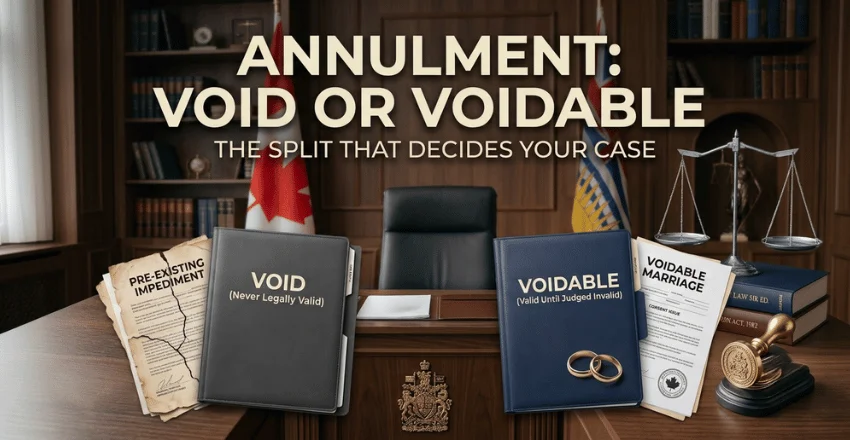
| Question | Void (void ab initio) | Voidable |
|---|---|---|
| Status before any order | No marriage ever existed | Valid and fully effective until annulled |
| Who may apply | Any interested person, including an estate or a prior spouse | Only one of the two parties |
| After a party dies | Can still be attacked | Cannot be attacked; the marriage becomes unimpeachable |
| Effect of the order | Declaratory: it confirms a nullity that already existed | Constitutive: the order is what makes the marriage null |
| Is an order strictly necessary? | Not to create the nullity, but usually needed to prove it | Yes. Without an order the marriage stands |
| Can delay or ratification bar it? | No. A void marriage cannot be ratified | Yes. Delay, approbation and insincerity are bars in the 1870 doctrine |
Only one federal provision expressly attaches the word “void” to a capacity defect: Marriage (Prohibited Degrees) Act s. 3(2). For every other ground the label comes from doctrine, not statute. Many articles present the classification as though Parliament wrote it down. It did not.
Which grounds fall on which side
| Ground | Category | Anchor |
|---|---|---|
| Prohibited degrees: lineal relatives, full or half siblings, including by adoption | Void, expressly | MPDA ss. 2(2), 3(2) |
| A prior subsisting marriage (bigamy) | Void | Civil Marriage Act s. 2.3 prohibits it, Criminal Code s. 290 criminalises it. Neither says the second marriage is void; that comes from the imported 1870 law |
| Under 16 years of age | Void in the doctrine | Civil Marriage Act s. 2.2 prohibits it but is silent on void or voidable |
| Total absence of consent: no understanding a marriage was happening, mistake as to the ceremony or the other person’s identity | Void in the doctrine | Civil Marriage Act s. 2.1 requires consent but attaches no label |
| Duress | Contested: traditionally void, though some authorities treat it as voidable | No statutory label; the Canadian literature splits |
| Permanent, incurable inability to consummate, existing at the date of marriage | Voidable | No statute. At 1870 essentially the only clearly voidable ground |
| Defects in the form of the ceremony | Rarely fatal | Ontario Marriage Act s. 31 validates most formal defects |
Marriage Act s. 31 closes off the ground people reach for first. Where a marriage was “solemnized in good faith and intended to be in compliance with this Act”, the parties were not disqualified, and they afterwards lived together as a married couple, it is deemed valid even if the officiant lacked authority or the licence was irregular. A paperwork error behind a marriage licence issued in Ontario will almost never produce a nullity.
The federal capacity rules, in their exact words
Three provisions set who may marry in Canada, all in the Civil Marriage Act, S.C. 2005, c. 33, and all added in 2015. Before that there was no federal statutory minimum marriage age outside Quebec.
- s. 2.1: “Marriage requires the free and enlightened consent of two persons to be the spouse of each other.”
- s. 2.2: “No person who is under the age of 16 years may contract marriage.”
- s. 2.3: “No person may contract a new marriage until every previous marriage has been dissolved by death or by divorce or declared null by a court order.”
Note what they do not say. They prohibit; none states the consequence of breach. The prohibited degrees are also narrower than most assume. Section 2(2) of the Marriage (Prohibited Degrees) Act reaches only persons “related lineally, or as brother or sister or half-brother or half-sister, including by adoption”, and s. 4 declares that the Act “contains all of the prohibitions in law in Canada against marriage by reason of the parties being related.” First cousins, an uncle and niece, step-relations and in-laws may all lawfully marry.
Bigamy under Criminal Code s. 290 is hybrid, carrying up to five years on indictment under s. 291, as does polygamy under s. 293. Section 290(2)(d) is the interlock that matters: it is a complete defence that “the former marriage has been declared void by a court of competent jurisdiction.” A civil declaration of nullity of the first marriage removes the criminal exposure created by the second ceremony.
Grounds that fail, including the immigration marriage
Most applications fail because the applicant describes a fraud about motive rather than about the marriage itself. Fraud annuls only where it goes to the nature of the ceremony or the identity of the other party, not to qualities, wealth, intentions, fertility or immigration motive. A marriage entered into purely to obtain Canadian status is therefore generally not annullable on that basis: the consent was real even where the motive was cynical. Wilful refusal to consummate also fails, because the 1870 law did not include it, as do a short marriage and a spouse who changed after the wedding. Where a relationship simply did not work, the realistic routes are divorce or, for unmarried partners, the rules governing a common law relationship in Ontario.
How an Ontario annulment actually proceeds
The Courts of Justice Act s. 21.8 and item 4 of its Schedule assign “Proceedings for annulment of a marriage or for a declaration of validity or invalidity of a marriage” to the Family Court where it has jurisdiction. Everywhere else the case goes to the ordinary Superior Court of Justice, and the Ontario Court of Justice cannot hear one at all. The Family Court branch covers only the 24 municipalities listed in Family Law Rules r. 1(3), including Durham, Hamilton, Niagara, Ottawa, Simcoe, Waterloo and York. Toronto, Peel, Halton and most of the north lie outside it, so checking the local daily court lists before filing is worth the minute.
Form 8, and how it must be served
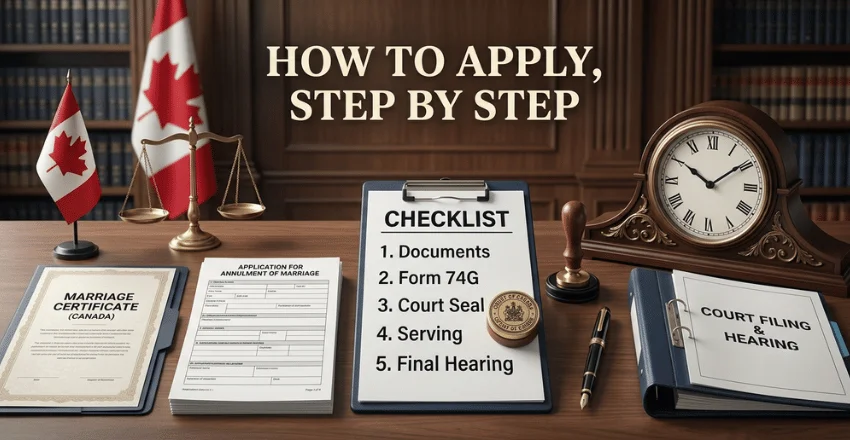
The Family Law Rules, O. Reg. 114/99 apply to an annulment case under r. 1(2)(d). A standalone annulment is started on Form 8, Application (General), version FLR 8 dated 13 June 2025, ticking claim box 31, annulment of marriage. Form 8A carries the same box but only inside the frame reserved for a joint application for divorce, so it fits only where the annulment is bundled into a joint divorce. The respondent answers on Form 10; an uncontested-trial affidavit uses Form 23C.
Service is stricter than expected. Rule 8(5) requires immediate special service, and r. 6(4.1) provides that special service of an application must be carried out “by a person other than the party required to serve the document”, so an applicant cannot hand the papers over personally. Rule 6(3) permits leaving a copy with the person, serving their lawyer of record, mailing with a prepaid Form 6 acknowledgment postcard that must be signed and filed, or leaving a copy at the residence with an apparent adult resident and mailing a second copy that day or the next. An answer is due in 30 days under r. 10(1), or 60 days if service was outside Canada and the United States.
Do you actually need a trial?
Often not, which undercuts the widely repeated claim that an annulment must be more painful than a divorce. Three routes avoid a contested hearing.
- Fast track, r. 39. In the Family Court branch, r. 39(7) makes only divorce, property and arbitration claims standard track. An annulment claim is not listed, so an annulment-only application is fast track, and under r. 39(5)(d), if no answer is filed the clerk sends the case to a judge for decision on affidavit evidence. Adding an equalization claim flips it to standard track.
- Uncontested trial, r. 23(22). Affidavit evidence in Form 14A or Form 23C “may be used without an order” unless the court directs oral evidence.
- Summary judgment, r. 16(2). Available “in any case … that does not include a divorce claim”. An annulment is not a divorce claim, so summary judgment is open here and closed on a divorce.
Rule 36, which governs divorce procedure, does not apply, so on its face the marriage certificate and Central Registry of Divorce Proceedings clearance required by r. 36(4) do not attach to an annulment, and nor does the federal $10 registry fee. Registrar practice on the point is not published, so confirm locally; a marriage certificate is inexpensive and usually worth filing anyway.
There is no official timeline. The Superior Court’s family process guide does not mention annulment, its 2024 to 2025 annual report publishes no time-to-disposition figures, and Ontario publishes no estimate, so any article quoting a “typical four to twelve months” is quoting nothing. The one hard marker is r. 41(5): outside the Family Court branch the clerk serves a notice of approaching dismissal on the 365th day after the case started unless it is settled, withdrawn or scheduled for trial, with dismissal 60 days later under r. 41(6).
What an Ontario annulment costs
Fees are prescribed by O. Reg. 293/92 and O. Reg. 417/95 under the Administration of Justice Act and published on the Ontario family court fees page, last updated 9 April 2026. The amounts came into effect on 1 January 2023.
| Step | Fee |
|---|---|
| Filing an application | $214.00 |
| Filing an answer without a divorce request | $171.00 |
| Filing an answer including a divorce request by a respondent | $214.00 |
| Placing an application on the list for hearing | $445.00 |
| Issuing a summons to a witness | $33.00 |
| Copies, uncertified and certified, per page | $1.00 and $4.00 |
| Central Registry of Divorce Proceedings fee | $10.00, and only where the filing includes a divorce claim |
Legal fees are another matter, and honesty beats a made-up range. No published Canadian data exists on the cost of an annulment specifically. The nearest reference point is the Canadian Lawyer 2021 Legal Fees Survey, published on 6 January 2022 by that commercial legal publication, giving national averages for divorce rather than annulment: roughly $1,860 uncontested and $20,625 contested. Those are five-year-old figures for a different proceeding.
Ontario’s Steps to Justice service states that an annulment can cost more than a divorce because divorce has a paperwork-only route. That page was last reviewed on 1 March 2021 and sits uneasily with rr. 39(5)(d), 23(22) and 16(2). The safer conclusion: an annulment costs more where the ground is disputed, because proving impotence, duress or absence of consent takes evidence an uncontested divorce never needs.
What survives an annulment, and what does not
This is the question readers actually have, and where competing articles are most often wrong. It turns on one definition in the Family Law Act, s. 1(1), as amended by 2024, c. 28, Sched. 9, s. 1, in force 1 May 2026.
“spouse” means either of two persons who, (a) are married to each other, or (b) have together entered into a marriage that is voidable or void, in good faith on the part of a person relying on this clause to assert any right.
Clause (b) covers void marriages as well as voidable ones, and requires good faith only from the person invoking it. An innocent party can therefore claim against a party who knew the marriage was invalid, while that party cannot claim in return.
| Entitlement | Available after an annulment? | Provision |
|---|---|---|
| Equalization of net family property | Yes, for a good-faith party. s. 5(1) applies expressly “When a divorce is granted or a marriage is declared a nullity”, and Part I does not redefine spouse | FLA s. 5(1) |
| Valuation date | Yes. The s. 4(1) list includes “The date the marriage is declared a nullity” | FLA s. 4(1) |
| Spousal support, provincial | Yes. Part III imports the s. 1(1) definition through s. 29, and s. 36(3) preserves an order where support was not adjudicated in the nullity proceeding | FLA ss. 29, 36(3) |
| Spousal support, Divorce Act | No. That relief is corollary to a divorce, and no divorce is granted | Divorce Act structure |
| Matrimonial home rights and exclusive possession | Yes, until the order issues | FLA ss. 19, 21, 24 |
| Child support and parenting arrangements | Yes, entirely unaffected | FLA and CLRA |
| Claims by a party who married in bad faith, for example knowingly bigamously | No equalization and no s. 1(1) claim, though the s. 29 three-year cohabitation limb may still apply | FLA ss. 1(1)(b), 29 |
There is a trap in s. 19(2)(b). Where only one spouse owns the matrimonial home, the other’s right of possession “ends when they cease to be spouses”, and the annulment order is the very event that ends it, so exclusive possession relief must be sought inside the nullity proceeding. Nor can this be contracted around casually: a prenuptial agreement or a separation agreement in Ontario signed on the assumption of a valid marriage raises its own questions once the marriage turns out to be void.
Children are unaffected, and the usual framing is wrong. Children’s Law Reform Act s. 3 makes Part I govern parentage “for all purposes of the law of Ontario” and s. 4(1) provides that “A person is the child of his or her parents”. Legitimacy was abolished as a legal concept, so the point is not that these children “remain legitimate” but that parentage is determined independently of the parents’ marital status. Child support and parenting arrangements proceed as after any separation.
No deadline to annul, but a hard deadline on the money
There is no limitation period to seek an annulment. The Limitations Act, 2002 s. 16(1)(a) removes any limitation period for “a proceeding for a declaration if no consequential relief is sought”, and s. 16(1)(c) does the same for Family Law Act support claims. Where consequential relief is claimed alongside the declaration the position is less settled, and the basic two-year discovery rule in s. 4 could be argued.
The dangerous deadline is elsewhere. FLA s. 7(3) bars an equalization application after the earliest of two years after the marriage is terminated by divorce or judgment of nullity, six years after separation with no reasonable prospect of resuming cohabitation, or six months after the first spouse’s death.
Those three words do the damage. Separation almost always long predates a nullity judgment, so the six-year clock frequently expires before the two-year clock ever starts. An annulment does not reset the equalization limitation period. Section 2(8) lets the court extend a time prescribed by the Act where there are apparent grounds for relief, the delay was incurred in good faith and no person suffers substantial prejudice, but that is a discretionary rescue, not a plan.
A religious annulment changes nothing in civil law
A Catholic declaration of nullity from a diocesan tribunal, a Jewish get and an Islamic faskh or khula are religious acts with religious consequences. None alters civil marital status in Canada. Alberta’s government puts it plainly on its separation and annulment page: a religious institution’s annulment “is different from a legal annulment.”
No Canadian statute says so in terms, so this is a legal conclusion drawn from two anchors. Civil Marriage Act s. 2.3 requires a previous marriage to have been “declared null by a court order” before a new marriage may be contracted, which excludes a tribunal decree. And the Courts of Justice Act Schedule and the Family Law Rules assign annulment to named civil courts. FLA s. 59.2(1) points the same way: where a family-law decision is made in a process “not conducted exclusively in accordance with the law of Ontario or of another Canadian jurisdiction”, the decision “has no legal effect”.
The barrier-to-remarriage provisions do not fill the gap. Divorce Act s. 21.1 lets a spouse file an affidavit about barriers within the other spouse’s control, and if no responding affidavit follows within fifteen days the court may dismiss that spouse’s application. But s. 21.1(6) excludes any barrier whose removal lies with a religious body or official, which takes Catholic declarations of nullity outside the section and confines it in practice to the get, and s. 21.1 operates only “in any proceedings under this Act”, so it never reaches a nullity. Ontario’s FLA s. 2(4) equivalent lists only Family Law Act applications. A bare annulment claim attracts neither. The definition of “barrier to religious remarriage” in s. 21.1(1) was also repealed in 2019; sources still quoting it are out of date.
Annulment and spousal sponsorship
Under the Immigration and Refugee Protection Regulations, s. 2 defines “marriage”, for a marriage outside Canada, as one “valid both under the laws of the jurisdiction where it took place and under Canadian law”. A marriage void under Canadian law is therefore not a marriage for immigration purposes at all, whether or not anyone has obtained a declaration. Section 4(1) separately excludes a spouse where the marriage “was entered into primarily for the purpose of acquiring any status or privilege under the Act” or “is not genuine”, and s. 5 excludes a foreign national under 18, one already married to another person, or one who married where a spouse was not physically present. Those thresholds are stricter than the civil rules: a 16 or 17 year old’s marriage can be civilly valid under Civil Marriage Act s. 2.2 and still create no sponsorable relationship.
The undertaking is a separate problem. IRPR s. 132(1)(b)(i) sets the spousal undertaking at three years from the day the sponsored person becomes a permanent resident, and the federal sponsorship guide states it is not cancelled even if the sponsor becomes divorced or separated. That guide does not address annulled or void marriages, and no regulatory text on the point could be located, so whether a nullity judgment retroactively releases a sponsor should not be assumed either way. Anyone in that position needs immigration advice before filing, and should understand the separate consequences that follow a removal or deportation proceeding.
How the provinces differ
| Ontario | Quebec | Alberta | British Columbia | |
|---|---|---|---|---|
| Source of nullity law | English law as at 15 July 1870, imported by federal statute | Civil Code of Quebec, arts. 380 to 390 | Common law, plus a statutory ground in Marriage Act s. 22 | Common law; the Supreme Court Family Rules recognise the claim |
| Court | Superior Court of Justice | Superior Court of Quebec | Court of King’s Bench | Supreme Court of British Columbia |
| Limitation on the claim | None for a bare declaration | Three years from solemnization, art. 380, unless public order is engaged, in particular where consent was not free or enlightened | An underage-consent claim under Marriage Act s. 22(2)(c) must be brought before the applicant turns 19 | None specified |
| Property rights for a party to a void or voidable marriage | Yes, with a good-faith requirement, FLA s. 1(1)(b) | Yes. Art. 382 preserves effects for good-faith spouses; art. 387 presumes good faith | Yes, with no good-faith requirement: Family Property Act s. 1(e) covers “a party to a marriage notwithstanding that the marriage is void or voidable” | No equivalent. A party must qualify through the two-year marriage-like relationship limb in Family Law Act s. 3 |
| Post-nullity property deadline | Two years, FLA s. 7(3)(a) | Governed by the Code | Two years, Family Property Act s. 6(1)(b) | Governed by the Family Law Act |
| Marriage certificate required | Not by Rule 36, which applies to divorce only | Court practice | Court practice | Yes, with the first document making a divorce or nullity claim |
Alberta’s Marriage Act s. 22 is the only true statutory annulment ground in the country, and it builds ratification into the statute: a marriage of a person under 18 without the required consent or medical certificate is void, but only where there was no pre-ceremony intercourse, the marriage was not consummated, and the parties did not afterwards cohabit as spouses.
British Columbia’s gap is substantive. Its Family Law Act s. 3 defines “spouse” by marriage or by a two-year marriage-like relationship, with no equivalent of Ontario’s s. 1(1)(b). Most annulled BC marriages will still meet the two-year test, but a short or non-cohabiting marriage may not, which matters to anyone comparing this with the ordinary route to a divorce in British Columbia or the requirements for a BC marriage licence.
What is current as of September 2026
- Family Law Act s. 1(1) was amended by 2024, c. 28, Sched. 9, s. 1, in force 1 May 2026. The definition quoted above is the current post-amendment text on e-Laws.
- The family court fees page was updated 9 April 2026 and still shows the amounts in effect since 1 January 2023: $214 to file an application, $171 or $214 for an answer, $445 to place it on the hearing list.
- Form 8 is at version FLR 8 dated 13 June 2025, with claim box 31. Form 8A remains at the April 2024 version.
- Online filing split on 14 October 2025 between the Ontario Courts Public Portal for the Toronto region and Justice Services Online elsewhere.
- Federal statutes are consolidated current to 21 June 2026, the Criminal Code last amended 15 June 2026. Civil Marriage Act s. 6 still names the “Court of Queen’s Bench” for Alberta, Manitoba, Saskatchewan and New Brunswick.
There are still no annulment statistics. The Canadian Vital Statistics Divorce Database counts only divorces and neither defines nor includes annulments. For scale, StatCan’s fifty-year look at divorces in Canada reports 42,933 divorces in 2020, the lowest since 1973 and less than half the 1987 peak of 97,773, down from 56,937 in 2019. Table 39-10-0051-01 was last updated 14 November 2022 and its most recent reference year is still 2020, a six-year lag.
Frequently asked questions
Is an annulment faster or cheaper than a divorce in Ontario?
Not reliably. The filing fees are identical: $214 for the application and $445 to place it on the hearing list. Where the ground is uncontested, Family Law Rules rr. 39(5)(d), 23(22) and 16(2) allow a paper-based decision. Where it is disputed, an annulment needs evidence about capacity, consent or consummation that an uncontested divorce never requires.
Can I get spousal support after an annulment?
Yes, under provincial law, if you married in good faith. Family Law Act s. 1(1)(b) extends “spouse” to a party to a void or voidable marriage acting in good faith, and Part III imports that definition through s. 29. Divorce Act support is not available, because that relief is corollary to a divorce that is never granted.
Does an annulment wipe out property claims?
No. Family Law Act s. 5(1) applies expressly “When a divorce is granted or a marriage is declared a nullity”, and s. 4(1) lists the date of a nullity declaration as a valuation date. Because Part I does not redefine “spouse”, the good-faith requirement in s. 1(1)(b) governs, so a knowingly bigamous party cannot claim equalization.
How long do I have to apply for an annulment?
For a bare declaration of nullity with no other relief, there is no limitation period at all under Limitations Act, 2002, s. 16(1)(a). The real deadline is on the money: FLA s. 7(3) bars an equalization claim after the earliest of two years from the nullity judgment, six years from separation, or six months after a death. The separation clock usually runs out first.
Is a marriage entered into for immigration purposes annullable?
Generally no. Fraud annuls a marriage only where it goes to the nature of the ceremony or the identity of the other person, not to motive, wealth or immigration status. The consent to marry was genuine even where the reason was cynical. The immigration side is handled separately under IRPR s. 4(1), which excludes a spouse where the marriage is not genuine.
Which form starts an annulment application in Ontario?
Form 8, Application (General), version FLR 8 dated 13 June 2025, with claim box 31, “annulment of marriage”, ticked. Form 8A carries the same box but only inside the frame for a joint application for divorce, so it fits only where the annulment is bundled into a joint divorce. The respondent answers on Form 10.
Can first cousins marry in Canada?
Yes. The Marriage (Prohibited Degrees) Act s. 2(2) prohibits marriage only between persons related lineally, or as brother and sister or half-brother and half-sister, including by adoption, and s. 4 states that the Act contains all of the prohibitions in Canadian law based on relationship. Cousins, an uncle and niece, step-relations and in-laws are outside it.
Does a Catholic declaration of nullity end my marriage legally?
No. A diocesan tribunal decree, a Jewish get and an Islamic faskh are religious acts with no civil effect on marital status in Canada. Civil Marriage Act s. 2.3 requires a previous marriage to have been dissolved by death or divorce or “declared null by a court order” before a new marriage can be contracted.
Can I annul a marriage that was never consummated?
Only where the non-consummation is caused by a permanent and incurable inability, physical or psychological, existing at the date of the marriage. That ground makes the marriage voidable, and either party may bring it, including the spouse who cannot consummate. Wilful refusal to consummate is not a ground in Canada; England added it in 1937, after the 1870 cut-off.
Was my marriage void because the officiant was not licensed?
Almost certainly not. Ontario’s Marriage Act s. 31 deems a marriage valid where it was solemnized in good faith and intended to comply with the Act, the parties were not legally disqualified, and they afterwards lived together as a married couple, even if the officiant lacked authority or the licence was irregular.
How many annulments are granted in Canada each year?
Nobody publishes that number. Statistics Canada’s Divorce Database counts only divorces, defined as the legal dissolution of a legal marriage, and does not include annulments. The Superior Court of Justice annual report for 2024 to 2025 publishes no annulment counts either. Any figure quoted for annulments in Canada is an estimate without a public source.
Before you act
If the goal is simply to end a marriage, a divorce is almost always the shorter road, and the entitlements that follow are broadly similar in Ontario. An annulment is worth pursuing where the status itself matters: to clear a bigamy exposure under Criminal Code s. 290(2)(d), to establish that no marriage existed for an estate or immigration purpose, or where a religious body will act only on a civil declaration. Where the relationship never became a marriage in law at all, the rules on a conjugal relationship and on cohabitation agreements may matter more.
This page is legal information, not legal advice, and Lawverra does not provide legal services or represent anyone. Annulment is a narrow, evidence-heavy area built on doctrine no statute spells out, and the void or voidable classification of several grounds rests on case law rather than legislation. Anyone considering an application should get advice from an Ontario family lawyer, and a licensed mediator may help where only the financial consequences are in dispute.
Last reviewed: September 2026. Primary sources checked: the Annulment of Marriages Act (Ontario), Civil Marriage Act, Marriage (Prohibited Degrees) Act, Criminal Code ss. 290 to 293, Divorce Act s. 21.1 and the Immigration and Refugee Protection Regulations on Justice Laws, all current to 21 June 2026; Ontario’s Family Law Act, Marriage Act, Courts of Justice Act, Children’s Law Reform Act, Limitations Act, 2002 and Family Law Rules on e-Laws; the ontario.ca family court fees page updated 9 April 2026; the Civil Code of Quebec, Alberta and British Columbia statutes named above; and Statistics Canada divorce data. No case citation is relied on anywhere on this page.