

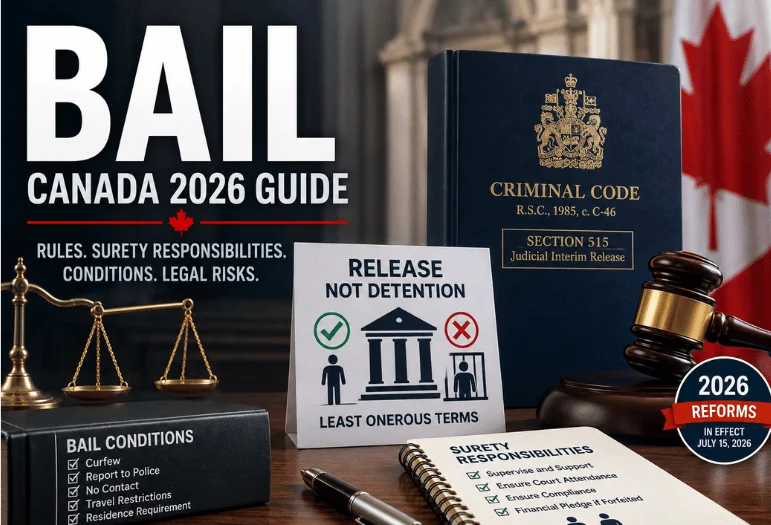
Bail, called judicial interim release in the Criminal Code, is a court order releasing a person into the community while their charges are outstanding. The starting point is release without conditions: under s. 515(1) the justice shall release the accused unless the prosecutor shows cause why detention, or some more restrictive form of release, is justified.
That starting point changed on 15 July 2026. The Bail and Sentencing Reform Act (Bill C-14), S.C. 2026, c. 11, received Royal Assent on 15 June 2026 and its bail provisions came into force thirty days later. It is the largest rewrite of Canadian bail law since 2019: seven new reverse-onus categories, a higher test for reverse-onus accused, the principle of restraint switched off in those cases, and a new bar on most people with a recent indictable conviction acting as a surety.
One warning before anything else. The consolidated Criminal Code on the Justice Laws website is stamped “Act current to 2026-06-21”, three weeks before C-14 came into force. The consolidated s. 515 does not show any of these amendments and its history table stops at 2024. Most bail articles online, and the free statute text people check, are describing superseded law.
| Point | Detail |
|---|---|
| Governing law | Criminal Code Part XVI, as amended by S.C. 2026, c. 11 |
| C-14 bail provisions in force | 15 July 2026 (Royal Assent 15 June 2026) |
| Time to appear before a justice | Within 24 hours of arrest where a justice is available, s. 503(1)(a) |
| Longest adjournment without consent | Three clear days, s. 516(1) |
| Grounds for detention | Three, and only three: s. 515(10)(a), (b) and (c) |
| New surety disqualification | Indictable conviction in the past 10 years, s. 515(2.11), from 15 July 2026 |
| Automatic detention review | 90 days after the detention order, s. 525 |
| Ontario remand share of jail population | 85.7% of average daily custody, 2023/24 |
What Bill C-14 changed on 15 July 2026, and why the online Criminal Code does not show it
Sponsored by Minister of Justice Sean Fraser, C-14 had first reading on 23 October 2025, passed the House on 13 February 2026 and the Senate on 28 May 2026, and was assented to on 15 June 2026. Section 84(1) brought ss. 2 to 55, 59 to 70, 73, 74 and 79 to 81 into force thirty days after assent, and every bail provision sits in that block. Section 81.1 requires a five-year parliamentary review.
Because the consolidation lags, the authoritative text is the enacted annual statute, S.C. 2026, c. 11. Anyone reading the consolidated s. 515 page today is reading the pre-C-14 version. Check the “Act current to” date at the top of any Justice Laws page before relying on it.
| Change | Provision | Effect |
|---|---|---|
| Hybrid offences count as indictable | s. 493.01 | Unless the Crown elects summarily, widening every reverse onus keyed to “indictable offence” |
| Restraint narrowed | s. 493.11 | s. 493.1 “does not require the accused to be released”; primary consideration of release removed for reverse-onus accused |
| Ladder switched off on a reverse onus | s. 515(2.04) | The least-onerous-form rule in s. 515(2.01) no longer applies to s. 515(6) accused |
| Surety disqualification | ss. 515(2.11), (2.12) | No surety with an indictable conviction in the past 10 years unless no other suitable surety exists and it is in the interests of justice, with reasons on the record |
| Higher test on a reverse onus | s. 515(6) opening words | Accused must show cause “by clearly demonstrating that their proposed release plan addresses the risks posed by the accused” |
| Seven new reverse-onus offences | s. 515(6)(a)(ix) to (xiv) | Strangulation assaults, human trafficking, violent or organised auto theft, violent extortion, a third violent indictable offence, break and enter of a dwelling, human smuggling |
| Weapon reverse onus widened | s. 515(6)(b.2) | Prior-conviction window grows from five years to 10 |
| New factor and new tertiary consideration | ss. 515(3)(a.1), 515(10)(c)(v) | Random and unprovoked violence; the number or gravity of outstanding charges from separate events |
| Conditions for auto theft and break-ins | s. 515(4.4) | Justice must consider geographic exclusion, no break-in instruments, and remaining at a residence at specified times |
| Detention reviews limited | ss. 525(4.1), (5.1), (5.2) | After a continued-detention order, no further s. 525 hearing unless the judge requires one |
| Annual public reporting | Department of Justice Act | Minister must table a yearly report on the state of judicial interim release in Canada |
The constitutional floor: Charter s. 11(e) and its two aspects
Bail is a constitutional right, not a favour. Section 11 of the Canadian Charter of Rights and Freedoms provides that any person charged with an offence has the right:
(e) not to be denied reasonable bail without just cause.
The Supreme Court in Antic held that eleven words carry two protections. The first is the right not to be denied bail without just cause, which exists only where denial happens in a narrow set of circumstances and is necessary to the proper functioning of the bail system. The second is the right to reasonable bail, which “relates to the terms of bail, including the quantum of any monetary component and other restrictions.”
From arrest to bail court: the 24-hour rule
Most people arrested in Canada never see a bail court. Under s. 498(1) an officer who arrests without warrant shall, as soon as practicable, release the person by summons, appearance notice or undertaking. That duty is displaced only under s. 498(1.1): where detention is needed to establish identity, secure evidence, prevent repetition of an offence or protect a victim or witness, or where the person will not attend court. A first shoplifting charge ordinarily ends with an appearance notice at the station.
Where the person is held, s. 503(1)(a) requires they be taken before a justice without unreasonable delay and in any event within 24 hours, if a justice is available in that period; otherwise, as soon as possible. Section 503(1.1) adds a continuing duty to release if the officer becomes satisfied that further detention is no longer necessary.
If a relative was arrested overnight, 24 hours is the number to hold on to. Ontario runs weekday and weekend bail courts, and the daily court lists for the courthouse are the fastest way to find when the hearing will happen.
The ladder principle: the least onerous release the Crown cannot displace
Section 515(2) sets out five rungs in ascending order of onerousness, and a justice may not skip one. Section 515(2.01) bars any order under paragraphs (2)(b) to (e) “unless the prosecution shows cause why an order containing the conditions referred to in the preceding paragraphs for any less onerous form of release would be inadequate.”
| Rung | Form of release | Money |
|---|---|---|
| s. 515(1) | Release order with no conditions, the statutory default | None |
| s. 515(2)(a) | Conditions, but no financial obligation | None |
| s. 515(2)(b) | Accused promises to pay a specified amount on breach | Pledged, not paid up front |
| s. 515(2)(c) | One or more sureties, with or without a promise to pay | Pledged by the surety, not paid up front |
| s. 515(2)(d) | Deposit of money or other valuable security | Actually deposited with the court |
| s. 515(2)(e) | Deposit, only where the accused is not ordinarily resident in the province or lives more than 200 km from the place of custody | Actually deposited, with or without sureties |
Two further subsections push against money. Section 515(2.02) says the justice “shall favour a promise to pay an amount over the deposit of an amount of money” where the accused or surety has reasonably recoverable assets. Section 515(2.03) says that before requiring a surety at all, the justice must be satisfied a surety is the least onerous form of release possible. Both came from Bill C-75 in 2019, alongside s. 493.1, the principle of restraint, and s. 493.2, which requires particular attention to Aboriginal accused and to accused from vulnerable populations overrepresented in the justice system.
What C-14 did to this. New s. 493.11 states for greater certainty that s. 493.1 does not require release, redefines least onerous conditions as those “necessary to address the risks posed by the accused”, and provides that a justice shall not give primary consideration to early release where the accused falls under s. 515(6), 522(2), 523(2.1) or 524(4). New s. 515(2.04) then disapplies the least-onerous-form rule to reverse-onus accused outright. In plain terms: the ladder still governs an ordinary bail hearing, but in a reverse-onus case it no longer does.
The three grounds for detention under s. 515(10)
Detention is justified only on the grounds in s. 515(10). There is no fourth ground, and the seriousness of the allegation on its own is not one of them.
Primary ground, s. 515(10)(a): will they come back to court
where the detention is necessary to ensure his or her attendance in court in order to be dealt with according to law
This turns on ties to the community: a fixed address, employment, family, and any record of failing to appear. A person with a stable address and no s. 145 history is rarely detained on this ground alone.
Secondary ground, s. 515(10)(b): public safety and reoffending
where the detention is necessary for the protection or safety of the public, including any victim of or witness to the offence, or any person under the age of 18 years, having regard to all the circumstances including any substantial likelihood that the accused will, if released from custody, commit a criminal offence or interfere with the administration of justice
The threshold is “substantial likelihood”, not possibility. This is the ground most hearings are fought on, and the one a release plan answers: a surety who will supervise, a residence, a curfew, non-association terms, and where relevant a supervision placement.
Tertiary ground, s. 515(10)(c): confidence in the administration of justice
if the detention is necessary to maintain confidence in the administration of justice, having regard to all the circumstances
The section then lists what must be weighed: the apparent strength of the prosecution’s case; the gravity of the offence; the circumstances of its commission, including whether a firearm was used; and the fact that the accused is liable on conviction to a potentially lengthy term, or, for a firearm offence, to a minimum of three years or more. C-14 added a fifth item at s. 515(10)(c)(v): “the number or gravity of any outstanding charges against the accused that arise out of separate events.”
In R. v. St-Cloud, 2015 SCC 27 the Supreme Court restored a detention order and held that the tertiary ground is a distinct, free-standing basis for detention, not a residual one available only when the first two fail. It “must not be interpreted narrowly or applied sparingly”, and is not limited to exceptional circumstances or the most heinous crimes. For a family that is the hard news: a person with a good address, a job and no record can still be detained under (c) on a serious charge, particularly a violent offence causing serious bodily harm or one involving a firearm.
Reverse onus: every category, and the year it was added
Normally the Crown must show cause why detention is justified. Section 515(6) reverses that: for the listed charges the accused must show cause why detention is not justified, or be detained. Since 15 July 2026 the accused must do so “by clearly demonstrating that their proposed release plan addresses the risks posed by the accused” as they relate to the s. 515(10) grounds. That is a materially higher bar than the old open-ended wording, and the same formula now appears in ss. 522(2), 523(2.1) and 524(4).
| Reverse-onus category | Provision | Added or last changed |
|---|---|---|
| Indictable offence allegedly committed while at large on release for another indictable offence | s. 515(6)(a)(i) | Long-standing |
| Criminal organization offences, ss. 467.11 to 467.13, and serious offences for a criminal organization | s. 515(6)(a)(ii) | Long-standing |
| Terrorism offences, ss. 83.02 to 83.04 and 83.18 to 83.23 | s. 515(6)(a)(iii) | Long-standing |
| Listed offences under the Foreign Interference and Security of Information Act | s. 515(6)(a)(iv), (v) | Cross-reference corrected by C-14, 2026 |
| Firearms offences: ss. 95, 98, 98.1, 99, 100, 102, 103 | s. 515(6)(a)(vi) | ss. 95, 98, 98.1, 102 added by C-48, in force 4 January 2024 |
| ss. 244 and 244.2, and ss. 239, 272, 273, 279(1), 279.1, 344, 346 committed with a firearm | s. 515(6)(a)(vii) | Long-standing |
| Weapon or explosive offence committed while under a prohibition order | s. 515(6)(a)(viii) | Extended by C-48 to treat a bail release order as a prohibition order, 4 January 2024 |
| Assault or sexual assault, ss. 266 to 268 or 271 to 273, involving choking, suffocating or strangling | s. 515(6)(a)(ix) | New, C-14, 15 July 2026 |
| Trafficking in persons, ss. 279.01, 279.011 | s. 515(6)(a)(x) | New, C-14, 15 July 2026 |
| Motor vehicle theft with violence, or for a criminal organization, s. 333.1(3), (4) | s. 515(6)(a)(xi) | New, C-14, 15 July 2026 |
| Extortion, s. 346, where violence was used, threatened or attempted | s. 515(6)(a)(xii) | New, C-14, 15 July 2026 |
| A violence offence that would be a third or subsequent indictable violence offence | s. 515(6)(a)(xii.1) | New, C-14, 15 July 2026 |
| Break and enter of a dwelling-house, s. 348(1)(d) | s. 515(6)(a)(xiii) | New, C-14, 15 July 2026 |
| Human smuggling, ss. 117, 118 Immigration and Refugee Protection Act | s. 515(6)(a)(xiv) | New, C-14, 15 July 2026 |
| Indictable offence where the accused is not ordinarily resident in Canada | s. 515(6)(b) | Long-standing |
| Intimate partner violence with a prior conviction or s. 730 discharge for violence against an intimate partner | s. 515(6)(b.1) | Discharges added by C-48, 4 January 2024; re-enacted by S.C. 2024, c. 22, in force about 8 April 2025 |
| Violence with a weapon plus a prior weapon-violence conviction, both offences carrying 10 years or more | s. 515(6)(b.2) | Created by C-48, 4 January 2024; window widened from five to 10 years by C-14, 15 July 2026 |
| Failure to attend or comply, ss. 145(2) to (5), allegedly committed while at large | s. 515(6)(c) | Long-standing |
| Drug offences punishable by life under ss. 5 to 7 of the Controlled Drugs and Substances Act, and conspiracies | s. 515(6)(d) | Long-standing |
Three points matter more than the list itself. C-14’s s. 493.01 means a hybrid offence counts as indictable unless the Crown elects summarily, so these categories reach further than the offence sections suggest. Because s. 515(2.04) turns off the ladder here, the release plan must be complete at the first attempt. And s. 515(6.1) requires written reasons if the justice does release a reverse-onus accused.
Two categories deserve separate mention. Serious trafficking and production charges under ss. 5 to 7 of the Controlled Drugs and Substances Act reverse the onus from the first appearance. A person not ordinarily resident in Canada faces both s. 515(6)(b) and a possible immigration hold, with removal proceedings running alongside the criminal case.
Being a surety: what you are actually signing
A surety undertakes to the court to supervise the accused in the community and pledges a sum that becomes forfeitable if the accused breaches. Sureties sit at rungs (c) and (e) of the ladder. In R. v. Antic, 2017 SCC 27 the Supreme Court said at para. 67(g) that “a recognizance with sureties is one of the most onerous forms of release”, and should not be imposed unless all less onerous forms have been considered and rejected.
The obligation, and the Form 12 declaration
Section 515.1 requires a prospective surety to swear a declaration in Form 12. It records name, date of birth and contact details; financial information showing suitability; the relationship to the accused; any other accused the person already acts for; an acknowledgment of the charge, other outstanding charges and the accused’s record; the amount to be promised or deposited; an acknowledgment that the role is voluntary; and the surety’s own record. It is a sworn document.
The practical obligations are to know the charges and conditions, ensure the accused attends court and obeys every term, report any breach to police, and stand liable for the pledged amount. Reporting a breach means calling the police on a family member. Anyone who cannot see themselves doing that should not sign.
Do you have to hand over cash
Usually not. The pledge is normally a promise to pay, not a payment. Section 515(2.02) directs the justice to favour a promise to pay over an actual deposit where there are reasonably recoverable assets, and s. 515(2)(e), the only rung requiring a deposit as such, applies only where the accused is not ordinarily resident in the province or lives more than 200 kilometres from the place of custody.
Antic is stricter still. At para. 67(h) a recognizance is functionally equivalent to cash bail and has the same coercive effect, so cash should be used “only in exceptional circumstances”. At para. 67(i), where cash is ordered the amount “must not be set so high that it effectively amounts to a detention order”, and the justice must inquire into ability to pay.
The new 10-year disqualification
This is the change most likely to surprise a family assembling a plan. Under s. 515(2.11), in force since 15 July 2026, a judge, justice or court shall not name a person as surety if that person was convicted of an indictable offence within the ten years before the release order is made, unless satisfied that no other suitable surety is available and that naming them is in the interests of justice. Section 515(2.12) requires reasons on the record where such a person is named anyway. Check the proposed surety’s record before court, not at the courthouse door.
How a surety gets out
A surety is not locked in for the life of the case. Section 766(1) allows a written application to be relieved of the obligation, after which the court shall make a written committal order; under s. 766(2) the surety or any peace officer may then arrest the accused and deliver them to the named prison, and once the sheriff certifies the committal, ss. 766(3) and (4) cancel the release order and discharge the sureties.
There are gentler routes. Section 767 allows a surety to render the accused in open court and be discharged there. Section 767.1 lets the court substitute another suitable person instead, discharging the original once the substitute signs. That is the one to raise if the aim is to hand the role over rather than send the accused back to jail.
Estreatment: what happens if the accused breaches
Forfeiture of a pledge is called estreatment and it is not automatic. Under s. 770(1) a court or justice with knowledge of the facts endorses a certificate in Form 33 on the release order, setting out the nature and reason of the default and whether the ends of justice were defeated or delayed. That certificate is evidence of the default.
The money is then dealt with under s. 771. A judge fixes a hearing on application by the clerk or Attorney General, and the clerk must give each accused and surety at least 10 days’ notice by registered mail to show cause why the amount should not be forfeited. Section 771(2) gives the judge discretion to grant, refuse or vary the order, so partial forfeiture is available and a surety’s diligence matters.
If forfeiture is ordered, s. 771(3) makes the accused and their sureties judgment debtors of the Crown, and s. 771(3.1) allows the order to be filed with the clerk of the superior court, who shall issue a writ of fieri facias in Form 34 to the sheriff where the person resides or has property. That writ is how a pledge never paid in cash becomes enforceable against a surety’s house or bank account. Where a deposit was made, s. 771(4) means no writ issues.
Release conditions and the Zora principle
Section 515(4) lists the conditions a justice may impose: reporting at specified times; remaining within a specified territorial jurisdiction; notifying a designated person of a change of address, employment or occupation; not communicating with a victim, witness or named person; staying out of a specified place or area; depositing all passports; any condition necessary for a victim’s or witness’s safety; and, in paragraph (h), any other reasonable condition the justice considers desirable.
Notice what is absent. House arrest, curfews, abstaining from alcohol or drugs and counselling requirements appear nowhere in s. 515(4). They are imposed under the residual paragraph (h). C-14’s new s. 515(4.4)(c) is the first express curfew or residence provision in the section, and it applies only to motor vehicle theft under s. 333.1 and break and enter of a dwelling-house under s. 348(1)(d).
That is why R. v. Zora, 2020 SCC 14 matters. Zora held that the fault element for breaching a bail condition is subjective mens rea: the Crown must prove the accused knowingly or recklessly failed to comply, not that a reasonable person would have complied. Justice Martin used the case to restate that conditions must be imposed sparingly, and that each must be necessary, reasonable, least onerous, sufficiently linked to the s. 515(10) grounds and realistically capable of being obeyed. Rehabilitative conditions untethered to those grounds are improper. Bail is not probation, and a bail order is not a treatment plan.
Section 515(4.1) requires a weapons prohibition for listed offences unless the justice considers it unnecessary for safety, with written reasons if omitted (s. 515(4.12)); C-14 restructured it into paragraphs (a) to (k) and added criminal organization offences and extortion. Section 515(4.2) requires the justice to consider non-communication, geographic exclusion and, if the Attorney General asks, an electronic monitoring device. That monitoring paragraph, s. 515(4.2)(a.2), came from Bill C-233, S.C. 2023, c. 7, assented 27 April 2023, not from either bail bill.
Non-communication terms do similar work to a civil restraining order but come from a different authority, and a geographic exclusion can make returning to a shared home an act of trespass as well as a breach. Where the concern is future harm rather than a laid charge, a peace bond is the separate mechanism, and S.C. 2024, c. 22 added a fear-of-domestic-violence recognizance at s. 810.03 from around 8 April 2025.
Breaching bail, and the judicial referral hearing alternative
Failing to comply with a police undertaking is an offence under s. 145(4); failing to comply with a court release order, s. 145(5). Both are hybrid, with a maximum of two years on indictment, and failing to attend court is caught by s. 145(2). A new charge under any of ss. 145(2) to (5) allegedly committed while at large triggers the reverse onus in s. 515(6)(c), which is how one missed reporting date turns the next bail hearing into an uphill fight.
There is an alternative to charging. The judicial referral hearing under s. 523.1, created by Bill C-75 in 2019, applies where the prosecutor asks for a decision under that section instead of prosecuting. If the justice is satisfied the failure “did not cause a victim physical or emotional harm, property damage or economic loss”, they review the conditions and may take no action, cancel the existing process and make a new release order, or order detention if the Crown shows cause.
The outcome is the point. Section 523.1(4) provides that the charge for the failure shall be dismissed, and s. 523.1(5) that no information may be laid and no indictment preferred for it. No conviction, no record. If a breach was technical and harmed nobody, this is the disposition to ask about.
C-14 also replaced s. 512.3, allowing a warrant to bring the accused before a justice under s. 524, and rewrote s. 524 itself: broader grounds for cancelling a release order, the “clearly demonstrating” test where outstanding charges include a s. 515(6) or s. 522(2) offence, and a new court of appeal review of cancellation decisions.
Bail review: ss. 520, 521 and the 90-day s. 525 hearing
A detention order is not the end. Under s. 520, where a justice makes an order under s. 515(2), (5), (6), (7) or (12), the accused may apply to a judge for review at any time before trial, on at least two clear days’ written notice unless the prosecutor consents. Section 521 is the Crown’s mirror provision. In Ontario the reviewing judge is a Superior Court of Justice judge, per the definition of “judge” in s. 493.
A s. 520 or s. 521 review is not a fresh hearing. Per St-Cloud, the judge may intervene only for an error of law, where the decision was clearly inappropriate on the material, or where new evidence shows a material change of circumstances. Once an application has been heard, ss. 520(8) and 521(9) bar another for 30 days except with leave, and C-14 extended that bar so a s. 525 hearing also counts.
Section 525 is the provision families most often do not know about. Where a detained accused charged with a non-s. 469 offence has not started trial within 90 days, the person having custody of the accused, meaning the jail, shall apply to a judge to fix a hearing date, immediately after the 90 days expire. If the judge is not satisfied that continued detention is justified within the meaning of s. 515(10), s. 525(5) says the judge shall make a release order.
In R. v. Myers, 2019 SCC 18 a unanimous Court held that the s. 525 review is automatic and mandatory, triggered by the passage of 90 days rather than by any application from the accused, and that the sole question is whether continued detention is justified under s. 515(10). There is no threshold of unreasonable delay and no need to show changed circumstances. The judge must weigh the impact of continued custody, including whether the accused will spend longer on remand than any likely sentence, and may give directions to expedite the trial.
C-14 narrowed this. New s. 525(4.1) clarifies that a s. 525 judge conducting a s. 515 proceeding orders release or detention on cause shown; s. 525(5.1) provides that if no release order is made the judge shall order continued detention, deemed made under s. 515; and s. 525(5.2) provides that no further s. 525 hearing shall be held unless the judge requires one under s. 525(4)(b). The 90-day review still happens, but it no longer recurs automatically.
How Ontario bail court actually works
The Ontario Court of Justice Practice Direction Regarding Bail Hearings and its companion protocol, both effective 1 June 2026, govern the mechanics. They set a same-day principle: all reasonable steps should be taken to hear bail on the day the parties are ready, in weekday and weekend bail courts, and consent releases should be completed the same day.
| Type of matter | Time target |
|---|---|
| Consent release | 15 minutes or less |
| Routine contested bail hearing | 30 minutes or less |
| Complex matter, two or more listed factors such as multiple sureties, interpreters or multiple existing release orders | Up to 2 hours |
Crown materials for a contested hearing are limited to the criminal record, a synopsis of the allegations and any prior release orders, and the bail package must reach defence in advance. At the outset the parties must state who bears the onus, the Crown’s position, the grounds relied on, and the defence release plan. Bail can be decided on filed materials and focused submissions without oral evidence, and examination of a surety is generally unnecessary unless the Crown raises a specific concern. Worth reading twice if you are a nervous prospective surety.
Consent release and the written consent release process
Most Ontario releases are consent releases: where the Crown does not seek detention, the parties negotiate terms and put them to a justice of the peace without a contested hearing. The Ontario Crown Prosecution Manual, chapter D.24, tells prosecutors the default favours the least restrictive form, that each less restrictive option must be rejected before a more onerous one is sought, and that conditions must be necessary, required and rationally connected to the three grounds.
Since 1 December 2025 the court has also run a Written Consent Release process under Rule 5.1 of its Criminal Rules: a justice of the peace or judge may issue a release out of court on a filed Proposed Consent Release form with the Information, synopsis, criminal record and sworn surety declaration, after which the accused appears by audio, video or in person to acknowledge the terms. Adult matters only, with pilot locations including Thunder Bay and Brantford.
The three-day rule, and why waits run longer
Section 516(1) provides that no adjournment shall be for more than three clear days except with the accused’s consent. C-14 re-enacted s. 516 in identical terms and moved the non-communication power on remand into a new s. 516.1. In practice most Ontario adjournments are taken on consent by the defence, to line up a surety and a plan, which is why real waits routinely exceed three days. The rule protects against being remanded against your wishes; it does not cap a delay you agreed to.
Duty counsel, legal aid, and supervision instead of a surety
A person in custody is automatically eligible for Legal Aid Ontario duty counsel regardless of income. For bail that is the operative rule: no means test applies to a detained accused. LAO’s published thresholds, effective March 2025 and in effect through spring 2028, matter for a certificate covering the case as a whole.
| Legal Aid Ontario threshold | Gross annual family income |
|---|---|
| Duty counsel, family of 1 to 4 | $45,440 |
| Duty counsel, family of 5 or more | $50,803 |
| Criminal certificate, family of 1 to 4 | $45,440 |
| Criminal certificate, family of 5 or more | $50,803 |
| Asset threshold, any family size | $15,000 |
| In custody, youth, or urgent motions without notice | Automatically eligible for duty counsel, no income test |
Where no suitable surety exists, the Bail Verification and Supervision Program is the alternative. It is a Ministry of the Attorney General programme, listed among the Policy Division’s programmes in the ministry’s published plans for 2025-2026 and delivered locally by community agencies such as the John Howard Society. Staff verify the accused’s background and plan, report to the court, and supervise reporting, curfew and condition compliance after release. The ministry keeps no dedicated public page for it, so the regional delivery agency is where to enquire. The same plan records Ontario permanently establishing Intensive Serious Violent Crime Bail Teams of prosecutors focused on repeat accused.
On what a private bail hearing costs, no reliable current published figure exists. The most recent is the Canadian Lawyer Legal Fees Survey of 2020, a commercial industry survey, reporting a national average of $2,111 and $2,500 in Ontario. Those figures are six years old and indicative only.
How many people are in custody before trial
Far more people sit in Ontario jails awaiting a bail decision or trial than are serving provincial sentences. The most recent Statistics Canada data, for 2023/2024, puts remand at 85.7% of the average daily provincial custody population in Ontario.
| Average daily count | 2021/22 | 2022/23 | 2023/24 |
|---|---|---|---|
| Canada, provincial and territorial custody, total | 20,438.5 | 22,318.5 | 25,349.8 |
| Canada, remand | 14,414.5 | 16,193.9 | 19,334.5 |
| Canada, sentenced | 5,798.3 | 5,915.7 | 5,895.1 |
| Ontario, total in custody | 7,247.7 | 7,943.9 | 9,364.9 |
| Ontario, remand | 5,719.8 | 6,386.8 | 8,024.0 |
| Ontario, sentenced | 1,468.1 | 1,503.5 | 1,287.9 |
The arithmetic is stark. Remand was 76.3% of average daily provincial and territorial custody across Canada in 2023/24 and 85.7% in Ontario, the highest share among the large provinces, and Ontario alone accounted for 41.5% of all provincial and territorial remand in the country. In the same year Ontario’s sentenced count fell, from 1,503.5 to 1,287.9, while remand rose 25.6%. Statistics Canada published the figures in The Daily on 23 September 2025.
On how long a decision takes, the best published Ontario figure remains Justice Canada’s 2018 JustFacts analysis: 4.1 days from first appearance to a bail decision and 2.1 appearances to an outcome for July 2017 to June 2018, with 46% of Ontario Court of Justice criminal cases beginning in bail court. No comparable post-2020 figure exists, so treat it as a 2017-18 benchmark, not a current expectation.
Frequently asked questions
How long after arrest does a bail hearing happen?
Section 503(1)(a) requires a person held after arrest to be taken before a justice without unreasonable delay and within 24 hours where a justice is available; if none is, as soon as possible. The hearing may then be adjourned, but not for more than three clear days without the accused’s consent.
What changed in bail law on 15 July 2026?
The bail provisions of S.C. 2026, c. 11 came into force: seven new reverse-onus categories, a requirement that a reverse-onus accused show cause by clearly demonstrating their release plan addresses the risks, the least-onerous-form rule disapplied to those accused, a bar on most people with an indictable conviction in the past 10 years acting as surety, and limits on repeat s. 525 reviews.
Why does the Criminal Code online not show these changes?
The consolidated Criminal Code on Justice Laws is stamped “Act current to 2026-06-21”, which predates the 15 July 2026 coming-into-force date. Consolidated s. 515 still shows the pre-C-14 wording and its history ends at 2024. Until it catches up, the authoritative text is the enacted annual statute, S.C. 2026, c. 11.
What does a surety actually promise?
To supervise the accused in the community, ensure they attend court and obey every condition, report any breach to police, and be liable for a stated sum on default. The promise is recorded in a sworn Form 12 declaration under s. 515.1, which also discloses the surety’s finances, relationship to the accused, and own criminal record.
Does a surety have to deposit cash?
Usually not. Section 515(2.02) directs the justice to favour a promise to pay over a deposit where there are reasonably recoverable assets, and s. 515(2)(e), the deposit rung, applies only where the accused lives outside the province or more than 200 km from the place of custody. Antic holds cash bail should be used only in exceptional circumstances and never at an amount that becomes a detention order.
Can someone with a criminal record be a surety?
Since 15 July 2026, s. 515(2.11) says a court shall not name a person as surety if convicted of an indictable offence in the previous 10 years, unless no other suitable surety is available and it is in the interests of justice, with reasons under s. 515(2.12). A summary conviction, or an older indictable one, does not automatically disqualify but will be examined.
How does a surety stop being a surety?
Three routes. Section 766(1) allows a written application to be relieved, after which the court orders committal and the accused can be arrested and returned to custody. Section 767 allows the surety to render the accused in open court. Section 767.1 allows substitution of another suitable surety, discharging the original once the substitute signs.
Does a surety automatically lose the money if bail is breached?
No. Estreatment requires a Form 33 certificate of default under s. 770 and a hearing under s. 771 on at least 10 days’ notice by registered mail. Section 771(2) gives the judge discretion to grant, refuse or vary forfeiture, so partial forfeiture is possible. If ordered, the surety becomes a judgment debtor of the Crown and a writ in Form 34 can issue against their property.
What are the three grounds for keeping someone in jail?
Only the three in s. 515(10): the primary ground, attendance in court; the secondary ground, protection or safety of the public including any victim, witness or person under 18; and the tertiary ground, maintaining confidence in the administration of justice. St-Cloud confirms the tertiary ground stands on its own and is not a last resort.
What happens if a bail condition is breached by accident?
Zora held the fault element for breach under s. 145 is subjective: the Crown must prove the accused knowingly or recklessly failed to comply. Where the failure caused no physical or emotional harm, property damage or economic loss, s. 523.1 allows a judicial referral hearing instead of a prosecution, and s. 523.1(4) then requires the charge to be dismissed.
What is the 90-day detention review?
Under s. 525, where a detained accused’s trial has not started within 90 days, the jail must apply immediately for a hearing, and if the judge is not satisfied that continued detention is justified under s. 515(10) they shall order release. Myers confirmed the review is automatic and mandatory, with no threshold of unreasonable delay. C-14’s s. 525(5.2) now limits repeat hearings.
What if no one can be a surety?
Release without a surety is the legal default, and s. 515(2.03) requires the justice to be satisfied a surety is the least onerous form of release possible before requiring one. Where a supervised plan is needed, Ontario’s Bail Verification and Supervision Program, run through community agencies for the Ministry of the Attorney General, provides court reporting and supervision instead.
Before you sign anything
Two things are worth doing before a bail hearing. Find out whether the charge triggers a reverse onus, because that decides who proves what and, since 15 July 2026, whether the ladder principle applies at all. And check any proposed surety’s record against the new 10-year bar in s. 515(2.11) before the family arrives at court expecting that person to sign.
This page is legal information, not legal advice. Bail outcomes depend on the charge, the record, the plan and the courthouse, and no article can predict them. Anyone facing a bail hearing, or being asked to act as a surety, should speak to duty counsel or a criminal defence lawyer first.
Last reviewed: September 2026. Primary sources checked: the Bail and Sentencing Reform Act, S.C. 2026, c. 11 (enacted text, Justice Laws Annual Statutes); the consolidated Criminal Code, Part XVI (current to 2026-06-21); S.C. 2023, c. 30 (Bill C-48); S.C. 2019, c. 25 (Bill C-75); S.C. 2024, c. 22; S.C. 2023, c. 7 (Bill C-233); the Canadian Charter of Rights and Freedoms, s. 11; the Supreme Court of Canada decisions in St-Cloud, Antic, Myers and Zora; the Ontario Court of Justice Practice Direction Regarding Bail Hearings, effective 1 June 2026; the Ontario Crown Prosecution Manual, chapter D.24; Statistics Canada Table 35-10-0154-01; and Legal Aid Ontario’s financial eligibility guidelines.