

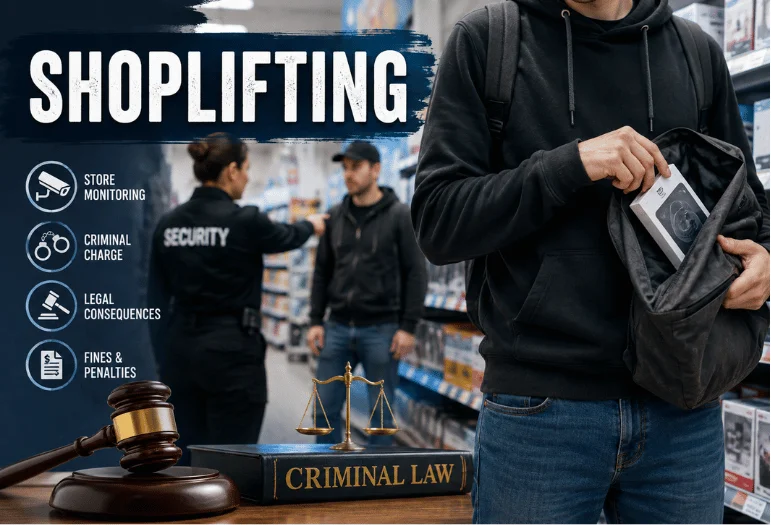
Shoplifting is not a named offence in Canadian law. It is prosecuted as theft, almost always theft of property worth $5,000 or less under Criminal Code s. 334(b), with a maximum of two years by indictment, or two years less a day and a $5,000 fine on summary conviction. For a first offence involving a low-value item, the realistic Ontario outcomes are diversion ending in a withdrawn charge, a discharge, or a fine. You might also like Foreclosure.
The newest law on the subject is the Bail and Sentencing Reform Act, S.C. 2026, c. 11, which received royal assent on 15 June 2026 and took effect on 15 July 2026. It created Criminal Code s. 334.1, an aggravating factor written for retail theft committed to resell the goods or return them fraudulently. The consolidated Criminal Code on the Justice Laws site is current only to 21 June 2026 and does not yet show it.
Three further things are commonly misunderstood: the offence is complete before anyone leaves the store, store security has no general power to search, and a civil demand letter from a retailer’s lawyer is not a bill anyone must pay.
| Question | Answer |
|---|---|
| Charge | Theft under $5,000, s. 334(b). Hybrid: the Crown elects. |
| Maximum | 2 years indictable; 2 years less a day and/or $5,000 fine summary (s. 787(1)) |
| Offence complete | On moving the item with intent to steal (s. 322(2)). Leaving the store is not required. |
| New on 15 July 2026 | s. 334.1 aggravating factor: theft to resell, barter or fraudulently return |
| Store security’s power | Citizen’s arrest, s. 494(2); must deliver to police forthwith, s. 494(3) |
| Ontario diversion | Charge withdrawn on completing the Direct Accountability Program |
| Discharge purge | 1 year absolute, 3 years conditional. Automatic, no fee (Criminal Records Act s. 6.1). |
| Civil demand letter | Usually $300 to $800. Creates no legal obligation to pay. |

What changed on 15 July 2026: the new s. 334.1 retail theft aggravating factor
Royal assent came on 15 June 2026, and under s. 84 the relevant provisions took effect on the thirtieth day afterwards. Clause 10 enacted Criminal Code s. 334.1.
“it shall consider as an aggravating circumstance the fact that the offence was committed with intent to sell or barter the stolen property or to fraudulently return it to a retail merchant.”
Criminal Code s. 334.1, as enacted by S.C. 2026, c. 11, cl. 10
It reaches sentencing under ss. 322, 343, 348, 351 and 354. The wording is in the full text of S.C. 2026, c. 11, which is where it must be read until the consolidation catches up. Three limits matter, because trade coverage has been loose. It creates no new offence, no mandatory minimum and no presumption of jail, and it applies only where the Crown establishes the resale, barter or fraudulent-return intent. An ordinary first theft of a personal-use item does not engage it.
What the Act did not do matters too. Its bail changes, including reverse onus, target motor vehicle theft under s. 333.1 and break and enter into a dwelling under s. 348(1)(d), as do the new denunciation and deterrence priorities for repeat offenders. Neither touches retail theft, so anyone told the 2026 bail reforms mean detention on a shoplifting charge has been misinformed. The framework is set out on the page about how bail works in Canada.
The data behind the change
Statistics Canada released 2025 police-reported crime data on 22 July 2026. Shoplifting rose while nearly everything else fell, and was the largest contributor offsetting the drop in the Crime Severity Index, for the second year running.
| Measure, 2025 | Figure | Change |
|---|---|---|
| Shoplifting $5,000 or under, incidents | 208,941 | Up 11% |
| Shoplifting rate per 100,000 | 502 | Fifth straight annual rise; up 79% since 2015 |
| Other theft $5,000 or under, per 100,000 | 805 | Down 5% |
| Crime Severity Index | 75.0 | Down 4.9% |
| Police-reported crime rate per 100,000 | 5,585 | Down 2.4% |
How shoplifting is charged, and what theft under $5,000 carries
Section 322(1) defines theft as fraudulently and without colour of right taking or converting anything, with intent to deprive the owner. Punishment comes from Criminal Code s. 334, which splits on value: over $5,000 or a testamentary instrument gives an indictable maximum of ten years under s. 334(a), and $5,000 or less gives two years under s. 334(b).
Both branches are hybrid, and for retail theft the summary election is the norm. Because s. 334(b)(ii) sets no specific penalty, the general rule in s. 787(1) applies: up to $5,000, up to two years less a day, or both. That summary maximum was six months until 19 September 2019, when the reclassification provisions of Bill C-75 came into force.
| Charge | Section | Maximum |
|---|---|---|
| Theft $5,000 or under | s. 334(b) | 2 years indictable, or summary |
| Theft over $5,000 | s. 334(a) | 10 years indictable, or summary |
| Possession of property obtained by crime, $5,000 or under | ss. 354, 355 | 2 years indictable, or summary |
| Fraud $5,000 or under | s. 380(1)(b) | 2 years indictable, or summary |
| Fraud over $5,000 | s. 380(1)(a) | 14 years indictable, not hybrid |
| Mischief to property $5,000 or under | ss. 430(1), 430(4) | 2 years indictable, or summary |
| Obstructing a peace officer | s. 129 | 2 years indictable, or summary |
| Escaping lawful custody | s. 145(1) | 2 years indictable, or summary |
| Robbery | ss. 343, 344 | Life imprisonment |
Value is a live issue, not a formality. The Crown must prove it, ordinarily through retail price evidence, so where several items or incidents are aggregated into one count the arithmetic is worth checking.
When the offence is complete, and why “I never left the store” is not a defence
The most common misconception is that nothing criminal has happened until a person passes the last till. The Criminal Code says otherwise, in a subsection almost no article quotes.
“A person commits theft when, with intent to steal anything, he moves it or causes it to move or to be moved, or begins to cause it to become movable.”
Criminal Code s. 322(2)
On the words of s. 322, the offence completes at the moment of movement, provided the intent to steal exists then, so concealing an item in a bag, a coat, a stroller or a cart lining can complete it inside the store. Two neighbouring subsections close off other assumptions: s. 322(3) says a taking may be fraudulent even if done openly, and s. 322(4) makes it immaterial whether the property was originally lawfully possessed.
That does not make the Crown’s job easy. Intent at the moment of movement must be proved beyond a reasonable doubt, and someone who pocketed an item while distracted and walked toward a different till has not formed it. The argument has to be about intent, not geography. The guilty mind the Crown must establish is explained on the page about mens rea and criminal intent.
The stop itself: what store security may do, and when force turns theft into robbery
Citizen’s arrest under s. 494
A loss prevention officer is not a police officer. Their power comes from Criminal Code s. 494 and is narrower than most people assume. Section 494(1)(a) lets anyone arrest a person they find committing an indictable offence. Section 494(2), the provision that applies in stores, lets an owner or someone authorised by the owner arrest a person they find committing a criminal offence on or in relation to that property, either at that time or, under paragraph (b), within a reasonable time afterwards where they believe on reasonable grounds that a peace officer arrest is not feasible.
That second branch was added by the Citizen’s Arrest and Self-defence Act, S.C. 2012, c. 9, in force 11 March 2013. The Government of Canada backgrounder is explicit that the expanded power applies only where a police arrest is not feasible. There is no s. 494(2.1), despite that subsection being cited online. Two constraints run throughout: the arrester must actually find the person committing the offence, so suspicion or a tip is not enough, and s. 494(3) requires a private arrester to deliver the person to a peace officer forthwith. Force is governed by s. 25 and must be reasonable.
Searches, bag checks and how long a person may be held
“Forthwith” does real work. A private arrester has no authority to hold someone for a prolonged interview, to extract a written admission, or to extend a detention for paperwork. Delay beyond what is needed to hand the person over can engage Charter ss. 9 and 10 where the conduct is connected to state action, and can create civil liability for the store.
There is also no private power of search incident to arrest. A peace officer has one; a citizen making a s. 494 arrest does not. The Canadian Civil Liberties Association states the position bluntly: the shopkeeper has no right to search without consent, and the privilege is exercised after a theft is witnessed, not in anticipation of an imagined crime. Exit bag checks rest on consent, and declining one is not an offence. Nor is refusing to give a name to store staff, because s. 129 obstruction applies to peace officers and those lawfully assisting them.
In Ontario, loss prevention officers are licensed under the Private Security and Investigative Services Act, 2005 and subject to a ministry code of conduct administered by the Solicitor General, which is where complaints go. Licensing is covered on the page about how to renew a security guard licence in Ontario. A store may separately use provincial trespass legislation to ban a person from returning, a different question from the criminal charge and one dealt with on the page about trespassing law in Canada.
When a shoplifting stop becomes robbery
Section 343 defines robbery, and the operative branch is s. 343(a): stealing and, for the purpose of extorting what is stolen or preventing or overcoming resistance to the stealing, using violence or threats of violence to a person or property. Force used to keep or get away with the merchandise converts a two-year maximum into robbery under s. 344, which carries life imprisonment. Section 343(b) covers stealing from a person with violence immediately before or after, s. 343(c) assault with intent to steal, and s. 343(d) stealing while armed with an offensive weapon or an imitation.
The dividing line turns on purpose. Force applied purely to break away and flee, with the goods abandoned, is more often prosecuted as assault, obstruction or escaping lawful custody. That is a reading of the statutory language, not a proposition supported here by a reported case. The consequences of the reclassification are severe: robbery is categorically ineligible for Ontario’s adult diversion programs. The tiers that apply once violence enters a case are on the page about aggravated assault charges.
One incident can also generate possession of property obtained by crime under s. 354, fraud under s. 380 for tag switching or refund schemes, mischief under s. 430 for damaged packaging, and, where a search after arrest turns up controlled substances, the separate proceedings described on the page about drug charges in Canada.
After arrest in Ontario: release, conditions and Crown screening
Section 493.1 requires a peace officer, justice or judge to give primary consideration to release at the earliest reasonable opportunity on the least onerous appropriate conditions. For a first-time, low-value, cooperative accused, release at the scene is the norm; being held for bail usually reflects outstanding charges or warrants, a breach history, or an escalated incident. The Ontario Court of Justice describes four routes into criminal court: a summons, an appearance notice, an undertaking to police, or a bail hearing. Section 503(1) requires a person not released to be taken before a justice within twenty-four hours where one is available.
Conditions on an undertaking come from s. 501(3): reporting, territorial limits, no contact with witnesses, staying away from the store, passport surrender, house arrest hours and firearm surrender. The section caps a monetary pledge at $500 and a non-resident security deposit at $500. Breaching a release condition can put a person back in custody.
Ontario is a post-charge screening jurisdiction: police lay the charge and the Crown screens it afterwards under a two-part test in the Crown Prosecution Manual. There must be a reasonable prospect of conviction, a standard higher than a bare prima facie case but lower than a finding that conviction is more likely than not, and prosecution must serve the public interest, assessed against an eleven-factor framework in which no factor is determinative. The duty is continuous, and where the standard is not met prosecutors are directed to withdraw rather than stay. Appearance schedules appear in the daily court lists.

Diversion in Ontario: the Direct Accountability Program
For a first adult shoplifting charge, diversion is the outcome most people want. The governing policy is the Crown Prosecution Manual directive on community justice programs for adults. The Direct Accountability Program is the principal adult vehicle in most Ontario jurisdictions, with the Indigenous Community Justice Program as a parallel stream. It is post-charge diversion: the person is charged, appears in court, and the charge is withdrawn only on successful completion.
Every referral needs Crown Attorney approval, and there is no statutory right to diversion. The directive sets a precondition that surprises people: a prosecutor may only consider diversion where a reasonable prospect of conviction exists, because a weak case should be withdrawn outright rather than diverted. The accused must be willing to assume responsibility and prepared to make meaningful amends. Categorically ineligible offences include murder, serious violence, sexual offences, firearms offences, impaired driving, home invasion and robbery. Theft under $5,000 is not named as eligible anywhere in the directive; eligibility flows from the residual clause allowing a prosecutor to refer any other offence, which is why practice varies between courthouses.
Delivery is by agencies funded by the Ministry of the Attorney General, including the John Howard Society of Ontario, which serves adults charged with minor offences in provincial court. A coordinator builds an individualised plan, with sanctions such as a charitable donation, volunteer or community service hours, and educational work on substance use awareness, anger management or retail theft prevention. Non-completion returns the matter to the ordinary stream. Some police services, such as Ottawa’s, also run pre-charge adult diversion.
Withdrawal, discharge and conviction are three different things
These words are used interchangeably and should not be. A withdrawal means no court ever found guilt. A discharge under Criminal Code s. 730 means a court found guilt but declined to register a conviction. A conviction is a conviction.
Section 730(1) permits a discharge where the accused is not an organization, the offence carries no minimum punishment, and it is not punishable by fourteen years or life, so theft under and over $5,000 both qualify. Section 730(3) deems a discharged offender not to have been convicted. An absolute discharge takes effect at once; a conditional discharge requires completion of a probation order, commonly six to eighteen months here, and becomes absolute on completion. Those obligations are set out on the page about probation conditions and breaches.
The purge is automatic. Criminal Records Act s. 6.1 requires the RCMP Commissioner to remove all references to an absolute discharge once more than one year has elapsed, and to a conditional discharge after more than three years. No application, no fee. Ontario’s record check disclosure windows mirror those periods exactly. What the purge does not do is erase local police occurrence reports or undo anything foreign authorities have already recorded.
| Outcome | Finding of guilt | Criminal record | Ontario record checks |
|---|---|---|---|
| Charge withdrawn after diversion | No | No | Not disclosed on standard checks; local occurrence report remains |
| Absolute discharge | Yes | No conviction (s. 730(3)) | Judicial matters and vulnerable sector checks, within 1 year only |
| Conditional discharge | Yes | No conviction (s. 730(3)) | Judicial matters and vulnerable sector checks, within 3 years only |
| Conviction | Yes | Yes | Indefinitely, until a record suspension is granted |
Civil demand letters: whether the recipient actually has to pay
Weeks or months after an incident, a letter arrives on a law firm’s letterhead, sent for a large retailer, demanding between $300 and $800. The sum is not the value of the merchandise, which the store has usually recovered; the letters claim security and loss prevention costs, punitive damages and trespass. Where the person stopped was a minor, they sometimes invoke Ontario’s Parental Responsibility Act against the parents. Justice for Children and Youth, an Ontario legal clinic that publishes guidance on these letters, names Shoppers Drug Mart and Walmart among the retailers using them.
“The letter from the store does not create a legal requirement to pay. The store must start a lawsuit in court to force you to pay them.”
Justice for Children and Youth, guidance on shoplifting demand letters
That is the whole legal structure in two sentences. A demand letter is a private request for money. It is not a court order, not a judgment and not a fine. An obligation arises only if a court creates one, after a properly commenced civil action, which for these amounts would ordinarily be brought in Small Claims Court in Ontario.
The clinic also reports that it is rare for the lawyer or the store to follow up with a lawsuit if someone does not pay. That describes practice, not a guarantee, and carries a firm qualification: a letter from a collection agency, or a Statement of Claim, cannot be ignored. A Statement of Claim, or a Plaintiff’s Claim in Small Claims Court, is a court document, and failing to file a defence in time can produce a default judgment with no hearing on the merits. Where a collection agency is involved, the clinic advises disputing the debt with the agency and complaining to the provincial ministry that licenses collection agencies.
The clinic takes the further position that demand letters of this kind are not permitted under Ontario’s collection legislation. That is its stated view, not a judicial holding or a regulator’s ruling. No Law Society of Ontario rule, notice or practice guidance dealing specifically with shoplifting civil recovery letters was located in preparing this page, so nobody should be told the regulator has spoken on the practice.
- Paying does not resolve, reduce or prevent the criminal charge. The tracks are independent and the store is not the prosecutor.
- Refusing to pay does not aggravate the criminal charge. It is not evidence and not a sentencing factor.
- Restitution ordered by a criminal court is a separate mechanism arising from the prosecution, explained on the page about what restitution means in Canadian law.
- Nobody stopped in a store is required to sign an acknowledgment or admission before being allowed to leave.
- On parental liability, the clinic’s view is that parents are liable only where negligent in supervision, and that a court is unlikely to find negligence in letting a teenager go shopping with friends.
Records, record suspensions and travel to the United States
A conviction produces a record that does not expire on its own. Criminal Records Act s. 4(1) makes a person ineligible to apply for a record suspension until ten years have elapsed after the sentence expires according to law for an indictable offence, or five years for a summary conviction offence. Section 4(2) bars applications for Schedule 1 offences and for anyone convicted of more than three offences each prosecuted by indictment with sentences of two years or more.
“Expiration according to law” is where people miscalculate: the clock starts only when the whole sentence is finished, including probation and payment of every fine and restitution order, so a five-year wait after eighteen months of probation is closer to six and a half years from sentencing. The Parole Board of Canada fee is $50, in effect since 1 January 2022, with service standards of six months for summary applications and twelve for indictable ones after acceptance.
Ontario’s Police Record Checks Reform Act, 2015 provides three checks. A criminal record check shows convictions; a criminal record and judicial matters check adds discharges, outstanding charges, warrants and court orders; a vulnerable sector check is broadest, adding certain mental health apprehension records and, narrowly, non-conviction information. The government page on police record checks sets out the rules. Withdrawn charges are generally not disclosed at all, and a vulnerable sector check can release non-conviction information only where the exceptional disclosure test in s. 10 is met.
Travel to the United States is the consequence people underestimate most. Government of Canada guidance is blunt: with a criminal record, no matter the severity or the date of the offence, entry may be refused, and entering without difficulty before is no assurance. It warns that attempting entry without a waiver could result in several weeks of detention and a permanent ban. A Canadian record suspension is not recognised under US law for entry, and a person in that position may apply for a temporary waiver of inadmissibility through a US embassy or consulate. The official travel advice for the United States sets this out, and permitted stay length is covered on the page about how long a Canadian can stay in the US.

Immigration and citizenship consequences under IRPA s. 36
For anyone who is not a Canadian citizen this carries the most risk, and it turns on one deeming provision. Serious criminality under s. 36(1) applies to permanent residents and foreign nationals alike, and is triggered by a conviction for an offence punishable by a maximum of at least ten years, or one for which more than six months was actually imposed. Criminality under s. 36(2) applies to foreign nationals only, and is triggered by a conviction for an offence punishable by way of indictment, or by two offences not arising out of a single occurrence.
“An offence that may be prosecuted either summarily or by way of indictment is deemed to be an indictable offence, even if it has been prosecuted summarily.”
Immigration and Refugee Protection Act s. 36(3)(a)
Theft under $5,000 is hybrid, so the Crown’s decision to proceed summarily, which feels like leniency in the criminal court, is disregarded entirely for immigration purposes. The full text is on the Justice Laws page for IRPA s. 36.
| Status | Theft under $5,000 | Theft over $5,000 |
|---|---|---|
| Permanent resident | The 2-year maximum is below the 10-year threshold, so generally not serious criminality unless a sentence over six months is imposed | Meets the 10-year threshold: serious criminality, s. 36(1)(a) |
| Foreign national (visitor, student, worker) | Deemed indictable by s. 36(3)(a). One conviction engages criminality under s. 36(2)(a), whatever the election or sentence. | Serious criminality, s. 36(1)(a) |
| Two separate incidents, both summary | Separate route to inadmissibility for a foreign national: two offences not arising out of a single occurrence | As above, plus serious criminality |
Section 36(3)(b) provides that inadmissibility may not be based on a conviction for which a record suspension has been ordered and remains in effect, or where there has been a final determination of an acquittal. Because s. 730(3) deems a discharged person not to have been convicted, a discharge should not engage the conviction-based grounds in s. 36 at all. That is the logical reading of the two provisions together rather than a point confirmed here against departmental guidance or a decided case, so it should be verified with an immigration lawyer. Where inadmissibility is found, what follows is described on the page about deportation from Canada.
Citizenship is affected too. Citizenship Act s. 22(1) prevents a grant of citizenship or the taking of the oath while a person is under a probation order, on parole or serving a sentence, or while charged with, on trial for or party to an appeal relating to a qualifying offence, so a conditional discharge with eighteen months of probation pauses a citizenship application for that period. Section 22(2) bars an applicant convicted of an indictable offence in the four years before the application or while it is pending, s. 22(3) extends a four-year bar to equivalent foreign convictions, and s. 22(1.1) allows a ministerial waiver on compassionate grounds for the foreign-offence bars.
Young people under 18: extrajudicial measures and record access periods
A person under 18 is dealt with under the Youth Criminal Justice Act, which tilts heavily against formal prosecution. Section 4 declares extrajudicial measures often the most appropriate and effective response to youth crime, and s. 4(c) presumes them adequate where the young person has committed a non-violent offence and has not previously been found guilty, which places a first shoplifting incident squarely inside the presumption. Sections 6 to 9 provide for police and Crown warnings and cautions without any charge, and police must consider them before laying one. Section 10 provides for extrajudicial sanctions, usable only where a warning or caution would be inadequate, and requiring the young person’s consent, an acknowledgment of responsibility, and provision for the victim to be informed.
The most misunderstood part is the ending. Youth records are not destroyed the moment a period expires in the way the public imagines. The Act works by restricting who may access a record and for how long, and s. 119(2) sets those access periods.
| Disposition | Access period, YCJA s. 119(2) |
|---|---|
| Extrajudicial sanction | 2 years after the young person consents to the sanction |
| Acquittal (other than by a mental disorder verdict) | 2 months after the appeal period expires, or 3 months after all appeals end |
| Dismissal, withdrawal or reprimand | 2 months |
| Stayed charge | 1 year, with no further proceedings |
| Absolute discharge | 1 year after the finding of guilt |
| Conditional discharge | 3 years after the finding of guilt |
| Summary conviction offence | 3 years after the youth sentence is completed |
| Indictable offence | 5 years after the youth sentence is completed |
Section 82(1) deems a young person not to have been found guilty or convicted on an absolute discharge or on completion of the youth sentence, subject to real exceptions: an autrefois convict plea remains available, a youth justice court may consider the finding on an adult sentence application, any court may consider it for bail or on sentencing for another matter, and the Parole Board may consider it. Section 82(3) provides that application forms for federal employment, Crown corporations, Canadian Forces enrolment or federally regulated work may not require disclosure of such an offence.
Defences the Crown has to overcome
Every real defence attacks an element of s. 322(1). The Crown must prove beyond a reasonable doubt a taking or conversion, that it was fraudulent, that it was without colour of right, and that it was done with the specific intent to deprive. Absence of intent is the most common genuine defence: an item forgotten under a cart, a child putting something in a bag, a self-checkout scan that failed, a phone call that interrupted the shopping.
Colour of right is an express element and a negative one, so the Crown must disprove it. An honest belief in a legal right to the property, even a mistaken belief, defeats the charge, including an honest belief that the item was paid for, that a companion had paid, or that a refund was owed. Mistake of fact operates similarly and need only be honest, not reasonable. Voluntary intoxication can in principle bear on the specific intent theft requires, though mere drunkenness rarely raises a reasonable doubt.
Mental disorder under s. 16 exists in principle but is rarely the right vehicle: s. 16(1) requires incapacity to appreciate the nature and quality of the act or to know it was wrong, and s. 16(2) presumes no such disorder until the contrary is proved on the balance of probabilities. In practice, mental health conditions, cognitive impairment, dementia, eating disorders and compulsive behaviour operate as mitigation on sentence or as the basis for a diversion plan addressing underlying causes.
Charter arguments are often the most productive avenue: unlawful arrest or detention under s. 9, denial of counsel under s. 10(b), unlawful search under s. 8, and unreasonable delay under s. 11(b). One qualification applies throughout, which is that the Charter binds state actors, so a loss prevention officer’s conduct engages it only where sufficiently connected to state action.
Frequently asked questions
Can someone be charged if they never left the store?
Yes. Criminal Code s. 322(2) says theft is committed when a person, with intent to steal, moves the item or begins to cause it to become movable. Passing the last till is not required, and concealment inside the store with intent can complete the offence. The battleground is whether intent existed at the moment of movement.
Do I have to pay the letter a store’s lawyer sent me?
Not because the letter says so. Justice for Children and Youth states that the letter creates no legal requirement to pay and the store must start a lawsuit to force payment. A demand letter is a private request, not a court order or a fine, and only a judgment creates an obligation. A Statement of Claim or collection agency letter is different and cannot be ignored.
Does paying the civil demand make the criminal charge go away?
No. The civil claim and the prosecution are independent. The store is not the prosecutor and cannot withdraw the charge. Paying does not resolve, reduce or prevent the criminal proceeding, and refusing to pay does not aggravate it. Restitution ordered by a criminal court is a separate mechanism arising from the prosecution itself.
Can store security search my bag or my pockets?
Not without consent. A citizen’s arrest under s. 494 carries no statutory power of search incident to arrest, unlike a peace officer’s arrest. The Canadian Civil Liberties Association’s position is that a shopkeeper has no right to search without consent. Exit bag checks rest on consent, and declining one is not an offence.
How long can a loss prevention officer hold someone?
Only as long as it takes to hand the person to police. Section 494(3) requires anyone other than a peace officer who makes an arrest to deliver the person to a peace officer forthwith. There is no authority to hold someone for a prolonged interview, obtain a written admission, or extend detention for paperwork. Delay can engage Charter ss. 9 and 10.
What is s. 334.1, and does it mean jail for shoplifting?
Section 334.1 came into force on 15 July 2026 under S.C. 2026, c. 11. It requires a sentencing court to treat as aggravating that a theft-related offence was committed intending to sell or barter the goods or fraudulently return them to a retailer. It creates no new offence, no mandatory minimum and no presumption of jail, and applies only where that intent is established.
Will a first shoplifting charge give me a criminal record?
Not necessarily. A charge withdrawn after the Direct Accountability Program produces no finding of guilt and no record. A discharge under s. 730 involves a finding of guilt but no conviction, and purges automatically after one year if absolute or three if conditional. Only a registered conviction creates a record lasting until a record suspension is granted.
Am I entitled to diversion in Ontario?
No. Diversion is discretionary and every Direct Accountability Program referral needs Crown Attorney approval. The Crown Prosecution Manual requires a reasonable prospect of conviction before diversion is considered, and that the accused assume responsibility and make amends. Robbery and other serious offences are categorically ineligible. Theft under $5,000 qualifies through the directive’s residual clause, not by being named.
When does shoplifting become robbery?
Under s. 343(a), when a person steals and uses violence or threats of violence for the purpose of extorting what is stolen or overcoming resistance to the stealing. Purpose is what matters. Force used to keep or get away with the merchandise turns a two-year maximum into robbery under s. 344, which carries life imprisonment and is categorically ineligible for adult diversion in Ontario.
Can a conviction affect permanent residence or a study permit?
Yes, and it differs by status. IRPA s. 36(3)(a) deems a hybrid offence indictable even where prosecuted summarily, so for a foreign national such as a visitor, student or worker a single theft-under conviction can engage criminality under s. 36(2)(a). For a permanent resident, one summary conviction with a short sentence generally does not meet the s. 36(1) thresholds. Individual advice is essential.
How long before I can apply for a record suspension?
Five years after a summary conviction sentence has fully expired, or ten years for an indictable conviction, under Criminal Records Act s. 4. The sentence is not expired until probation ends and every fine and restitution order is paid. The Parole Board of Canada fee is $50, in effect since 1 January 2022, with service standards of six and twelve months respectively.
What happens to a teenager charged with shoplifting?
Usually not a prosecution. Youth Criminal Justice Act s. 4(c) presumes extrajudicial measures adequate for a non-violent offence by a young person with no prior finding of guilt, and police must consider a warning or caution before laying a charge. Where extrajudicial sanctions are used, the access period under s. 119(2) is two years from the date consent is given.
Sources checked, review date and an important limit
This page is legal information, not legal advice, and reading it creates no lawyer-client relationship. Lawverra does not provide legal services and does not represent anyone. Outcomes turn on the facts, the charge as laid, the screening decision at the particular courthouse, and the person’s status and history. Anyone charged, and particularly anyone who is not a Canadian citizen, should speak to a licensed criminal lawyer; duty counsel is available free of charge at court, and a peace bond is one of several resolutions that can arise in a related matter.
Some points were left out because they could not be confirmed against a primary source: the reported second subsection of s. 334.1 dealing with essential infrastructure, the status of any pending federal bill replacing record suspensions with automatic record expiry, and any case citation on the escalation from theft to robbery. Nothing here should be read as reporting settled case law where none is cited.
Last reviewed: September 2026. Primary sources checked: the Criminal Code (Justice Laws consolidation current to 21 June 2026); the Bail and Sentencing Reform Act, S.C. 2026, c. 11; the Criminal Records Act; the Youth Criminal Justice Act; the Immigration and Refugee Protection Act; the Citizenship Act; Ontario Crown Prosecution Manual directives D-3 and D-4; Ontario Court of Justice criminal court guidance; Ontario police record check guidance; Government of Canada travel advice for the United States; Parole Board of Canada record suspension guidance; and Statistics Canada, The Daily, 22 July 2026.