

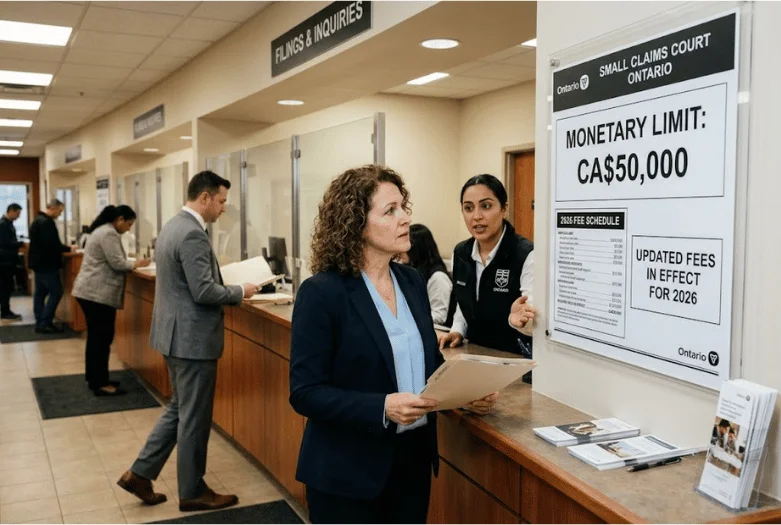
Two numbers decide whether suing is worth your time. The most you can claim in Small Claims Court Ontario is CA$50,000, and issuing that claim costs CA$108 if you are not a regular filer. Everything after that follows from those two figures.
The ceiling moved recently, and plenty of guides have not caught up. According to the Government of Ontario, effective October 1, 2025, the monetary jurisdiction of the Small Claims Court rose from CA$35,000 to CA$50,000. The minimum appealable amount rose on the same day, from CA$3,500 to CA$5,000. Any page still quoting CA$35,000 is out of date.
In short: file a Plaintiff’s Claim for up to CA$50,000 and pay CA$108, serve the defendant within six months, then wait 20 days for a defence. If a defence arrives, you attend a settlement conference. If that does not resolve it, you pay CA$308 to fix a trial date, argue your case, then enforce the judgment yourself.
What every stage costs and how long it takes
Fees are set by regulation and published by the Government of Ontario on its small claims court fee schedule, last updated on October 24, 2025. Only the 90-day settlement conference target below is an official figure. Everything else below is an estimate, and it swings widely between courthouses. We break this down further in Divorce in BC 2026.
| Stage | Court fee | Realistic elapsed time |
|---|---|---|
| File the Plaintiff’s Claim (Form 7A) | CA$108 infrequent, CA$228 frequent | Issued in days online, longer by mail |
| Serve the defendant | Your courier or process server cost | Must be done within six months of issue |
| Defence filed, paid by the defendant | CA$77 | Due 20 days after service |
| Default judgment, if no defence arrives | CA$94 infrequent, CA$128 frequent | Two to six weeks after day 20 |
| Settlement conference | No separate fee | Target 90 days after the first defence, often three to six months |
| Fix a trial date | CA$308 infrequent, CA$403 frequent | Requested within 30 days of the conference |
| Trial | CA$33 per witness summons, CA$11 daily witness fee | Commonly six to twelve months after the conference |
| Enforcement, if the debtor will not pay | CA$144 to issue a garnishment, CA$68 per writ | Open-ended, months to years |
Key takeaways
- The CA$50,000 cap applies per plaintiff, and it excludes costs and interest.
- A defended claim that reaches trial runs roughly CA$400 to CA$500 in court fees, before collection costs.
- The settlement conference itself carries no fee, and it is where most cases end.
- Filing to trial usually runs twelve to eighteen months.
- The court does not collect for you. That job is yours, and it costs extra.
What you can claim, and what the limit really means
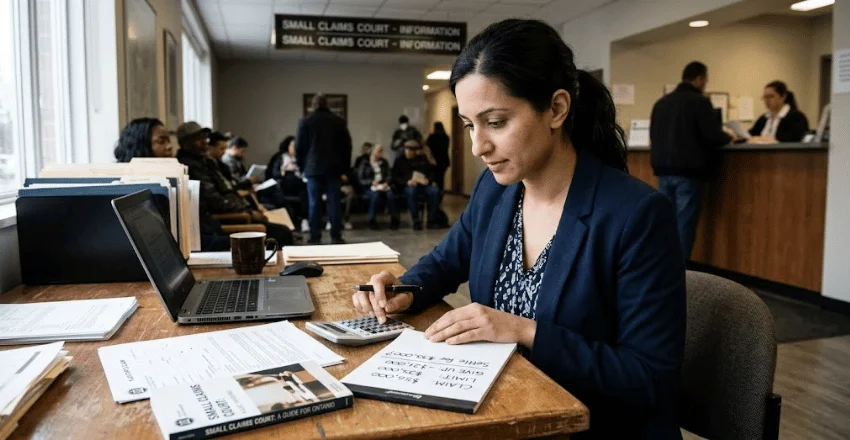
This court hears claims for money and claims for the return of personal property. Unpaid invoices, unpaid loans, unpaid rent and NSF cheques are the classic examples. So are damages for property damage, minor personal injuries and breach of contract.
Owed more than CA$50,000? You can still file here if you agree in writing to give up the excess. Do the arithmetic before you sign it away. Giving up CA$6,000 to avoid a Superior Court fight can pay for itself. Giving up CA$40,000 rarely does.
Unpaid invoices and broken contracts fill much of the docket, and there is more on commercial disputes in our business law section.
What you’ll need before you file
- The full legal name and address of the person or business you are suing. A storefront name is not enough.
- Your evidence: contracts, invoices, photos, messages, receipts, repair estimates.
- The exact amount claimed, plus a short explanation of how you reached it.
- The date the problem happened. You generally have two years from that date to file.
- The correct courthouse, which is where the problem happened or where the defendant lives or trades.
- CA$108, or a fee waiver request if paying it would be a genuine hardship.
- An honest answer to one question: does this defendant have income or assets you could actually reach?
How to Sue in Small Claims Court Ontario, Step by Step
- Send a demand letter first. Put the amount, the reason, and a deadline in writing. Some defendants pay at this point, and the letter becomes evidence if they don’t.
- Fill out the Plaintiff’s Claim, Form 7A. Keep the story short and factual. Community Legal Education Ontario runs a free guided tool that fills out the form based on your answers.
- File the claim and pay CA$108. You can file online, by mail or at the counter. Toronto matters now go through the Ontario Courts Public Portal, and everything else through Justice Services Online.
- Serve the defendant within six months. The clerk issues your claim, but delivering it is your job, not the court’s.
- File an Affidavit of Service, Form 8A, for each defendant. Without it, the court has no proof anyone was served, and your case stalls.
- Wait 20 days. A defendant who wants to fight files a Defence, Form 9A, and pays CA$77. A defendant who does nothing can be noted in default.
- Attend the settlement conference. Serve and file your List of Proposed Witnesses, Form 13A, plus any new documents at least 14 days beforehand.
- Fix a trial date and present your case. Pay CA$308, summon the witnesses you need at CA$33 each, and bring organized copies of every document.
The settlement conference is where most cases end
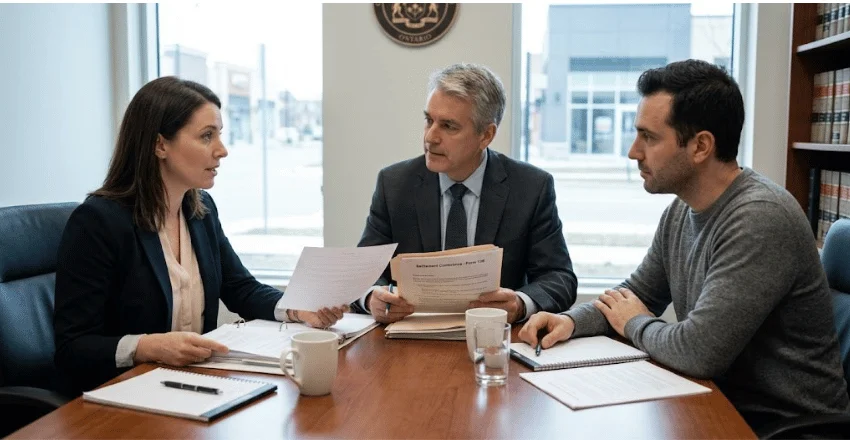
Once any defendant files a defence, the court schedules a settlement conference. The Government of Ontario’s guide to small claims procedures says it should be held within 90 days after the first defence is filed. Busy courthouses miss that target regularly, so treat three to six months as the planning assumption.
There is no fee for the conference itself.
It is an informal, confidential meeting with a judge or deputy judge. They will tell you how your case is likely to go at trial. You can ignore that opinion. Most people shouldn’t. For claims under CA$3,500, a judge can decide the whole case right there if both sides file a signed consent on Form 13B.
Come prepared. A party who skips it or turns up empty-handed can be hit with costs, and a defendant can have their defence struck. Court procedure across civil matters is covered further in our general law section.
Winning is not collecting
Here is the part most guides bury. A judgment is a piece of paper saying you are owed money. It is not money. No one at the courthouse will chase the debtor, phone them, or freeze anything on your behalf.
Enforcement is a separate process that you start, you run, and you pay for. The Superior Court of Justice lists four routes. They are garnishment, a writ of seizure and sale of personal property, a writ of seizure and sale of land, and a writ of delivery. Each carries its own fee.
- Notice of garnishment, to reach a bank account or wages: CA$144 to issue or renew.
- Writ of seizure and sale, or a notice of examination: CA$68 to issue.
- Filing that writ with the sheriff: CA$100 if it goes to the land registrar, CA$75 if not.
- Each sheriff’s attempt to enforce a writ of seizure and sale: CA$240, successful or not.
- Certificate of judgment, to enforce in another court office: CA$30.
If you don’t know what the debtor owns, request an examination hearing using Form 20H. They must complete a Financial Information Form and answer questions under oath about income, property, and debts. Refusing can lead to a contempt hearing, and contempt can mean up to five days in jail.
One number works quietly in your favour while you chase. Postjudgment interest runs automatically from the date of the order until you are paid. Ontario’s published rate is 4.0% for the first three quarters of 2026, and the rate that applies is fixed by the quarter your judgment was made. It stays at that rate even if collection takes years.
When this is the wrong court
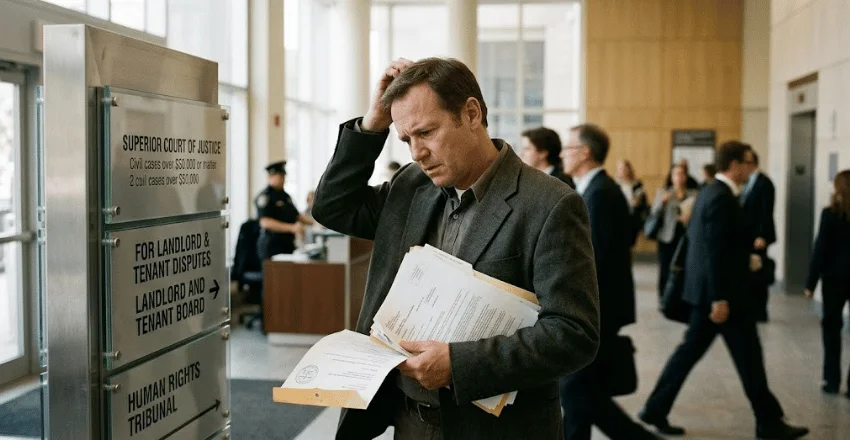
Claims above CA$50,000 that you won’t waive down belong in the Superior Court of Justice. Residential landlord and tenant disputes go to the Landlord and Tenant Board. Human rights and most employment standards complaints have their own tribunals. Filing in the wrong forum wastes your fee and your months.
Deciding whether to file
Work through it in this order. Confirm the amount sits under CA$50,000, confirm you are inside the two-year window, then ask yourself the collection question honestly. A CA$20,000 judgment against someone with no job, no property, and no bank balance is worth less than the CA$108 you paid for it.
If the answers line up, file. If you want a second opinion on whether your dispute belongs here at all, contact the Lawverra team, and we’ll point you to the right resources.
This article is general information about Ontario court procedure, not legal advice. Fees and rules change. Confirm current figures with the court office or a licensed lawyer or paralegal before you act. There is more on this in Slip and Fall Lawyer in Ontario.
Frequently asked questions
Often yes. CA$108 buys a real judgment, and many defendants settle once they are served. Weigh that against the odds of collecting, not just of winning.
No. You can represent yourself, and this is the one Ontario court where a licensed paralegal can represent you fully. Many people handle a simple debt claim alone and hire help only if it heads to trial.
After 20 days, you can ask the clerk to note them in default using Form 9B, then request default judgment on Form 11B for CA$94. If the amount owed is not a fixed sum, you will need an assessment hearing instead.
Two years from the day the problem arose, in most cases, under the Limitations Act, 2002. Miss it and the claim is usually dead no matter how strong it was.
Yes. Ontario has a fee waiver for people who cannot afford court and enforcement fees, and once granted, it applies to most later fees in the same case.
You may be a frequent claimant. That means 10 or more claims in one calendar year at the same court office. Your claim fee then jumps from CA$108 to CA$228. Default judgment goes from CA$94 to CA$128, and the trial date fee from CA$308 to CA$403.