
Two laws end a British Columbia marriage, not one. The federal Divorce Act dissolves the marriage and covers parenting and support for married spouses. BC’s Family Law Act splits property and debt, and it applies to unmarried couples too. You bring both claims in the same Supreme Court file.
That split explains most of the confusion. Judges can end your marriage while the house stays unsorted for another year, because the two statutes answer different questions on different clocks. Anyone searching for divorce in BC is really asking about both of them at once.
Key takeaways
- Only the Supreme Court of BC can dissolve a marriage or divide property.
- One year of separation is the usual ground. Adultery and cruelty are the other two.
- You or your spouse must have lived in the province for a year before you file.
- Court fees run to roughly CA$290, plus CA$40 for the certificate.
- Your order takes effect on the 31st day, and only then can you remarry.
- Property rules apply to unmarried couples after two years of living together.
- You have two years to bring a property claim, and the clock is unforgiving.
Two statutes, one marriage
Most pages on this topic describe a single process. There are two, running in parallel, and knowing which law governs which question saves a lot of wasted effort.
| Question | Divorce Act, federal | Family Law Act, provincial |
|---|---|---|
| Who it covers | Married spouses only | Married spouses, plus anyone who lived in a marriage-like relationship for two years |
| What it decides | Dissolving the marriage, parenting arrangements, child and spousal support | Property, debt, pensions, guardianship, support, protection orders |
| Which court | Supreme Court of BC | Supreme Court, and Provincial Court for everything except property and pensions |
| Deadline to claim | None for the marriage itself | Two years, under section 198 |
A common-law couple never touches the federal statute. They still get the whole of Part 5 of the provincial one, which is the part that matters financially.
The three grounds, and the one nearly everyone uses
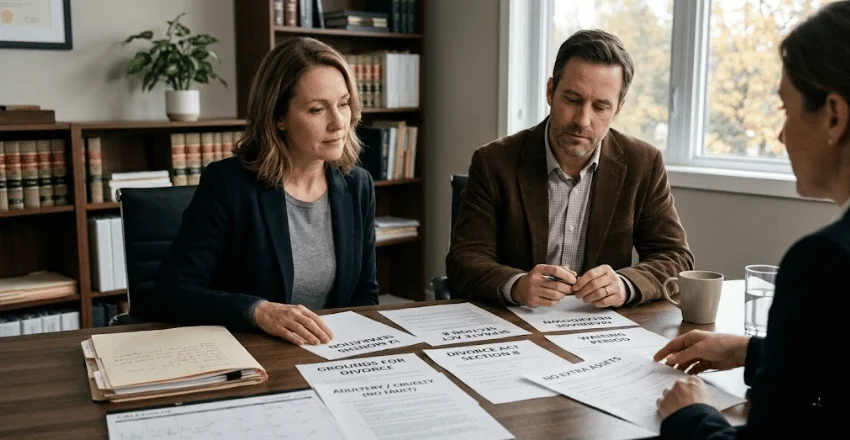
According to the federal Divorce Act, breakdown of the marriage is the only ground. Section 8 gives you three ways to prove it: 12 months living separate and apart, adultery, or physical or mental cruelty that makes living together intolerable. Section 12 then holds the order back for 31 days after a judge signs it.
Almost everyone uses the first route. Fault grounds need evidence a judge will accept, which means affidavits, sometimes a hearing, and a fight you were probably trying to avoid. They also buy you nothing extra. Nobody wins a bigger share of the house because a spouse strayed.
One detail catches people out. You can start the claim the week you separate, because the year only has to be complete when the judge decides, not when you file. Trying again for up to 90 days does not restart the clock either.
Separated, but still under the same roof
Separation is not about addresses. Legal Aid BC is blunt about this: you can be separated and still live in the same home. That is exactly what happens when neither of you can afford to move out mid-mortgage.
What a judge looks for is the end of the shared life. Separate bedrooms, separate money, separate meals, separate laundry, no social appearances as a couple, and someone told at least one friend or relative. Write down the date you regard as the split. That date drives the year, the property valuation, and the limitation period.
The one-year residency rule
You cannot bring the claim here just because you married here. Either you or your spouse must have been ordinarily resident in British Columbia for the full year before the file opens, and still be living here.
Where you married is irrelevant. Couples married in Manila, Lagos or Las Vegas can end that marriage in Vancouver, provided one of them clears the year and can produce the marriage certificate. Registry staff will want a certified translation of a foreign certificate.
Supreme Court or Provincial Court
BC runs two family courts, and readers routinely file in the wrong one.
The Provincial Court is free to use, faster, and designed for people without lawyers. It handles parenting arrangements, guardianship, contact, child support, spousal support and protection orders.
What it cannot do is dissolve a marriage or divide property, because those calls belong to federally appointed judges. Section 193 of the Family Law Act draws the line: no parentage declarations, no property division, no pension division, no children’s property. One odd exception, added recently, is companion animals. A Provincial Court judge can decide who keeps the dog but not who keeps the condo.
The Supreme Court does everything. If you want the marriage ended, that is the only door. Where children are involved, a judge has to be satisfied that reasonable arrangements for support are already in place. Before you draft that affidavit, read up on how support amounts are calculated under the guidelines.
How a desk order divorce in BC actually runs
Uncontested files never reach a courtroom. Instead, a judge reads the paperwork at a desk and signs it, which is where the name comes from. There are two routes into it.
A joint application is for couples who agree on everything: the split, the children, the support, the money. Nobody serves anybody, and BC’s free Online Divorce Assistant will build the forms for you. A sole application is for everyone else, including couples who agree in principle but cannot coordinate paperwork. Your spouse does not have to consent. They simply have to be served.
- Order your marriage certificate from Vital Statistics, or from the province or country where you married.
- File a Notice of Joint Family Claim (Form F1) or a Notice of Family Claim (Form F3), together with the Registration of Divorce Proceeding.
- Sole applications only: serve your spouse personally, then file an Affidavit of Personal Service (Form F15). They get 30 days to respond.
- Build the desk order package: Requisition (Form F35), Certificate of Pleadings (Form F36) and your own affidavit (Form F38). Add a Child Support Affidavit (Form F37) if you have children, plus a draft Final Order (Form F52).
- File the package and pay the final fee. Expect a judge to review it within four to six weeks.
- Wait out the 31 days, then order the certificate if you need one.
Legal Aid BC estimates three to four months from start to signed order on a clean file. Joint applications land at the fast end of that range. Sole ones lose time to service and the response window.
What the registry charges
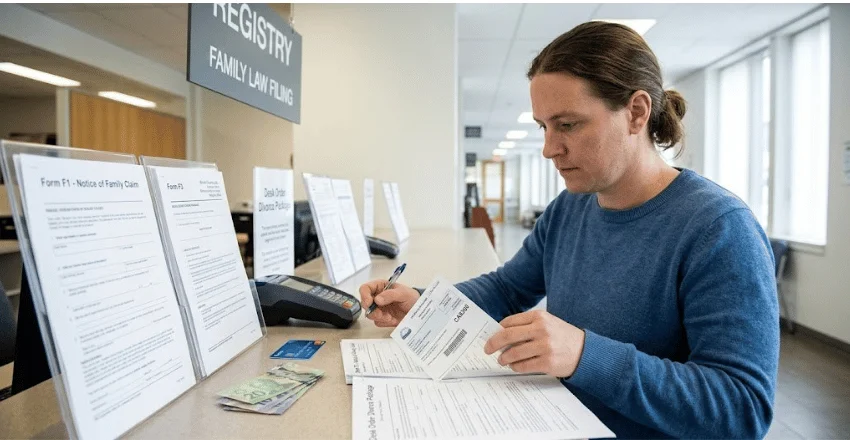
The court fees are modest and public. Lawyers are the expensive part, and an uncontested file does not need one.
| Item | Fee | When you pay |
|---|---|---|
| Opening the family file | CA$200 | On filing Form F1 or F3 |
| Opening it with a filed separation agreement already on record | CA$30 | On filing |
| Registration of Divorce Proceeding | CA$10 | On filing |
| Final application for the order | CA$80 | With the desk order package |
| Certificate, Form F56 | CA$40 each | After the 31 days |
Call it CA$290 in court fees for a typical file, or CA$330 with the certificate. Add a process server for a sole application, which runs somewhere between CA$75 and CA$150 in the Lower Mainland. If those fees are out of reach, the registry can waive them on a sworn statement of your finances.
Splitting property under the Family Law Act
Here the provincial statute takes over, and it is genuinely different from the federal one.
Section 81 starts everyone at an even split of family property and family debt, whatever either of you earned or contributed. Family property means what either spouse owns on the separation date. That presumption is strong. Judges depart from it only where equal division would be significantly unfair.
Then comes the rule that surprises people. Section 85 excludes what you brought into the relationship, plus inheritances, gifts from third parties, most personal injury settlements, and anything traceable to those. Your pre-relationship condo stays yours. What does not stay yours is the growth. Under section 84, the increase in value of excluded property during the relationship counts as family property and gets shared.
Work it through. Say you owned a Burnaby condo worth CA$400,000 when you moved in together, and it appraises at CA$650,000 on the separation date. Your original CA$400,000 remains excluded. The CA$250,000 of growth is family property, so your spouse’s share is CA$125,000. Keep the documents that prove the starting value, because the burden of proving an exclusion sits on the person claiming it.
Unmarried couples get identical treatment once they have lived together two years in a marriage-like relationship. That single threshold is the most consequential date in BC family law, and plenty of people cross it without noticing. Our family law guides cover the agreements that let couples opt out of it in advance.
Watch the deadline in section 198. Married spouses have two years from the date the order takes effect to start a property or spousal support claim. Unmarried spouses have two years from separation. Miss it, and the claim is gone, even though the property is still sitting there.
When it becomes final
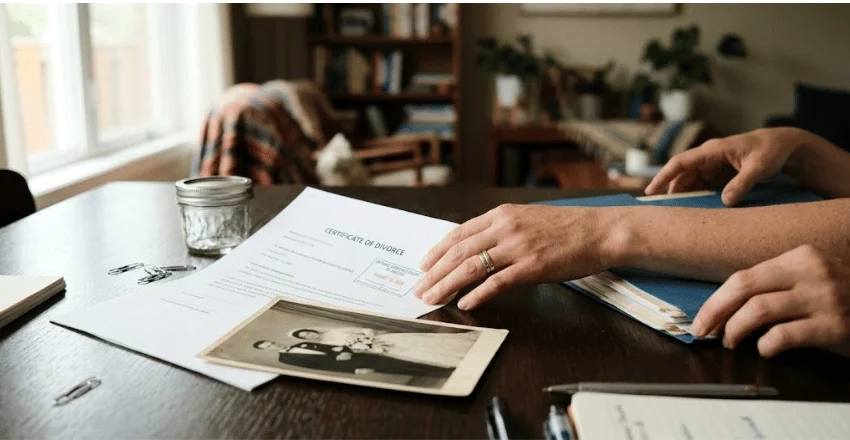
A signed order is not the end. It takes effect on the 31st day, which exists so the appeal window can close, and until that day passes you are still married in law.
That certificate is a separate, optional document. It is one page, it costs CA$40, and it proves the marriage ended on a given date. You do not need it for ordinary purposes. You will be asked for it if you remarry, and some foreign authorities want nothing else.
Where to go next
If your file is uncontested and your paperwork is tidy, the do-it-yourself route works, and Legal Aid BC publishes step-by-step guides for both routes. Get advice before you sign anything where a pension, a business, a family home bought before the relationship, or family violence is in play. Those are the files where a mistake costs six figures rather than a filing fee. Reach out through our contact page if you want a plain answer about which court your situation belongs in.
FAQ: questions people actually ask
Yes. Your year has to be complete when a judge decides the case, not when you open the file, so filing early can shave weeks off the wait.
Yes, as long as one of you has lived in the province for a year. Bring the original foreign marriage certificate and a certified English translation.
No court order ends a common-law relationship. You just separate. Property and support rules still bite, though, and so does the two-year deadline.
Nothing stops you. File a sole application, serve it properly, and if no response arrives within 30 days the desk order route continues without them.
It settles the money and the children, and it is enforceable, but it cannot dissolve the marriage. Filing one first also drops your opening court fee to CA$30.