
Canadian criminal law never convicts you on your conduct alone. It also asks what was going on in your head at the time. That second question is mens rea, and it settles far more cases than most people expect. Answer it wrong and a charge either collapses or sticks.
Fault is the guilty mind the Crown must prove beyond a reasonable doubt, next to the prohibited act itself. Canadian judges measure it in two ways. Subjective fault looks at what this particular accused knew, meant, or foresaw. Objective fault asks whether the conduct fell far below what a reasonable person would do.
Key takeaways
Here is the short version, before the detail.
- Every criminal charge has two halves: a prohibited act and a fault element that lines up with it.
- Subjective fault asks what the accused knew and meant. Objective fault asks what a reasonable person would have known.
- Recklessness and wilful blindness both count as subjective fault, and they are not the same thing.
- For a small group of serious crimes, murder among them, the Charter demands subjective fault and nothing less.
- Regulatory charges are usually strict liability, where proof of due diligence answers the charge outright.
- Absolute liability offences carry no fault requirement at all, and they cannot send anyone to jail.
Guilty act, guilty mind, and why both matter

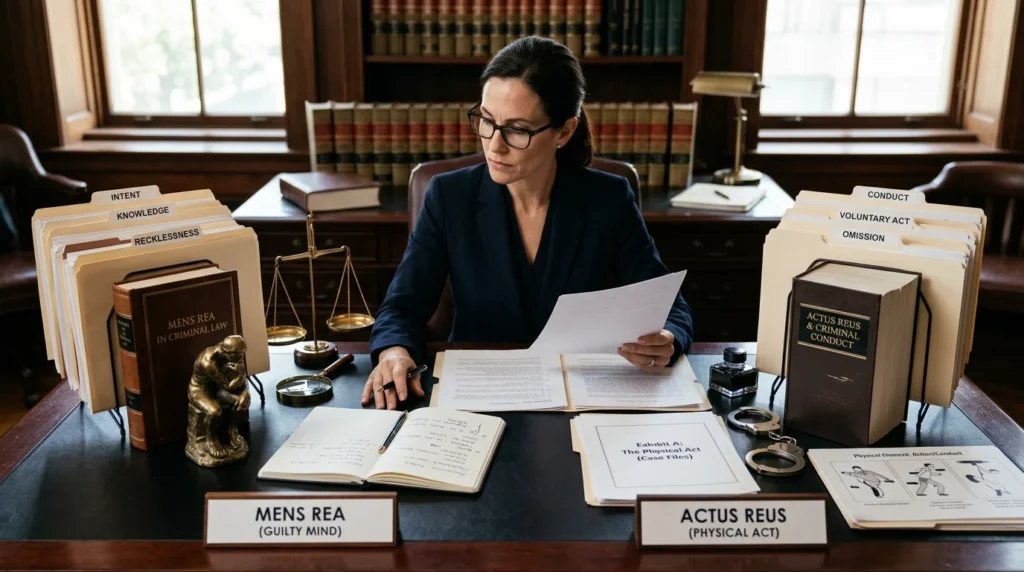
Latin turns up in criminal law more than it needs to. Actus reus is the prohibited act, the conduct the Criminal Code forbids. Mens rea is the mental state that has to accompany it. Both have to exist at the same moment, a rule lawyers call contemporaneity.
Take theft. Walking out of a shop with someone else’s umbrella is the act. Honestly believing the umbrella was yours removes the fault element, so no offence occurs. Same conduct, opposite result.
Motive is a separate idea. Why you acted can help a jury work out what you intended, but the Crown does not have to prove it.
The fault ladder Canadian courts use
Fault is not one setting. It runs on a ladder, from a fully intended act at the top down to no fault at all at the bottom. Where a charge sits on that ladder decides what the Crown has to prove and what a defence lawyer can attack.
| Fault standard | What the Crown must prove | Where you meet it |
|---|---|---|
| Intent | The accused meant to bring about the result | Murder, theft, fraud |
| Knowledge | The accused knew a key fact was true | Possession of stolen property |
| Recklessness | The accused saw the risk and ran it anyway | Assault, mischief, arson |
| Wilful blindness | The accused suspected the truth and refused to look | Drug couriers, aiding an offence |
| Penal negligence | Conduct was a marked departure from the reasonable standard | Dangerous driving, criminal negligence |
| Strict liability | Only the act, though due diligence is a full answer | Workplace safety, most provincial charges |
| Absolute liability | Only the act, with no fault defence available | Some parking and licensing tickets |
Most Criminal Code charges sit in the top four rows. The bottom two belong to regulatory law, the world of provincial tickets and workplace prosecutions.
Subjective fault: what the accused knew and meant

Subjective fault is personal. Courts are not asking what a careful citizen would have realised. It is asking what this accused, with their own knowledge and their own blind spots, actually had in mind. Judges get there through evidence and inference, not mind reading.
Intent and knowledge
Intent means the accused wanted the outcome, or knew it was practically certain to follow. Knowledge means the accused was aware of a fact that matters to the charge, such as the goods being stolen. Parliament sometimes spells the standard out. Section 429(1) of the Criminal Code, for property offences, deems an act wilful when the person knew the result would probably follow and was indifferent to it.
Recklessness
Recklessness sits one rung below knowledge. R v Sansregret gave the classic Canadian formulation in 1985: the accused sees the risk and takes the chance. Awareness is the key. A person who genuinely never spotted the danger is not reckless, however careless they were.
Wilful blindness
Wilful blindness is not carelessness either. It is a deliberate choice to stay ignorant. In R v Briscoe, decided in 2010, the Supreme Court framed the test as a question. Did the accused shut their eyes because they knew or strongly suspected that looking would fix them with knowledge?
The two doctrines get confused constantly, including by police and by first-year students. They do different work.
| Recklessness | Wilful blindness | |
|---|---|---|
| Starting point | The accused knows a risk exists | The accused suspects a fact is true |
| What they do next | Proceeds despite the risk | Deliberately avoids checking |
| Leading case | R v Sansregret, 1985 | R v Briscoe, 2010 |
| Legal effect | A lower rung than knowledge | Substitutes for actual knowledge |
| Typical excuse | I thought it would be fine | I never asked any questions |
Objective fault and the marked departure test
Some crimes drop the personal enquiry. For dangerous driving, criminal negligence and unlawful act manslaughter, the Crown does not have to show that the accused foresaw anything. It has to show a marked departure from the care a reasonable person would use in the same circumstances.
That word marked is load-bearing. Ordinary carelessness, the kind that grounds a civil claim, is not enough for a criminal conviction. The gap between the accused’s conduct and the reasonable standard has to be wide and obvious.
Manslaughter shows how the standard is calibrated. In R v Creighton (93, the Supreme Court held that the Crown need only prove objective foreseeability of bodily harm, not of death. That is why a fight that ends in a fatality can be manslaughter rather than murder. It also explains why the line between aggravated assault charges in Canada and a homicide count is thinner than people assume.
Why the Charter demands mens rea for some crimes
Canada is unusual here, and this is the part American explainers leave out. According to the Department of Justice guidance on section 7 of the Charter, a few crimes carry such stigma that the principles of fundamental justice require a subjective mental element. Murder is the leading example, settled in R v Martineau in 1990.
Another floor sits lower down. In the 1985 Motor Vehicle Act reference, the Supreme Court struck down an absolute liability driving offence because it carried a mandatory jail term. No-fault plus a prison sentence breaches section 7. Legislatures can still create absolute liability tickets, but they cannot attach a cell to them.
Two recent rulings extended the same instinct. R v A.D.H. in 2013 confirmed a presumption that Criminal Code offences carry subjective fault unless Parliament says otherwise. R v Zora in 2020 applied it to breaching a bail condition, so forgetting a curfew is not automatically a crime.
Strict liability, absolute liability and the Sault Ste. Marie categories
In 1978, the Supreme Court sorted public welfare offences into three boxes in R v Sault Ste. Marie. That framework still governs every provincial prosecution in the country.
- True crimes, where the Crown proves a full mental element beyond a reasonable doubt.
- Strict liability, where proof of the act is enough, unless the accused shows on a balance of probabilities that they took all reasonable care.
- Absolute liability, where the act alone convicts and reasonable care is irrelevant.
Most regulatory charges land in the middle box. A company facing an Ontario workplace safety charge under OHSA does not get to argue that nobody intended the injury. It has to produce training records, inspections and supervision, and prove it did everything reasonable. Due diligence is the whole defence.
How the Crown proves what was in your head
Nobody confesses their state of mind. Courts work backwards from conduct, words, planning, weapons, flight and anything else in evidence. A trier of fact may draw the common sense inference that a sane and sober person intends the natural and probable consequences of their actions. The Supreme Court revisited that inference in R v Walle in 2012.
That inference is permissive, never automatic. Evidence of intoxication, mental illness or a genuine mistake can displace it. This is where most trials are actually won or lost, long after everyone has stopped arguing about who did what.
What this means if you are charged
Read the charge and ask which rung it sits on. Stakes vary widely. Where the Criminal Code sets no special penalty, a summary conviction can bring a fine of up to CA$5,000, jail, or both.
If the offence demands subjective fault, your knowledge and intention at the moment of the act become the battleground. If it is a regulatory charge, start gathering the records that show reasonable care, because that evidence wins strict liability cases. A finding of guilt also opens the door to consequences beyond a fine, including restitution orders payable to a victim.
None of this replaces advice on your own file. Talk to a criminal defence lawyer in your province before you plead to anything, and bring the disclosure with you.
FAQ
No. Absolute liability offences convict on the act alone. They are rare; they are almost always provincial, and the Charter stops them from carrying a jail sentence.
Canada does not. The purposely, knowingly, recklessly, and negligently scheme comes from the American Model Penal Code. Canadian courts work with intent, knowledge, recklessness, wilful blindness, and penal negligence instead.
Not on its own. Recklessness needs actual awareness of the risk. Pure carelessness may still support a negligence-based charge if the departure from reasonable conduct was marked.
An honest mistake can defeat subjective fault, because a person who believes the wrong facts cannot intend the offence. The mistake has to be honest, and for some offences it also has to be reasonable.
Yes. Sections 22.1 and 22.2 of the Criminal Code attribute fault to organizations through their senior officers. Corporations also face strict liability charges under provincial statutes, where due diligence remains the answer.