

Sexual interference is the section 151 offence of touching a person under 16, directly or indirectly, with a part of the body or with an object, for a sexual purpose. It is a hybrid offence. The Crown may proceed by indictment, where the maximum is 14 years, or by summary conviction, where the maximum is two years less a day.
This is general legal information, not legal advice. If police have charged you, or want to speak with you about an allegation involving a person under 16, contact a criminal lawyer immediately. Say nothing to anyone else first.
Key takeaways
- Section 151 reaches touching for a sexual purpose, and the touching can be indirect or through an object.
- Agreement is not a defence below 16 unless a narrow close-in-age exception applies.
- Maximum sentences run to 14 years on indictment and two years less a day on summary conviction.
- Bill C-16 restored the mandatory minimums on July 18, 2026, and gave judges one narrow way around them.
- Conviction brings a DNA order, a registry order and, in most cases, a section 161 prohibition.
What Sexual Interference Under Section 151 Actually Says
The consolidated text of section 151 published on the federal Justice Laws Website states the offence in one sentence. It reaches any person who, for a sexual purpose, touches a person under the age of 16 directly or indirectly, with a part of the body or with an object. Parliament lifted the ceiling to 14 years in 2015, and the 2026 consolidation still carries that wording.
Two key features make sexual interference under section 151 especially important. The offence requires no force, no injury, and no complaint from the young person. It also requires no skin-to-skin contact, because touching through clothing or with an object can satisfy the touching element.
What the Crown must prove
Every element rests on the Crown, and the standard is proof beyond a reasonable doubt. Three elements matter.
- Touching. The accused touched the complainant, directly or indirectly, with a body part or an object.
- Sexual purpose. The touching served a sexual purpose. A judge assesses that objectively, from the whole context, rather than from the accused’s private explanation.
- Age. The complainant was under 16 at the time.
State of mind sits inside those elements. Crown counsel must show the touching was deliberate, and that the accused knew the complainant was under 16 or was reckless about it. Agreement by the young person does not assist, because section 150.1(1) strips consent of any legal effect below 16, outside the exceptions set out further down.
Penalties on indictment and on summary conviction
This is a hybrid offence. Crown counsel picks the route after weighing the seriousness of the allegation, any record and the age gap, and that election fixes both the ceiling and the floor.
Sentencing exposure under section 151, as at August 10, 2026
| Indictment | 14 years | 1 year | Restored on July 18, 2026, subject to a narrow judicial exception |
| Summary conviction | 2 years less a day | 90 days | Restored on the same date, after two territories had set it aside |
Maximums are ceilings, not forecasts. Courts reach the top of a range only on the gravest facts. Across the whole Code, the distance between the statutory number and the sentence a judge imposes is wide. Our breakdown of how a 14-year maximum plays out in real sentences shows the same pattern in another serious offence.
Where the mandatory minimum stands now
For several years the printed minimum and the working law were different things. Canada’s Department of Justice keeps a running list of minimum penalties that courts have found unconstitutional. According to that list, judges declared the one-year minimum on indictment inoperative in six provinces: Nova Scotia, Quebec, Manitoba, British Columbia, Alberta and Ontario. Yukon and the Northwest Territories did the same to the 90-day minimum on summary conviction.
Parliament answered with Bill C-16, the Protecting Victims Act. It received Royal Assent on June 18, 2026, and most of it came into force on July 18, 2026. That Act restores the minimums that courts had made inoperative.
It also gives a sentencing judge one way out. Judges may impose a shorter term where the minimum would be grossly disproportionate for the particular offender in front of the court. That is the constitutional standard for cruel and unusual punishment. Murder and high treason sit outside that exception. Imprisonment stays mandatory even when a judge uses it.
So the practical answer today is that a conviction means custody, and the one-year floor applies again across the country. Appeal courts will test the new scheme, and the position may shift. Ask a lawyer where your province stands before you rely on any number here.
Age of consent and the close-in-age exceptions
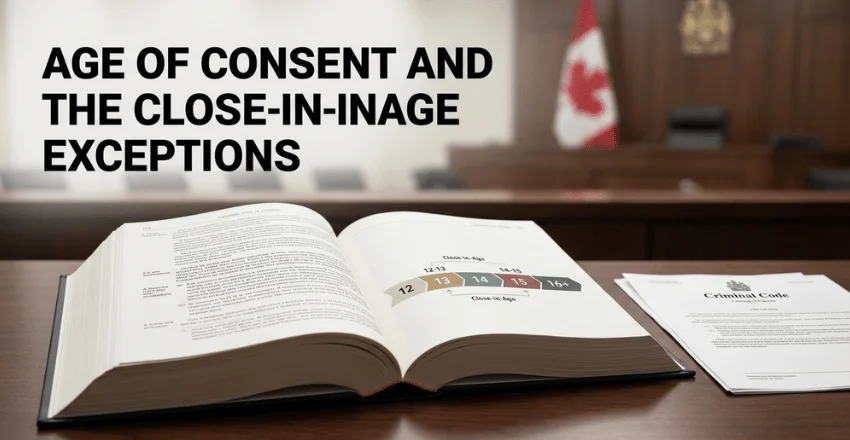
Canada sets the age of consent to sexual activity at 16. Below that line, the law treats agreement as legally impossible, with two narrow exceptions written for peers rather than for adults.
- A 12- or 13-year-old can consent to a person less than two years older.
- A 14- or 15-year-old can consent to a person less than five years older.
Both exceptions switch off in the same three situations. They do not apply where the older person holds a position of trust or authority, where the younger person depends on that person, or where the relationship is otherwise exploitative. A child under 12 can never consent, and no exception exists at that age.
Canada raises that line to 18 in two further situations: where trust, authority, dependency or exploitation is present, and where the activity involves payment or pornography.
Why an honest mistake about age rarely works
Section 150.1(4) sets a two-part test, and an honest belief only answers the first part. That subsection removes the mistake of age defence unless the accused took all reasonable steps to ascertain the complainant’s age. What counts as reasonable steps rises with the circumstances.
Where appearance, school, friends or the setting itself raise a question about age, courts expect more than one question and a quick answer. Judges have refused to accept reliance on a stated age, an online profile or entry to a licensed venue when other signals pointed the other way. Those steps also have to come before the touching, not after the charge.
Sexual interference, sexual assault and invitation to sexual touching
Police often lay more than one count on a single allegation. These sections overlap, but each asks a different question.
How the three offences differ
| 151, sexual interference | Touching for a sexual purpose | Consent is unavailable, so the Crown never has to disprove it |
| 271, sexual assault | An assault in circumstances of a sexual nature | 14-year maximum and a one-year minimum on indictment |
| 152, invitation to sexual touching | Inviting, counselling or inciting a young person to touch anyone | Same penalty structure as section 151 |
Section 152 needs no touching by the accused at all. Words can complete it.
When a section 151 count and a section 271 count rest on the same Act, the Kienapple rule blocks two convictions for one wrong. Judges enter a conviction on one count and conditionally stay the other. That is why a trial can end with findings of guilt on two counts and a criminal record showing one.
What follows a conviction
The sentence is only part of the outcome. Three orders travel with a conviction under this section, and only one of them is discretionary.
Registration under SOIRA
Parliament rebuilt this regime through Bill S-12 in 2023, after the Supreme Court struck down automatic registration. Registration now works as a presumption, and the offender carries the burden of displacing it. Judges must order it where the Crown proceeded by indictment, the sentence is two years or more, and the victim was under 18.
That also applies where the offender already has a primary offence on record. Otherwise, the court still makes the order. Offenders can displace it by showing no connection to the Act’s purpose. Another route is proving that the impact on their privacy or liberty would be grossly disproportionate to the public interest.
Because the maximum for this offence is 14 years, the order runs for 20 years rather than 10. It becomes lifelong in three situations: a prior primary offence, an existing registry obligation, or two or more designated offences in one proceeding that show a pattern.
Section 161 prohibition order
Judges must consider one, and they may impose it. Such an order can bar the offender from parks, pools, daycare centres, school grounds, playgrounds and community centres where children under 16 are likely to be. It can also bar work or volunteering in any position of trust or authority over a person under 16.
Contact with children and internet use fall within its reach too, except on terms the court sets. Such orders can last for life or any shorter period, and breaching one is a separate offence.
DNA order
Section 151 sits in paragraph (a) of the primary designated offence list, the most serious tier, so a DNA order is mandatory on conviction. That sample joins the national DNA data bank.
Financial and reporting consequences can follow as well. Sentencing judges may order restitution for losses the victim can prove, such as counselling costs. They fix that amount in Canadian dollars (CAD), on the evidence filed at sentencing. Our guide to how restitution orders are calculated walks through the way a court arrives at a figure. Publication bans protecting the complainant’s identity are routine, and the Criminal Records Act sharply limits access to a record suspension for this offence.
If police have contacted you

Timing matters more than most people expect. Most charges move through these stages.
- Police arrest you or serve a summons. You have the right to speak to a lawyer without delay, so use it before you answer any question.
- Next comes a bail hearing, usually with conditions banning contact with the complainant and with any person under 16.
- Crown counsel discloses the case, and your lawyer reviews that material before any plea.
- Prosecutors elect their route, and on an indictable election you may choose your court.
- Resolution or trial follows, often many months later.
Nothing here replaces advice about your own file. If you face a charge under section 151, contact Lawverra about your charge today, and avoid discussing the allegation with anyone else in the meantime.
Frequently asked questions
Yes. The Crown elects to proceed by indictment or by summary conviction, and that single choice sets both the maximum and the minimum.
Under the scheme in force since July 18, 2026, yes. Imprisonment stays mandatory. A judge may go below the stated minimum only where it would be grossly disproportionate for that offender.
No. Once police lay a charge, the Crown owns it, and only the Crown can withdraw it. What the complainant wants is one factor among many.
Twenty years for an order tied to this section, because the maximum sentence is 14 years. It runs for life in the situations listed above.
Sixteen, subject to the close-in-age exceptions, and 18 where trust, authority, dependency or exploitation enters the picture.