

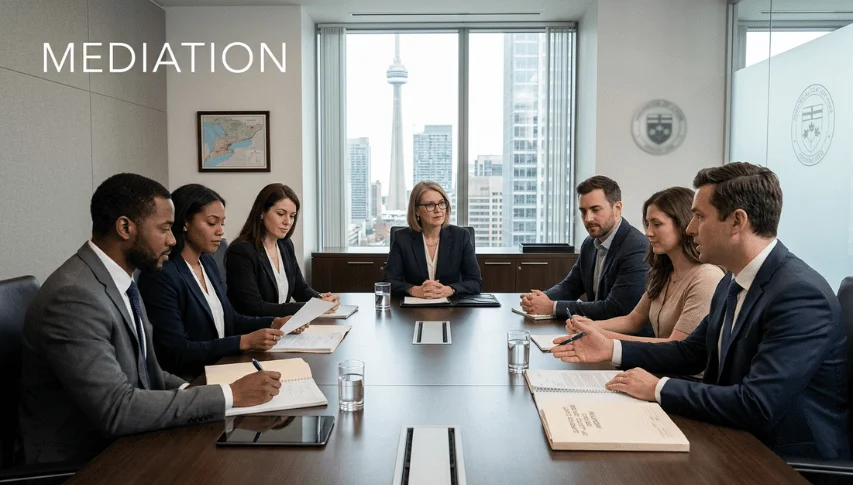
Mediation is a negotiation the parties control, guided by a neutral who has no power to impose an outcome. Rule 24.1 makes it compulsory for most civil actions filed in those three centres. You get 180 days from the first defence to hold that meeting. A roster mediator’s fee for three hours is capped at CA$600 for two parties, split evenly.
Get sued in Toronto, Ottawa or Windsor, and one appointment is already booked for you. Long before a judge reads the file, the parties have to sit down with a neutral third party and try to end the fight themselves. Ontario wrote that step into its civil rules in 1999, and it still catches people who assume settlement talks are optional.
Key takeaways
- Rule 24.1 makes the process compulsory in three Ontario centres: Toronto, Ottawa and Windsor, which covers the County of Essex.
- Rule 24.1 skips family cases, class proceedings and Commercial List matters.
- Counting starts at the first defence, and you get 180 days. Your Statement of Issues goes out seven days before the meeting.
- Roster fees carry a hard cap, and the parties share them evenly. Two parties pay CA$600 plus tax between them for three hours.
- A mediator decides nothing. Nothing binds anyone until people sign.
- What you say is deemed without prejudice, with real exceptions worth knowing before you speak.
Which track are you actually on?
| Civil action in Toronto, Ottawa, or Windsor | Mediation is compulsory under Rule 24.1 | Within 180 days of the first defence | CA$600 plus tax for two parties, split evenly |
| Estates, trusts or substitute decisions in those same three centres | Compulsory under Rule 75.1 | Set by court order or by consent | Capped roster rates, split evenly |
| Civil action anywhere else in Ontario | Voluntary, though judges lean on parties to try | Any time before trial | Private rates, usually several hundred CA$ an hour |
| Family court case | Information program required, settlement talks optional | Program within 45 days of filing | Program free, on-site help free, off-site CA$5 to CA$105 an hour |
| Small Claims Court | A settlement conference in front of a judge instead | Scheduled by the court | Built into the court fees |
Is mediation mandatory in Ontario?
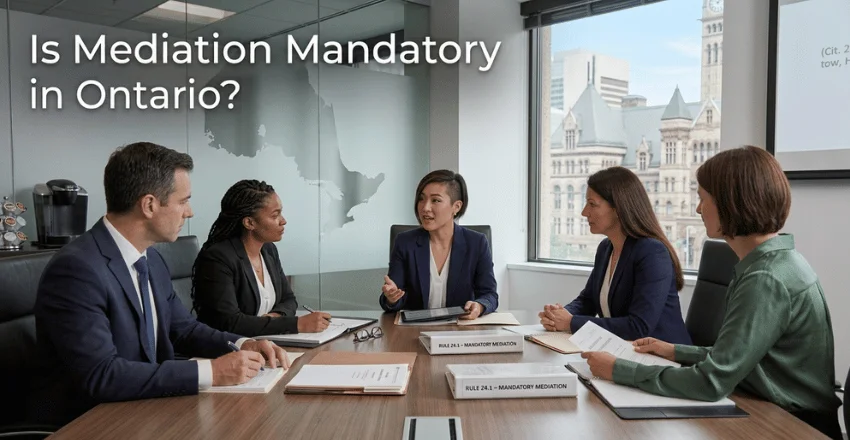
In three places, yes. Ontario’s Mandatory Mediation Program applies to civil actions started in Toronto, Ottawa, or the County of Essex, which people generally call Windsor. Everywhere else in the province, the step is voluntary, although a judge at a pretrial conference will usually ask why you have not tried it.
Carve-outs matter as much as the rule itself. Family law files sit outside it, as do matters on the Toronto Commercial List, mortgage actions, most Construction Act claims, insolvency proceedings under federal law, plus class proceedings.
Small Claims Court is its own world. Every defended claim there goes to a settlement conference before a judge. That is one of several ways Small Claims Court in Ontario pushes disputes below the CA$50,000 limit toward an early resolution.
The timetable, deadline by deadline
- The first defence lands. That filing starts the 180-day clock, not the statement of claim.
- Both sides pick a neutral. You can choose someone from the local roster or hire a mediator off it, then file Form 24.1A naming your choice.
- Nobody agrees. A local coordinator then assigns a roster mediator and serves Form 24.1B. You lose the choice by not making it.
- Statements of Issues go out. Form 24.1C reaches the mediator and every other party at least seven days ahead, with the key documents attached.
- Three hours in a room. That block is the civil standard. Parties attend with their lawyers, and whoever comes has to have authority to settle.
- A report goes to the court. It says whether the meeting happened. It never says what anyone offered.
Miss the date and the consequences are procedural rather than dramatic. A judge can order costs against you, adjourn your motion, or set a timetable you did not want. Judges notice a party who treats the step as a box to tick.
Mediation or arbitration: who actually decides
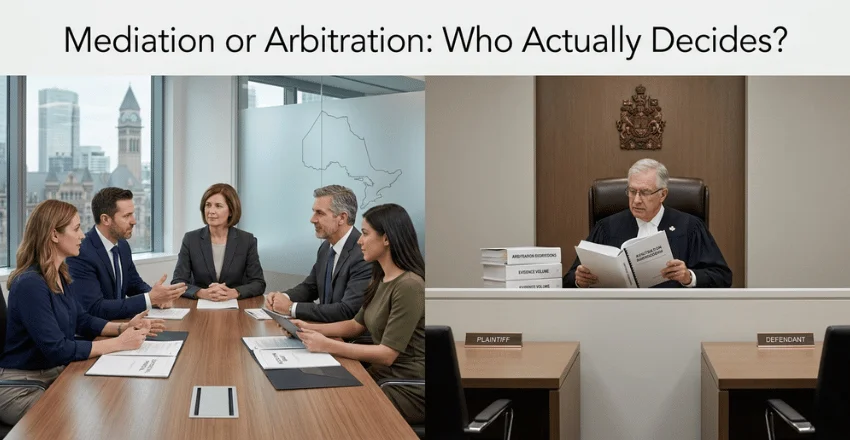
People use the two words interchangeably and then get a nasty surprise. One ends with your signature, the other with somebody else’s decision.
| Who decides the outcome? | You and the other side | The arbitrator | The court |
| Is the result binding? | Only once you sign | Yes, on release of the award | Yes |
| Can you walk away? | Yes, at any point | No, once the hearing starts | No |
| Is it private? | Yes | Usually | No, the courtroom is open |
| Can you appeal? | Nothing to appeal | Narrow grounds only | Yes, on the usual grounds |
A mediator has no authority to rule on your evidence, order anyone to pay, or find a fact. That powerlessness is the point. It lets you float a number you would never plead, because the neutral cannot hold it against you later.
What “without prejudice” protects, and what it does not
Rule 24.1 deems everything said in the room, plus the mediator’s notes and records, to be without prejudice settlement discussion. Your opponent cannot read your opening concession back to a trial judge. That protection is what makes candour rational.
It is not a vault, though. Four limits deserve your attention before you speak:
- Your signed agreement is fair game. Your opponent can file the terms you signed and enforce them in open court.
- Pre-existing documents stay discoverable. An email does not become privileged because you handed it across the table.
- Threats and safety concerns override. A credible threat of serious harm is not shielded by settlement talk.
- Child protection duties come first. Anyone who hears a reasonable suspicion that a child needs protection has to report it, whatever the setting.
Family court: the information session and free help at the courthouse
Family files run on a separate track. Most applicants and respondents must attend the Mandatory Information Program under rule 8.1 of the Family Law Rules. Timing is tight: before the first appearance or case conference, and no later than 45 days after the case starts.
Expect one hour if you have no children and two hours if you do. It costs nothing. You will hear how separation affects children, what child support and property division involve, and which alternatives to a courtroom exist. Exemptions cover people who have already attended, parties who agree on everything, and divorce-only claims.
Ontario also funds settlement help at the courthouse itself. On-site service is free on the day your matter is scheduled, and off-site work runs on a sliding scale tied to income and dependants. Parenting time, property division, and how child support amounts are calculated can all be settled this way, which spares two people a case conference that decides nothing.
What it costs in CA$, and what the alternative costs
According to the Ontario government’s guidance on the mandatory program, a roster mediator may charge at most CA$600 plus tax for three hours with two parties. That cap climbs to CA$675 with three parties, CA$750 with four, and CA$825 where five or more attend. That same guidance sets the deadline at 180 days after the first defence.
Parties split the fee equally and pay the mediator directly. A two-party file therefore costs CA$300 a side, before anyone’s lawyer opens a folder. Now price the other road. Ontario charges CA$243 to issue a statement of claim, CA$339 to file a notice of motion, and CA$859 the first time you file a trial record.
Those are the receipts, not the bill. Counsel fees for a contested motion routinely run past CA$5,000, and a short civil trial can consume a year of income for a small business. Off the roster, rates float. A senior commercial mediator in Toronto may quote several thousand CA$ for a full day, which sounds steep until you compare it against three more years of a defended action.
Making the deal stick
An agreement in principle is worth very little at 6 p.m. when everyone is tired and wants to go home. Sign before you leave. Signed minutes of settlement form a contract. In a civil action, a party who reneges can face a motion for judgment on the settled terms, and courts enforce those terms rather than reopening the merits.
Many parties go further and turn the minutes into a consent order, which converts the deal into something enforceable like any other judgment. Family agreements carry their own formalities. Under the Family Law Act, a domestic contract binds only if it is in writing, signed by both people and witnessed.
Support terms can then be filed with the court, which opens the door to enforcement through the Family Responsibility Office. Three things belong in the document every time: who pays what by which date, whether the payment is taxable, and a release describing exactly which claims die on signature.
How to get value out of the day

- Fix your walk-away number before you arrive, then test it against your worst realistic outcome at trial.
- Bring the person with authority. An adjuster on a phone in another time zone stalls the room.
- Send documents that prove your numbers, not a brief that argues them.
- Use private caucus. Most movement happens when the neutral shuttles between rooms, not across the table.
- Treat the first offer as an opening position, because it always is.
Where to go from here
Two questions decide your next move: which court location holds your file, and whether a defence has been filed yet. Answer those, and you know whether a rule sets your date or you do.
Frequently asked questions
Inside the mandatory program, CA$600 plus tax for three hours with two parties, split evenly. Family court on-site help is free, and off-site work runs on a sliding scale that starts around CA$5 an hour for low incomes. Private neutrals set their own rates.
Not in the three mandatory centres, unless a judge grants an exemption. You must show up. You never have to settle.
Rule 24.1 expects parties and their lawyers to attend together. You can appear without counsel, though you give up the running advice on whether an offer is better than your litigation risk.
Three hours is the standard civil block. Family matters often need several shorter meetings across a few weeks, because parenting arrangements rarely resolve in one sitting.
Partial deals are common and useful. Sign what you have agreed, narrow the issues in dispute, and let the court deal with the remainder on a shorter timetable.
No. A mediator has no stake in the result and no power to give you one. If the person starts sounding like a judge, say so in caucus.