
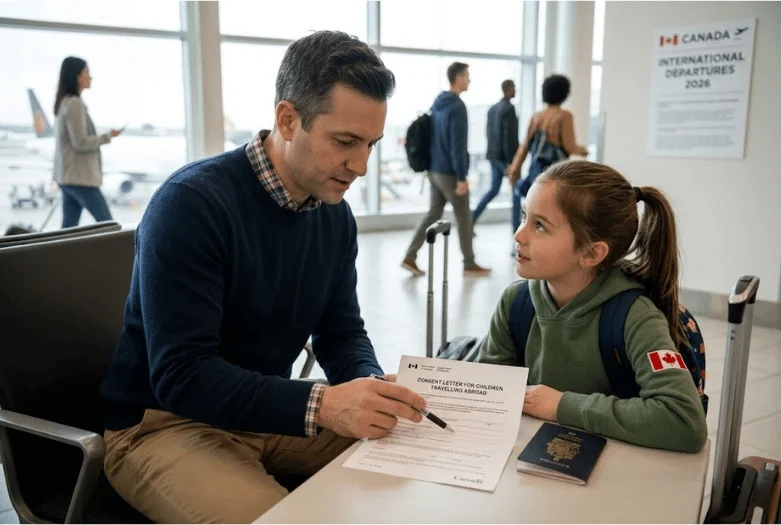
Your March break flights are booked. One parent is staying home, and someone at the airline counter has mentioned a consent letter. There is an official Canadian version; it costs nothing, and you can have it signed today.
Short answer: the travel consent form for minors that Canadian families need is the Consent Letter for Children Travelling Abroad, a free interactive form published by Global Affairs Canada. Fill it in, name every parent who is not travelling, add the trip dates and the accompanying adult, then sign it in front of a notary public.
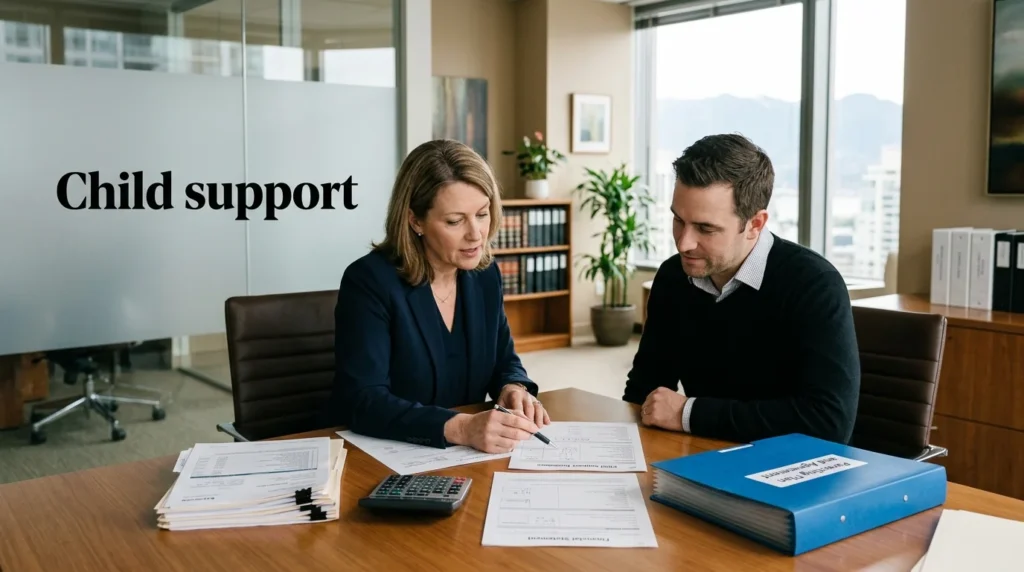
TL;DR: what to do before you fly
- Download the interactive consent letter from travel.gc.ca and complete it on screen.
- Every parent or guardian with decision-making responsibility who stays behind signs it.
- Nothing in Canadian law forces you to carry the letter. Officers ask for it anyway.
- A notary public witness is optional in law, but a notarized letter carries more weight at a border.
- Pack the original, plus a birth certificate and any parenting order.
Where to get the travel consent form for a minor PDF
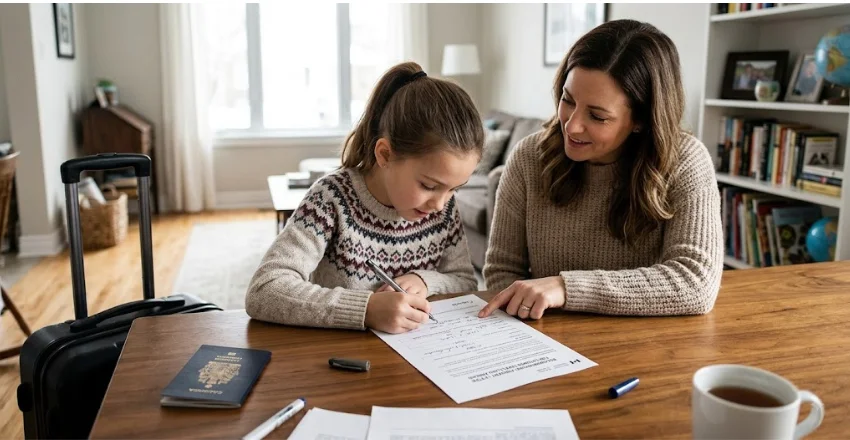
Global Affairs Canada publishes the letter on travel.gc.ca, and its guidance was last updated on February 11, 2026. The department recommends that any child under the age of 19 carry the consent letter for children travelling abroad when they travel without both parents.
You get two formats, and both produce the same letter. The interactive PDF lets you type into the fields on a computer, then print the finished page for signing. A printable document version suits families who would rather write the details out by hand, or who want a blank copy in a drawer for the next trip.
Paid template sites also rank for this search. Their forms are not wrong, but they are generic, and a border officer in Lisbon or Cancun has seen the Canadian one many times before. Use the government version.
Is the letter legally required?
No, not in Canadian law.
Nothing makes it mandatory to carry a consent letter when a child leaves the country. That is where most families stop reading, and it is the wrong place to stop.
Immigration authorities, airline agents and Canadian officials can all ask to see one. If you cannot produce it, the trip can end in a long delay or a refusal to enter or exit. Cheap insurance against a bad hour at a counter.
Who signs, by family situation
One rule covers almost every case: anyone with decision-making responsibility for the child who is not on the trip should sign. Whether the parents are married, common law, separated or divorced changes nothing about that.
| Situation | Who signs the letter | Carry as well |
|---|---|---|
| Both parents travelling with the child | No letter needed for this trip | Passports for everyone |
| One parent travelling | The parent staying home | A phone number that parent will answer |
| Separated or divorced, shared decision-making | Every parent with decision-making responsibility who stays behind | A copy of the parenting order |
| Sole decision-making responsibility | Sign one yourself, even though the order allows you to decide | The order granting sole responsibility |
| One parent has died | The surviving parent | A copy of the death certificate |
| Grandparents, an aunt or a family friend | Both parents | The adult’s identification, named in the letter |
| Legal guardian or tutor | The guardian or tutor | Guardianship or adoption papers |
| Child in temporary care | A representative of the child welfare agency | Agency contact details |
| School, sports, musical or religious group | Both parents, with the group leader named | The itinerary and the leader’s number |
| Child flying alone | Both parents | The airline’s unaccompanied minor paperwork |
Support payments and travel consent are separate questions. A parent who has fallen behind still keeps decision-making rights, and our explainer on how child support is calculated in Canada shows where those money obligations actually come from. Never trade a signature for a payment in writing.
What the letter must contain
- The child’s full name and date of birth, spelled as the passport spells them.
- Names and contact information for each parent or person with decision-making responsibility.
- The accompanying adult’s full name, address, contact information and relationship to the child.
- Where the child is going and how long the trip lasts, with specific travel dates.
- A dated signature from every parent who stays home, with the witness signature beside it.
Keep the wording plain and the dates exact. “February 14 to February 28, 2026” tells an officer far more than “two weeks over the winter”.
What you’ll need before you fill it in
- The child’s passport, for the exact spelling of their name.
- Flight or itinerary details with firm dates, including stopovers.
- An address and phone number for each parent staying home.
- Any parenting order or separation agreement that mentions travel.
- A witness, ideally a notary public, plus photo identification for whoever signs.
How to fill in and sign the letter, step by step
- Open the interactive form from travel.gc.ca on a computer rather than a phone. The fields are fillable, so type instead of printing first.
- Enter the child’s details exactly as the passport shows them, middle names included.
- List every parent or guardian who holds decision-making responsibility, travelling or not.
- Name the accompanying adult, with their address, phone number and relationship to the child.
- Add the destination and the dates, and name any country the child transits through.
- Print the letter and take it, still unsigned, to your witness.
- Sign in front of the notary public, who then signs, dates, and stamps it as witness.
- Carry the original in the passport folder, and leave a scanned copy with someone at home.
Does it need to be notarized?
Not by law.
Any adult may witness the signing, so a neighbour or a colleague technically qualifies.
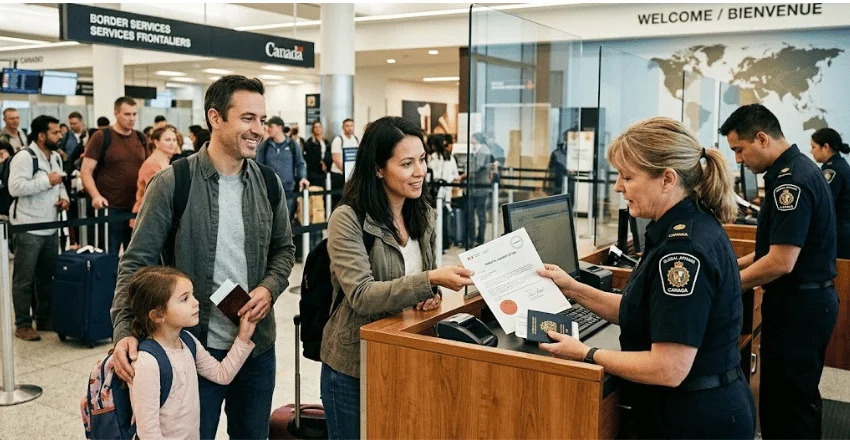
In practice, notarization is the part worth paying for. Global Affairs Canada strongly recommends that a notary public witness the signature, and officials give a notarized letter more weight than one witnessed by a friend. Original signed letters work best. Border officials may refuse photocopies or digital versions outright, and they are far more likely to question whether a phone screenshot is genuine.
What to carry alongside the letter
- The child’s passport. A Canadian child needs their own, from birth onward.
- A birth certificate, ideally the long form version naming both parents.
- Any court order or parenting arrangement that sets out decision-making responsibility.
- A death certificate where one parent has died, whether the child travels with the surviving parent or alone.
- Guardianship or adoption papers, when the accompanying adult is not a parent.
Read your parenting order again before the trip, not at the airport. Orders written years ago often say nothing useful about foreign travel, and our family law explainers cover the vocabulary you will meet in one.
Destination rules that catch families out
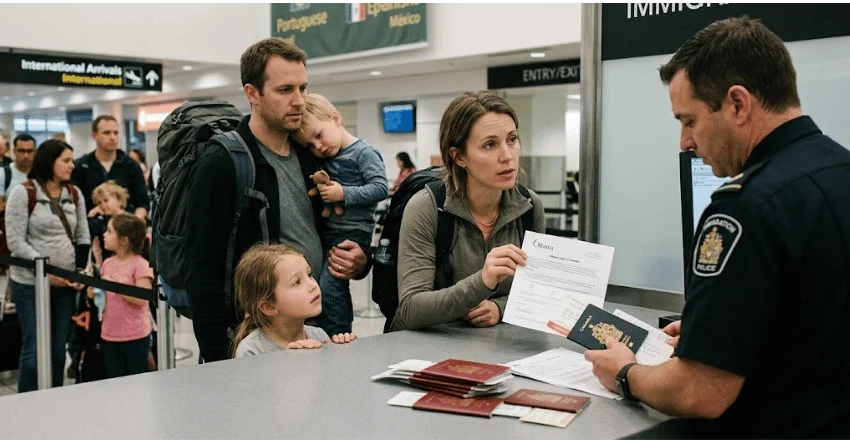
Canadian advice is only half the picture. Every country sets its own entry and exit rules for children, and Ottawa’s letter does not always satisfy a foreign immigration service.
| Destination | What surprises Canadian families |
|---|---|
| Brazil | Travel authorization is mandatory for Brazilian children leaving Brazil alone, with one parent, or with a third party. Dual citizens are caught by it. |
| Mexico | Children under 18 who are Mexican citizens or residents need the Mexican minor travel consent form, or a notarised consent form, to leave without a legal guardian. |
| South Africa | Unaccompanied minors face extra document checks, and so does any minor holding South African citizenship. |
| Anywhere | A country’s immigration authorities may decide the Canadian letter is not enough on its own. |
| Coming home | Border services officers screen for missing and runaway children, and a child is not admitted where the officer doubts the parents authorized the stay. |
Check the destination’s own immigration website, or its embassy in Canada, before you book. Dual citizenship changes the answer more often than anything else on this list.
Before you leave
Complete the form tonight, book a notary this week, and put the signed original with the passports rather than in a suitcase. The whole task takes about an hour, which is shorter than the argument you would otherwise have at a boarding gate.
If a parenting order leaves you unsure who has to sign, that is a question for a lawyer in your province. An airline agent cannot settle it for you. You can also reach the Lawverra editorial team with a correction or a topic you want covered.
Frequently asked questions
Yes. Global Affairs Canada charges CA$0 for the interactive form and for the printable version, and there is no filing step and nobody to submit it to. Your only outlay is what a notary public charges to witness the signature.
There is no expiry date. Because the letter names specific travel dates, it covers one trip, so write a fresh one each time. A letter naming last summer’s dates helps nobody in December.
Try not to. Officials prefer the original, and a photograph invites the question you least want asked at a counter. Bring paper, and keep the digital copy as your backup.
Probably yes. A child of 16 or older can hold an adult passport. Foreign authorities still request consent letters for teenagers, so keep writing them until the child turns 19.
Get legal advice before you book anything. Where contacting the other parent is unsafe or impossible, carry any court order that addresses the situation, and never sign on someone else’s behalf.
The consent letter is written for travel abroad, so a domestic flight does not call for one. Airlines still apply their own rules to children flying alone, so read those when you book.