
OHSA stands for the Occupational Health and Safety Act, the law that governs workplace safety in Ontario. It reaches nearly every employer and worker in the province, from a two-person garage to a hospital. Banks and airlines sit outside it, because Ottawa regulates them. This guide sets out what the statute asks of each side. We break this down further in Complete Guide To Common Law Ontario Rights, Property, Support.
Key takeaways
- The Act applies to nearly every Ontario workplace, but not to federally regulated employers, and not to work an owner does around their own home.
- Employers, supervisors, workers, constructors and owners each carry their own duties. The internal responsibility system ties those duties together.
- Every worker holds three rights: to know about hazards, to participate in safety decisions and to refuse unsafe work.
- A corporation now faces a maximum fine of CA$2,000,000 per charge. A director or officer can be fined up to CA$1,500,000.
- Section 50 bans reprisals, and at the Ontario Labour Relations Board the employer must prove the discipline had a lawful reason.
Who OHSA Covers, and Who It Does Not
OHSA names five parties under Ontario’s health and safety law: the employer, the supervisor, the worker, the constructor and the owner. Parts of OHSA also bind self-employed people. Two carve-outs matter for ordinary readers. First, work that an owner or occupant does in a private residence falls outside the statute. Second, the legislation now reaches telework from a home office.
Federally regulated workplaces answer to Part II of the Canada Labour Code instead. That list includes banks, airlines, railways, telecom carriers, postal services, and interprovincial trucking. Every other province and territory keeps its own equivalent statute, so an Alberta or British Columbia workplace follows different wording and different numbers. Working elsewhere in the country? Start with other legal explainers on Canadian law instead.
Duties of every workplace party under OHSA
The internal responsibility system is the engine here. Nobody waits for an inspector. Each party fixes what sits inside their own control and reports what does not. Alongside those basics, employers also carry newer duties, including a naloxone kit where a worker faces a risk of an opioid overdose on the job, a rule in force since June 2023.
| Employer | Take every precaution reasonable in the circumstances to protect a worker. Provide information, instruction and supervision, post the Act, and prepare a written health and safety policy. |
| Supervisor | Make sure workers follow the legislation and wear the protective equipment the job calls for, and warn workers of any hazard the supervisor knows about. |
| Worker | Work safely, use the equipment the employer supplies, and report hazards, defects and contraventions to the supervisor. |
| Constructor | On a construction project, make sure every employer and every worker on that project complies, and that the project itself meets the regulations. |
| Owner | Give the constructor a designated substances report before tendering, keep the building compliant, and file the notices a regulation demands. |
The right to know
A worker can find out what might hurt them. Your employer must explain the hazards in plain terms, train you, and label what you handle. Basic awareness training is mandatory for every worker and every supervisor in Ontario, whatever the sector.
- WHMIS labels and a safety data sheet for every hazardous product on site.
- A copy of the Act and the workplace safety policy, posted where people actually read things.
- Training records the employer keeps and produces on request.
- A warning about any hazard the supervisor already knows about.
The right to participate
Workers help run safety rather than simply receiving it. First, once a workplace regularly employs more than five workers, the workers choose a health and safety representative. Then, at 20 or more workers, both sides form a joint health and safety committee. Half the members must be workers.
Two of them need certification, and the committee meets every three months. Committee members inspect the site, review incidents, and make written recommendations the employer has to answer.
The right to refuse unsafe work, step by step
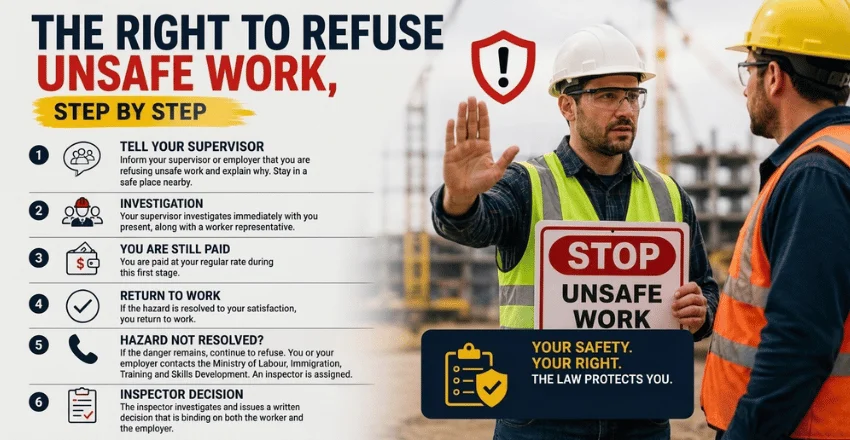
This is the sharpest right in the statute, and the one workers use least. Section 43 sets out two stages, and the order matters. Start with the first stage, then move to the second only if needed.
- Tell your supervisor or employer that you are refusing, and say why. Stay in a safe place nearby.
- The supervisor investigates right away, with you present, alongside a worker member of the committee, the health and safety representative, or another worker the workers pick.
- Your pay keeps running at your usual rate during this first stage.
- If the fix satisfies you, you return to the job.
- If you still have reasonable grounds to believe the danger continues, keep refusing. You or the employer then calls the Ministry of Labour, Immigration, Training and Skills Development. From there, an inspector takes over.
- An inspector investigates with you, the worker representative and management there, then gives a written decision that binds everyone.
Management may hand the refused work to someone else while the inspector travels. First, though, a manager has to tell that second worker about the refusal, in front of a worker representative. A few people hold only a limited version of the right. Police officers, firefighters, correctional staff and some hospital and ambulance workers cannot refuse where the danger forms a normal part of the job. Nor can they refuse where stopping would put another person in danger.
Reprisals: what section 50 protects
Your employer cannot punish you for using any of this: section 50 bans dismissal, discipline, suspension, demotion, threats and coercion. What matters is the reason behind the treatment: the worker obeyed the Act, asked the employer to comply, refused unsafe work, or spoke to an inspector.
Remedies run through the Ontario Labour Relations Board, or through a grievance where a collective agreement covers the job. Then the onus flips. The employer has to prove the discipline had a lawful reason, which is unusual, and it is the single most useful feature of the section.
The Board can lift the penalty, order reinstatement and award lost wages. Money for the injury itself usually comes through the WSIB rather than a court, and our guide to how personal injury claims work shows where that line falls.
Inspections, orders and the current maximum fines
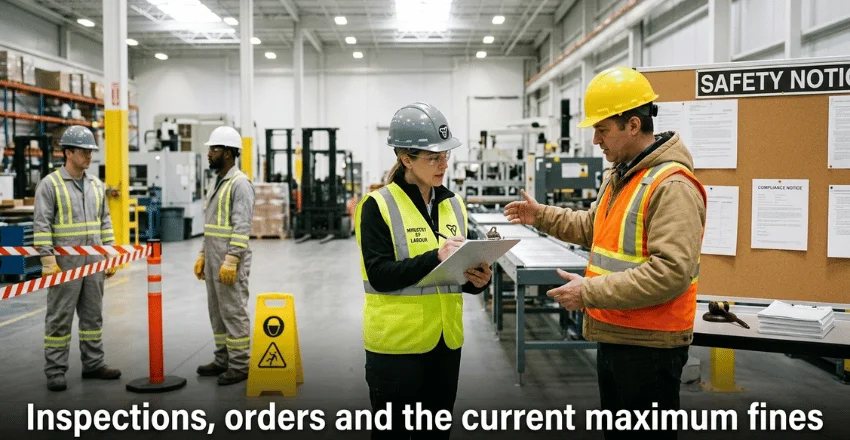
Ministry inspectors enter a workplace without a warrant and without warning. They write orders with deadlines, and a stop-work order can shut down one machine or a whole project until the employer fixes the problem. An employer must also report a critical injury or a death to the ministry immediately, then file a written report within 48 hours.
That corporate ceiling rose from CA$1,500,000 in October 2023. Where a court convicts a corporation a second time within two years, and a worker died or suffered a serious injury, the minimum fine is CA$500,000.
Fines are not the whole cost. A conviction follows a company into every tender it bids on afterwards.
- Orders to comply, each with a deadline.
- Stop work orders covering a machine, an area or the entire project.
- Prosecution under Part IX, which the Crown must start within one year of the offence.
Where to go from here
Read your workplace safety policy, learn who your representative is, and ask for the training nobody gave you. Those three moves cost nothing. They also put you in a far better position on the day something goes wrong. If you need more help, start with the right office or adviser for your situation.
Frequently asked questions
Yes. Coverage turns on the work itself, not on the contract. Students on a work placement count as well, and so does a temporary help agency worker, whose agency and client both carry duties.
No. OSHA is an American federal agency, and it has no authority in Canada. Ontario runs its own statute, its own inspectors and its own penalties, and every other province does the same.
File a reprisal complaint with the Ontario Labour Relations Board, or ask your union to grieve it. Move quickly, and keep dated notes of what you reported and what followed. The Office of the Worker Adviser advises non-unionized workers for free. Where the dispute grows teeth, you can contact an employment lawyer.
An inspector normally attends the same day. Their written decision lands at the end of that visit, and it binds both the worker and the employer unless someone appeals it.