

In Ontario, you are common-law after three continuous years of living together in a conjugal relationship. You also qualify the moment you have a child together in a relationship of some permanence. That status brings support rights and tax obligations. It does not bring the automatic property rights marriage gives you.
Most common law Ontario guides stop at that three-year number. The trouble is that three different institutions apply three different tests to the very same couple, and only one of them uses three years. Get the wrong test, and you file your taxes incorrectly or miss a deadline that cannot be reopened.
Key takeaways
- Ontario family law: three continuous years of cohabitation, or a child together.
- The Canada Revenue Agency: 12 continuous months, or a child together.
- Immigration: 12 continuous months of cohabitation.
- There is no automatic property split and no automatic right to stay in the home.
- You inherit nothing automatically if your partner dies without a will.
- A support claim is governed by a two-year limitation period from separation.
Married Versus Common-Law in Ontario, Side by Side
Distance between the two statuses is wider than most people expect, and it is widest exactly where the money sits.
| Equalization of net family property | Yes, automatic on separation | No under common law Ontario rules |
| Right to stay in the family home | Yes, both spouses have possession rights | No, only the owner or tenant on the lease |
| Spousal support | Yes | Yes, after three years or with a child |
| Child support | Yes | Yes, identical rules |
| Automatic inheritance without a will | Yes | No |
| Canada Pension Plan credit splitting | Yes | Yes, after 12 months |
| Combined tax filing status | Yes | Yes, after 12 months |
Common Law Ontario Rules: The Three-Year Test
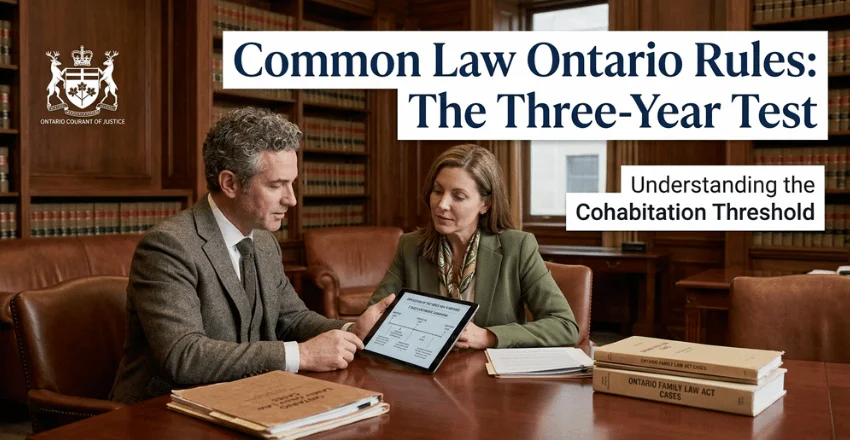
Section 29 of Ontario’s Family Law Act defines common law Ontario status for family law purposes. Two unmarried people qualify as spouses for support if they have cohabited continuously for at least three years, or if they are in a relationship of some permanence and are the parents of a child.
Cohabit has its own definition in the same statute. It means to live together in a conjugal relationship, whether within or outside marriage. Living together is necessary but not sufficient. Roommates who split the rent for a decade are not common-law, because the relationship is not conjugal.
Courts look at a cluster of factors to decide whether a relationship is conjugal. Shared shelter, sexual conduct, personal and domestic services, social presentation as a couple, financial interdependence and attitude toward children all feed into the answer. No single factor decides it.
That child exception matters more than most guides admit. If you have a child together, the three-year clock is irrelevant, and support obligations can attach in months rather than years. How child support amounts are built in Canada works identically for married and unmarried parents, because it follows the child rather than the parents’ status.
One Couple, Three Different Tests
According to the Canada Revenue Agency’s marital status guidance, you are living common-law once you have spent 12 continuous months in a conjugal relationship. That 12-month period holds even if you split for fewer than 90 days. So a couple at the 18-month mark is single under the Family Law Act and common-law to the CRA on the same day.
Money is the practical effect. Once the CRA sees you as a couple, your combined income determines the GST/HST credit, the Canada Child Benefit and the Canada Workers Benefit. Filing as single after that point creates an overpayment the agency will claw back, with interest.
Immigration uses its own 12-month rule for sponsorship, with no allowance for the kind of long-distance arrangement many couples assume will qualify. Three tests, one couple, three different answers on any given day.
Property, and Why Nothing Splits Automatically
Married spouses get equalization. Each calculates the growth in net worth during the marriage, and the one who gained more pays half the difference. Common-law partners get none of that.
Whatever you brought in stays yours. Whatever your partner bought stays theirs, even if you paid the grocery bills for eight years so they could pay the mortgage. Title decides ownership, and the family home is not treated differently from any other asset.
Unjust enrichment is the remedy, usually argued as a constructive trust or a claim in quantum meruit. It is a real remedy, and people win these cases. It is also not automatic. You have to prove three things:
- Your partner was enriched, meaning they received something of value.
- You suffered a corresponding deprivation, in money, labour, or foregone opportunity.
- There was no legal reason, such as a gift or a contract, for that transfer.
Then you have to show the size of your contribution with records. Claims under CA$50,000 can be filed in Ontario’s Small Claims Court, with its CA$50,000 limit, which keeps costs down. Larger claims go to the Superior Court, where legal fees frequently run into five figures before trial.
Spousal Support and the Two-Year Clock
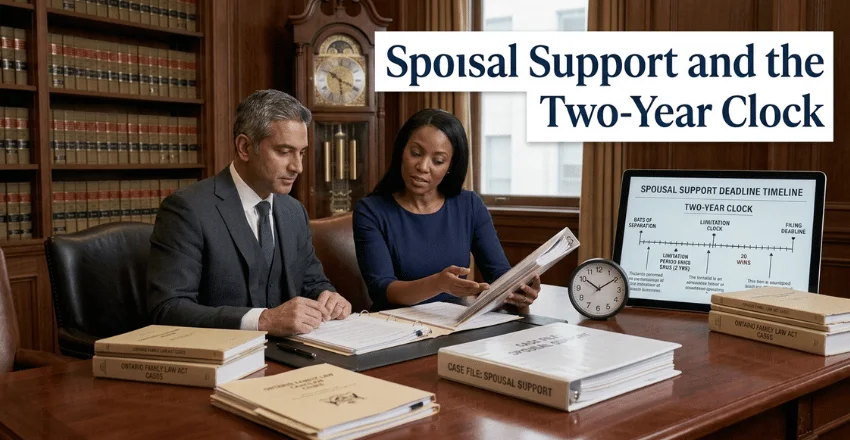
Support is the one place where common-law partners are treated almost identically to married spouses. Clear the three-year test or the child test, and you can apply. The amount is calculated the same way, using need, ability to pay, and the Spousal Support Advisory Guidelines.
Deadlines trip people up. Section 50 of the Family Law Act once set a specific limitation period for unmarried claimants, but it was repealed in 2002. The basic two-year period under the Limitations Act, 2002 now applies, running from the day you knew you had a claim. Sitting on a claim for three years while you hope for a reconciliation is how good claims die.
If Your Partner Dies Without a Will
Ontario’s intestacy rules give the surviving spouse a preferential share and then a portion of the rest. A common-law partner is not a spouse for that purpose and receives nothing at all. The estate passes to children, then parents, then siblings.
Your fallback is a dependant support claim against the estate, which requires you to show the deceased was providing support or was under an obligation to do so. That claim carries a six-month window from the date the certificate of appointment of estate trustee is issued. Miss it, and you need the court’s permission to proceed, which is discretionary.
Joint ownership with right of survivorship and named beneficiary designations sit outside the estate entirely. For most unmarried couples, they are the practical fix, and they cost nothing to set up.
How to Prove When You Started Living Together
Almost every dispute turns on the start date, because it decides whether you cleared three years. Build the record while you still have access to it:
- Leases, mortgage documents and utility accounts with both names and a start date.
- Driver’s licence and health card address changes, which are date-stamped by the province.
- Joint bank or credit accounts, and transfers between your accounts.
- Insurance policies naming the other as a partner or beneficiary.
- Tax returns and CRA correspondence showing your marital status change.
- Photographs, invitations and messages that place you at one address.
Two dated documents from independent sources are worth more than a dozen recollections.
Cohabitation Agreements Are the Cheap Fix
A cohabitation agreement lets you write your own rules on property, debt and support before anything goes wrong. It is enforceable in Ontario if it is in writing, signed, witnessed, and backed by honest financial disclosure from both sides. Most cost a fraction of a single day in court.
Your agreement converts automatically into a marriage contract if you later marry, so nothing is wasted. Our family law guides and explainers cover the related agreements in more detail.
What to Do Next
If you are approaching three years, or have already passed it, two steps cost very little and protect a great deal. Update your marital status with the CRA on time, and put a will and a cohabitation agreement in place. If a separation has already started, get the limitation period checked before anything else.
Frequently Asked Questions
Yes, after 12 continuous months. You must report the change to the CRA by the end of the month after it happens.
Not automatically. You would need to prove unjust enrichment or show you are on title.
A brief separation usually does not, but a genuine end to the relationship does. The CRA uses a 90-day threshold; family courts assess the facts.
No. There is no registry. Status arises from the facts of how you live.
Only for debts in both names or ones you guaranteed. Living together does not make you liable.