

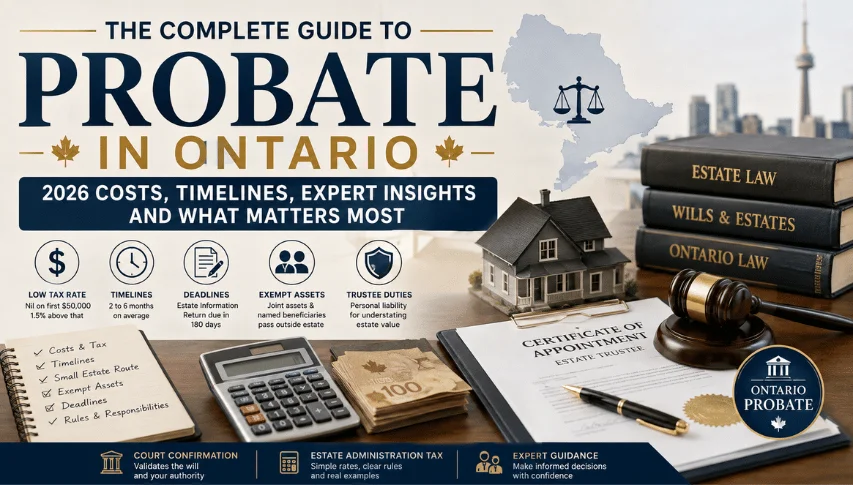
Probate is the court’s confirmation that a will is valid and that the named estate trustee has authority to act. Banks and land registry offices ask for that confirmation before releasing anything substantial. Ontario charges an estate administration tax for it, and the rate is far lower than most people fear. Daily Court Lists in Ontario is a useful companion read here.
The first CA$50,000 is free. Above it, the tax runs at CA$15 per CA$1,000, which is 1.5%. So an estate of CA$600,000 attracts CA$8,250. Most people brace for CA$9,000 because they apply the rate to the whole figure and forget the exempt band.
Key takeaways
- Nil tax on the first CA$50,000 of estate value.
- CA$15 per CA$1,000 above that, or 1.5%.
- Estates at CA$150,000 or less can use the simplified small estate route.
- The Estate Information Return is due 180 days after the certificate is issued.
- Joint assets and named beneficiaries pass outside the estate entirely.
- An estate trustee is personally liable for understating the estate’s value.
What the Probate Tax Actually Costs

According to the Ontario government’s estate administration tax guidance, an estate worth CA$50,000 or less owes nothing. Above that line, Ontario charges CA$15 for every CA$1,000 or part of it. Those figures cover every probate death on or after 1 January 2020.
Worked through:
| CA$45,000 | Nil | CA$0 | 0% |
| CA$150,000 | CA$100,000 | CA$1,500 | 1.0% |
| CA$600,000 | CA$550,000 | CA$8,250 | 1.4% |
| CA$1,200,000 | CA$1,150,000 | CA$17,250 | 1.4% |
Value the estate as at the date of death, gross of debts, with one exception. Ontario lets you deduct a mortgage registered against real property from that property’s value. Unsecured debts, such as credit cards, get no such treatment.
Assets That Never Enter the Estate
Planning happens here, not at the application stage. Some assets transfer on death by their own mechanism. They never reach the application, so Ontario never taxes them:
- Property held in joint tenancy with a right of survivorship.
- Registered plans with a named beneficiary, including RRSPs, RRIFs and TFSAs.
- Life insurance paid to a named beneficiary rather than to the estate.
- Assets governed by a properly drafted secondary will, typically private company shares.
Two warnings. Adding an adult child to title to dodge the tax can create a presumption of resulting trust, a bitter family dispute, and an unexpected capital gain in the same afternoon. Name your estate as beneficiary of a registered plan, which people usually do by accident, and you pull the whole plan back into the tax base.
Our Canadian law explainers cover the wider estate planning picture.
The Small Estate Route
Since 2021, Ontario has offered a simplified application for estates valued at CA$150,000 or less. It uses a shorter form, drops the bond requirement in most cases, and moves faster through the registry.
Limits apply. The certificate covers only the assets you list, so a forgotten account means starting again. Find more assets later, and the estate can cross the threshold, forcing you back to the regular process.
Add up everything before choosing the route. A house that only seemed to be jointly held, or a pension death benefit payable to the estate, is what usually breaks the CA$150,000 ceiling.
How Long Probate Takes

Two clocks run, and only one is under your control. Preparing the application usually takes two to six weeks, longer where the will reads ambiguously or the beneficiaries have scattered. Court processing then varies widely by registry, from a few weeks in a quiet county to several months in Toronto. Ontario estate firms tend to quote two to six months end to end for a straightforward file, and longer where anyone contests it.
Three things reliably slow a file down:
- An original will that cannot be found, or one with unexplained markings.
- A beneficiary or next of kin whose address is unknown.
- An estate trustee living outside Ontario, which usually triggers a bond.
Meanwhile, the deceased’s own tax filings and the clearance certificate from the Canada Revenue Agency run on a separate track. Distributing before that clearance arrives leaves the trustee personally exposed to whatever the Canada Revenue Agency later assesses against the estate, and no beneficiary will help repay it.
The Deadline Almost Everyone Misses
Paying the tax is not the end of it. You must also file an Estate Information Return with the Ministry of Finance within 180 calendar days of the certificate being issued. That return itemises every asset and how you valued it.
The Ministry treats an underestimated property or a missing account as a misstatement, and the estate trustee carries personal responsibility for the shortfall. Get a written appraisal for real property and keep the date-of-death statements for every account. Amend it if better information turns up within four years.
When You Can Skip the Application

Not every estate needs a certificate. Where the whole estate passes by survivorship or beneficiary designation, nothing may be left to administer. Some banks release modest balances, often under CA$25,000, on an indemnity rather than a court certificate.
Ask first. One bank’s internal threshold decides the answer far more often than the law does, and a single phone call can save you an entire court application.
If There Is No Will
Someone still has to apply, this time for a certificate without a will. Ontario’s intestacy rules then decide who inherits, in a fixed statutory order that pays no attention whatsoever to what anyone believes the deceased actually wanted. A married spouse takes a preferential share, then a portion of the remainder alongside any children.
Common-law partners inherit nothing automatically, though a dependant can bring a support claim against the estate. Those claims sit alongside the rest of our family law guides, because they turn on the same evidence about the relationship.
Your Next Step
Before applying, build a single list: every account, every property, how each one is held, and who is named as beneficiary. That list determines the tax, the route, and often whether an application is needed at all. Get a written valuation for anything you would struggle to defend later.
Frequently Asked Questions
No, and simple estates are often handled without one. Contested wills, foreign assets, or an out-of-province trustee are worth professional help.
Yes, but it is due when the application is filed, which is often before the estate has any accessible cash. Banks will usually advance it against the deceased’s own account.
No. It stays valid, though institutions may ask for a recent certified copy.
An alternate named in the will takes over. Where none is named, an interested party applies instead.
No. It is a provincial tax on the estate, separate from the deceased’s income tax.