
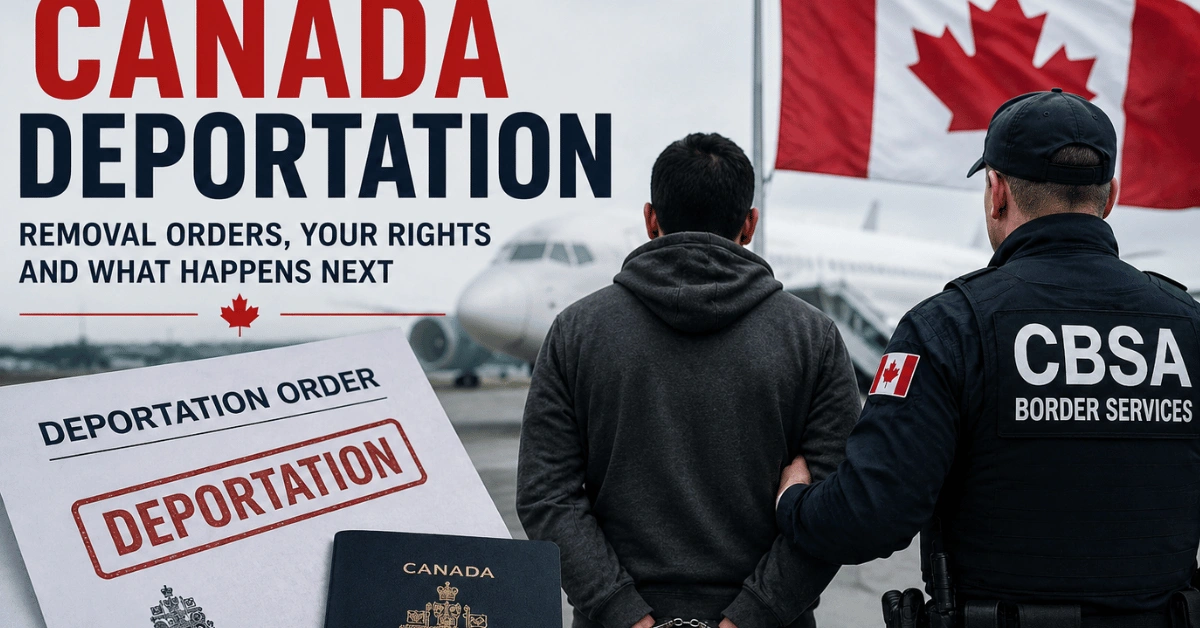
A border services officer slides a form across the counter and explains, in about a minute, that you have to leave the country. Canada deportation: That form has a name on it, and the name decides the next several years of your life.
The short version: Canada’s deportation law runs on three separate orders, and the one you were handed decides everything. A departure order gives you 30 days. An exclusion order locks you out for one year or five years for misrepresentation. The third order bars you for life unless the government later authorizes your return.
If an officer has already handed you one of these forms, call an immigration lawyer today. Deadlines here run in days rather than months, and missing one usually cannot be undone.
Key Takeaways
- The Immigration and Refugee Protection Regulations create three removal orders, and they carry very different consequences.
- A departure order turns into a deportation order if you overstay the 30 days or leave without confirming it at the border.
- An exclusion order keeps you out for one year. Misrepresentation stretches that to five.
- Permanent residents can be removed too, and a six-month sentence ends the right to appeal.
- A pre-removal risk assessment can pause a removal, but the window to ask is 15 days.
The Three Removal Orders, Side By Side
Readers usually arrive here using one word for all three. Officers do not. Here is what each order obliges you to do.
| Order | When you must leave | How long you stay barred | What gets you back sooner |
| Departure order | Within 30 days of the order becoming enforceable | No bar at all, if you go in time and confirm it. | Nothing, provided you hold a Certificate of Departure |
| Exclusion order | Immediately | One year, or five years for misrepresentation | An Authorization to Return to Canada (ARC) |
| Deportation order | Immediately | Permanent, with no clock running down | An ARC, which the government may refuse |
The Departure Order and Its 30-Day Clock
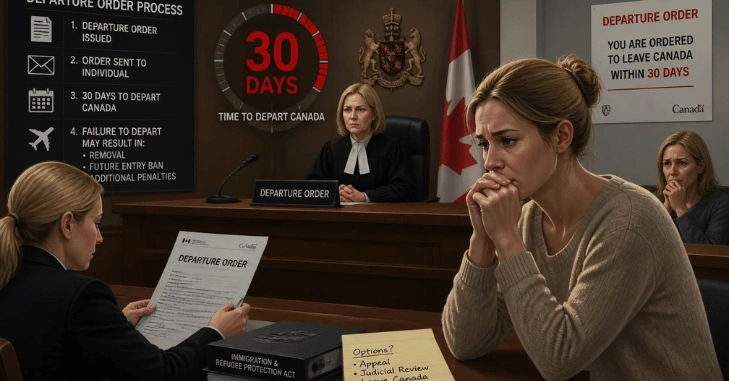
This is the mildest order, and it is also the one people lose by accident. The 30 days do not start when the officer signs the form. They start when the order becomes enforceable. Under section 48 of the Act, that means the order is in force, and nothing is holding it back. Canada deportation: For a refused refugee claimant, that moment usually arrives 15 days after the Refugee Protection Division sends its rejection notice. Your real deadline therefore sits well after the date printed on the paperwork.
Leaving is only half the job. You also have to report to a border services officer on your way out so that the Canada Border Services Agency can issue a Certificate of Departure. Skip that step, and you have technically never left.
Miss either half, and section 224 of the Regulations does the rest: the departure order becomes a deportation order automatically—no hearing, no warning letter, no discretion. Years later, when you apply to visit, that certificate is the single document IRCC looks for.
The Exclusion Order: One Year, or Five
An exclusion order is stricter. You go now, and the country keeps you out for a year from the date the removal takes effect. Misrepresentation changes the arithmetic. Section 40(2)(a) of the Act sets a five-year bar where the order flows from false or withheld information.
That ground catches more people than they expect. Staying quiet about a refused visa, a past marriage or an old charge counts, and so does an error a consultant made on a form you signed. Want back in before the year or the five years run out? You need written permission, and the same certificate rule applies. Without proof that you actually left, IRCC treats the clock as though it never started.
Canada Deportation: What the Permanent Bar Really Means
This order carries no expiry date. There is no one-year wait, no five-year wait, and no point at which you can book a flight. Section 226 of the Regulations is blunt about it: you need written authorization to return at any time after the order is enforced.
This is not an exotic outcome reserved for extreme cases. According to the CBSA removal statistics published in July 2026, Canada enforced 23,160 removals in 2025, and 11,112 of them ran on deportation orders. That is the largest of the three categories, ahead of exclusion orders at 6,820 and departure orders at 5,228.
Serious criminality is the common route there. An offence punishable by a maximum term of at least 10 years puts a foreign national in that bracket, even where the judge imposes no jail at all. Maximums matter far more than most defendants realize at the time. Read our guide to how aggravated assault is punished in Canada before any plea discussion.
Grounds of inadmissibility under IRPA
Nobody is removed for no reason. All of the grounds are in the Immigration and Refugee Protection Act. An officer must fit your case into one of them:
- security, including espionage, subversion, or terrorism (section 34)
- human or international rights violations, including war crimes (section 35)
- serious criminality and criminality (section 36)
- organised criminality, including people smuggling and money laundering (section 37)
- health grounds, where the danger to public health or the demand on services is excessive (section 38)
- financial reasons, where you cannot support yourself (section 39)
- misrepresentation (section 40)
- non-compliance with any provision of the Act (section 41)
- having an inadmissible family member (section 42)
Sections 228 and 229 of the Regulations then decide which order follows. An officer can issue some orders on the spot. Everything else goes to the Immigration Division of the Immigration and Refugee Board for an admissibility hearing first.
| Ground | Who it reaches | What normally follows |
| Security, rights violations, organized criminality | Residents and foreign nationals | Removal plus a permanent bar |
| Serious criminality, section 36(1) | Residents and foreign nationals | Removal plus a permanent bar |
| Health or financial grounds | Foreign nationals | Removal plus a one-year bar |
| Misrepresentation, section 40 | Residents and foreign nationals | Removal plus a five-year bar in most cases |
| Failing the residency obligation, section 28 | Permanent residents only | 30 days to leave |
Permanent Residents Can Be Removed Too
A PR card is not citizenship. It is a status the government can strip. Its gentlest version surprises people. A permanent resident who spends too little time in the country breaks the residency obligation and receives a departure order under section 228(2), the mildest of the three. Leave properly, and you keep the right to apply again from scratch.
Criminality is where it gets hard. Section 36(1) reaches permanent residents directly, either through an offence carrying a 10-year maximum or through a term of imprisonment of more than six months. The Supreme Court drew one useful line in Tran in 2017: a conditional sentence served in the community is not a term of imprisonment for this purpose.
Appeal Rights and the Six-Month Cliff
Permanent residents, protected persons, and holders of a permanent resident visa can appeal to the Immigration Appeal Division. Your notice has to reach the division within 30 days of the day you receive the order. The IAD can allow the appeal outright, dismiss it, or leave you in the country on conditions with removal stayed.
Section 64 of the Act shuts that door for certain findings. There is no appeal for inadmissibility on grounds of security, human or international rights violations, sanctions, serious criminality, or organised criminality. For the appeal bar, section 64(2) defines serious criminality narrowly: a crime punished in Canada by a term of at least six months.
Read that again, because it changes what a sentencing hearing is worth. The number that ends your appeal is the sentence the judge actually imposes, not the maximum in the Criminal Code. Six months costs you the IAD. Five months and 29 days does not. Other parts of a sentence, including what a restitution order covers, leave that threshold untouched.
Lose the appeal, or never have one, and the remaining route is judicial review at the Federal Court. That court reviews the decision for legal error. It does not rehear your case.
The Pre-Removal Risk Assessment
Before most removals go ahead, IRCC offers a pre-removal risk assessment. It asks a single question: would sending you back expose you to persecution, torture, a risk to your life, or cruel and unusual treatment?
Timing is everything. You get 15 days to apply once an officer hands you the forms in person, or 22 days if they come by mail. File inside the window, and nobody removes you while the application is pending. Let the window close and the removal proceedon schedule.
Plenty of people cannot use it. That bar covers claimants refused under the Safe Third Country Agreement, people already protected in a country they can return to, protected persons here, and anyone facing extradition. A negative decision from the board or a previous assessment normally locks you out for another 12 months.
Stays of Removal
A stay pauses enforcement without cancelling the order. Section 50 of the Act names four. One is a judicial decision that removal would contradict. Another is a sentence you are still serving in Canada. The IAD or a court can order a stay, and so can the minister.
CBSA adds two of its own when a country falls apart. An administrative deferral of removal handles a crisis, while a temporary suspension of removal covers longer conflicts. Neither one helps a person found inadmissible for serious or organized criminality. Note also what does not pause anything: a humanitarian and compassionate application, sitting in a queue, has no stopping power by itself.
Getting Back in Afterwards

A..n ARC application costs CA$492.50, and IRCC weighs why you were removed, how long ago it happened, and what you have done since. Approval is discretionary. You may also have to repay the cost of your removal before anyone will consider it.
Criminal inadmissibility needs a separate repair. Rehabilitation costs CA$246.25 for criminality and CA$1,231 for serious criminality. A temporary resident permit, which covers a single trip rather than fixing the problem, costs CA$246.25.
What To Do Next
Find the order, read the title line at the top, and write down the date you received it. Canada deportation: That single word, departure or exclusion or the permanent one, tells you which deadline you are living under. Then get advice quickly, because 15 days for a risk assessment and 30 days for an appeal both run whether or not you have found a lawyer.
If you are staring at one of these forms and are not sure what it is, contact the team at Lawverra and bring the paperwork with you.
Frequently Asked Questions
No. It lasts until IRCC issues an ARC, however many years pass. Only the exclusion order comes with a waiting period that ends on its own.
Leaving voluntarily is exactly what a departure order asks of you, and doing it properly within 30 days protects your record. Report to an officer before you fly and collect the certificate.
Not on its own. An application for judicial review does not pause anything. Your lawyer has to ask the court separately for a stay, and the court grants it only on a serious issue with real hardship at stake.
No. The order issued at the start of a claim is conditional and sits dormant until the claim fails or the board terminates it.
You do, in the ordinary case. Where a person cannot or will not pay, the government covers the ticket and then bills for it later, usually when that person applies to come back.