
Your pay stub, your schedule, and your last day of work all rest on the same legal floor. The Ontario Employment Standards Act builds it. What catches people off guard is how many jobs sit outside that floor and how thin it looks once a job actually ends.
In short: the Employment Standards Act, 2000, sets Ontario’s minimum terms of work. Right now that means CA$17.60 an hour and overtime after 44 hours. You also get nine public holidays, two weeks of vacation, and up to eight weeks’ notice. Federally regulated staff follow different rules, and many occupations lose parts of the Act.
TL;DR
- The general minimum wage is CA$17.60 an hour until September 30, 2026, then CA$17.95.
- Overtime begins after 44 hours in a work week, at one and a half times your regular rate.
- Vacation runs two weeks and 4% of gross wages, rising to three weeks and 6% after five years.
- Termination notice tops out at eight weeks. Severance pay is a separate entitlement worth up to 26 weeks.
- Bank staff, airline crew, and other federally regulated employees sit outside the statute entirely.
- You have two years to claim unpaid wages, and filing closes the courtroom door on the same issue.
The Statutory Floor at a Glance
| Standard | The 2026 minimum | Who commonly loses it? |
| Minimum wage | CA$17.60 general, CA$16.60 student | Lawyers, engineers, commissioned salespeople, live-in superintendents |
| Hours of work | 8 a day, 48 a week | Managers, IT professionals, and film and television crews |
| Overtime | After 44 hours, at 1.5x | Managers, supervisors, IT professionals, grounds gardeners |
| Public holidays | 9 days, paid by formula | Commissioned salespeople, live-in superintendents, teachers |
| Vacation | 2 weeks and 4%, then 3 weeks and 6% | Regulated professionals, commissioned salespeople |
| Termination notice | 1 to 8 weeks, after 3 months of service | Construction employees, fixed-term hires, and willful misconduct |
| Severance pay | Up to 26 weeks | Anyone under five years old, or at a smaller employer |
Who the Statute Covers, and Who It Misses
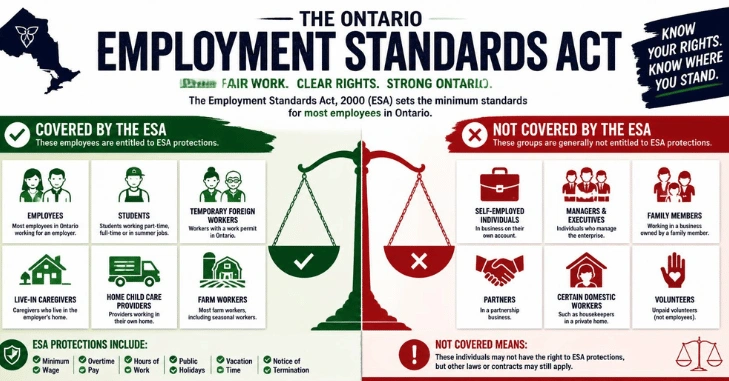
Start with the boundary, because everything below it is wasted on you if you are on the wrong side. The Ontario Employment Standards Act reaches employees of provincially regulated employers: shops, clinics, factories, restaurants, construction firms, charities, and most offices. Two groups fall outside. One is defined by industry, the other by job title.
Safety is a separate matter again. Machine guarding, harassment, and the right to refuse dangerous work live in a different statute. Our guide to OHSA rights, duties, and fines covers that ground.
Federally Regulated Workers Answer to the Canada Labour Code
Roughly one worker in fifteen across the country is federally regulated. Ontario’s statute does not apply where your employer appears on this list:
- banks and authorized foreign banks
- airlines, airports, and aircrew
- railways, marine shipping, and interprovincial trucking
- telephone, cable, and internet carriers
- radio and television broadcasters
- Canada Post, courier services, and the federal public service
- grain elevators, uranium mining, and First Nations band councils
Those workplaces answer to the federal Canada Labour Code instead. Its numbers differ in ways that matter to a paycheck. Federal overtime starts at 40 hours a week, not 44. Complaining to Ontario’s ministry in that situation buys nothing but delay, because the province has no authority over your employer.
The Exempt Occupations Nobody Warns You About
Job-based carve-outs are strange, and page-one guides tend to mention them in a single sentence and move on. Dozens of occupations keep the Act’s protection for some standards and lose it for others. These are the ones that surprise people most:
| Job | What the statute takes away |
| Lawyers, architects, professional engineers, public accountants, surveyors, teachers | Minimum wage, hours limits, eating periods, overtime, public holidays, vacation |
| Registered practitioners of medicine, dentistry, pharmacy, physiotherapy, or psychology | The same near-total exemption |
| Managers and supervisors doing genuinely managerial work | Hours limits, rest periods, overtime |
| Information technology professionals | Hours limits, rest periods, eating periods, overtime |
| Commissioned salespeople selling away from the office, real estate salespeople, and brokers | Minimum wage, hours limits, overtime, public holidays, vacation |
| Superintendents, janitors, and caretakers living in the building they service | Minimum wage, the three-hour rule, hours limits, overtime, public holidays |
| Gardeners maintaining lawns and grounds | Hours limits, overtime, public holidays |
| Students instructing or supervising children at a camp | Hours limits, rest periods, time off between shifts |
Read that table twice if your title contains the word manager. Employers hand out supervisory labels cheaply. Duties decide the question, not the wording of an offer letter, and an officer investigating a complaint will ask what you actually did all week. Spend most of your week performing the same tasks as the people you nominally direct, and the overtime exemption probably fails.
Minimum wage in Ontario right now
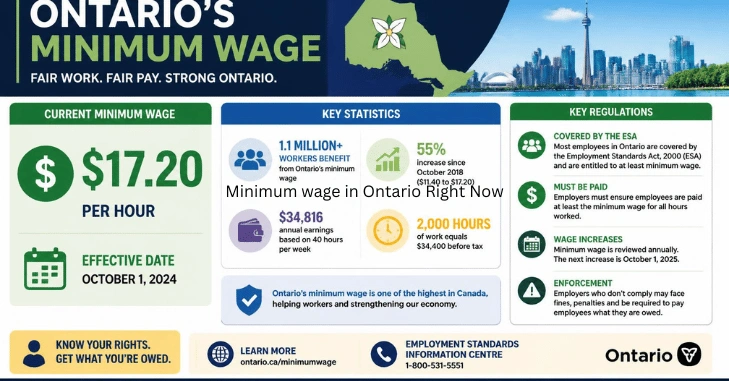
Right now the general rate is CA$17.60 an hour. Students under 18 who work 28 hours a week or less during the school year get CA$16.60. Homeworkers, meaning employees doing paid work from their own home, get CA$19.35, because they carry costs an office worker does not.
According to the Ontario government’s published minimum wage rates, the general rate rises to CA$17.95 on October 1, 2026. Student rates move to CA$16.90 and homeworker rates to CA$19.70. Each annual adjustment tracks the Ontario Consumer Price Index, and every October since 2022 has brought an increase.
Tips never count toward the minimum. Neither does a promised commission that fails to arrive.
Hours, Breaks, and the Three-Hour Rule
Eight hours is the daily ceiling, or the length of your regular workday, if that runs longer. Weekly, the cap is 48. Your employer can exceed either cap only with your written or electronic agreement. That agreement is invalid until the director’s information sheet on hours and overtime pay reaches you.
The rest is not negotiable. You get 11 consecutive hours off every day, and no agreement can sign that away. Eight hours between shifts is guaranteed, along with an unpaid 30-minute meal break after five consecutive hours of work. On top of that comes either 24 consecutive hours off each week or 48 hours across two weeks.
The three-hour rule catches the shift that gets cut short. Suppose you normally work more than three hours, you show up as scheduled, and the manager sends you home after 40 minutes. You must be paid three hours at your regular rate. Exceptions are narrow: fire, lightning, a power failure, a storm, or a similar cause beyond the employer’s control that stops work.
Overtime Starts At 44 Hours, Not 40
Forty is an American number. In Ontario, the threshold is 44 hours in a work week, and every hour past it earns one and a half times your regular rate. Salary changes nothing. A salaried employee who is not otherwise exempt still earns overtime on hour 45.
Two arrangements change the arithmetic without lowering the entitlement:
- Averaging agreements. With your written agreement and the director’s approval, your employer may average hours over two to four weeks. Overtime then applies only to the average above 44.
- Banked time. You may agree to take paid time off instead of cash, at 1.5 hours off for each overtime hour worked. Use it within three months, or within 12 if you agreed to that in writing.
Notice what is absent from that list. No employer may average two busy weeks against two quiet ones informally. None may pay straight time for hour 45 because last week was slow.
Public Holidays and How the Day is Paid
Ontario has nine public holidays: New Year’s Day, Family Day, Good Friday, Victoria Day, Canada Day, Labour Day, Thanksgiving, Christmas Day, and Boxing Day. The August civic holiday is not one of them, whatever your office calendar says.
Pay for a public holiday is not simply a day’s wages. Take all the regular wages you earned in the four work weeks before the work week containing the holiday. Add the vacation pay payable over those same weeks, then divide by 20.
Say you earned CA$3,400 in regular wages across those four weeks, plus CA$136 in vacation pay. Your entitlement for the day comes to CA$3,536 divided by 20, which is CA$176.80.
Work the holiday, and you choose between two packages. In hotels, restaurants, and continuous operations, the employer chooses:
- the statutory amount for the day, plus premium pay at 1.5 times your rate for every hour worked
- your regular wages for the hours worked, plus a substitute day off paid at the public holiday rate, scheduled within three months
Vacation Time and Vacation Pay

Under five years of service, you get two weeks off and 4% of gross wages. At five years or more, it becomes three weeks and 6%. Time and money are separate entitlements, which is why an employee who never books a day away is still owed the percentage.
Vacation pay normally arrives as a lump sum before the vacation begins. Agree in writing, and it can arrive on every check as it accrues instead. When employment ends, any unpaid vacation pay falls due within seven days or on the next pay day, whichever comes later.
Why the Ontario Employment Standards Act is only a floor
Notice starts once you have three months of continuous service. After that, it climbs by one week per completed year:
- 3 months to 1 year: 1 week
- 1 to 3 years: 2 weeks
- 3 to 4 years: 3 weeks
- 4 to 5 years: 4 weeks
- 5 to 6 years: 5 weeks
- 6 to 7 years: 6 weeks
- 7 to 8 years: 7 weeks
- 8 years or more: 8 weeks
Your employer can give working notice, pay you in lieu, or combine the two. Mass terminations run on their own clock. Fifty or more employees let go at one establishment within four weeks triggers eight weeks of notice. That rises to 12 weeks, where 200 or more go, and 16 weeks at 500 or more.
Severance pay is a different entitlement, and almost everyone conflates the two. You qualify only where you had five or more years of service, and your employer has a global payroll of at least CA$2.5 million. A second route opens where the employer severed 50 or more employees within six months because the business closed permanently.
Multiply your regular weekly wages by completed years, then add completed months divided by 12. Ontario’s own worked example: CA$1,000 a week and seven years and nine months of service produce CA$7,750. That total caps out at 26 weeks.
Here is the part most guides skip. Those figures are minimums, not the measure of what a dismissed employee is owed. Unless a valid written contract limits you to the statutory floor, the common law entitles most non-unionized employees to reasonable notice. Judges weigh your age, your length of service, the character of the job, and how easily comparable work can be found. A 55-year-old supervisor with 12 years in might see eight weeks under the statute and closer to a year at common law.
Termination clauses that try to cap the entitlement fail surprisingly often, because a clause capable of breaching the statute in any scenario is void in Ontario. That gap is the reason a wrongful dismissal case belongs in a courtroom rather than a claim form. Our guide to suing in Small Claims Court in Ontario sets out the monetary limit and the current filing fees.
Filing a claim with the Ministry of Labour
Filing happens online through the ministry’s e-claim service or on paper by fax or mail. There is no fee, and you do not need a lawyer. An early resolution officer contacts both sides first. Where that fails, an employment standards officer investigates, issues a written decision, and can order your employer to pay.
Two limits decide whether filing is worth it. Time is the first. You have two years from the date of the violation, and wages older than that window are gone. Sit on 18 months of shorted overtime, and you may collect only part of it.
Court is the second. You cannot file a claim and sue over the same issue. Change your mind and litigate, and you must withdraw a submitted claim within two weeks. Filing also carries a ceiling. An officer can order the eight weeks the statute allows and not a day more. An employee with a real common law case usually does better through a lawyer’s demand letter.
Volume matters here too. It’s published enforcement statistics: a record 11,940 claim investigations in the 2024 to 2025 fiscal year. A straightforward wage claim can still take months. A workplace injury follows a different path again, through the WSIB rather than the ministry, and our workers’ compensation explainers cover how those benefits get assessed.
What Changed Recently
- January 1, 2026. Employers with 25 or more employees must publish expected compensation in job postings and disclose any use of artificial intelligence in screening. They must also drop Canadian experience requirements and tell interviewed applicants the outcome within 45 days.
- November 27, 2025. Employees caught in a mass termination gained three unpaid days of job-seeking leave.
- June 19, 2025. Long-term illness leave gives up to 27 unpaid weeks in a 52-week period. Employees need 13 weeks of service and a qualified practitioner’s certificate.
What To Do Next
Pull your last four pay stubs and check three numbers. Compare your hourly rate against CA$17.60, your weekly hours against 44, and your vacation accrual against 4%. Most claims begin with an ordinary discrepancy someone noticed on a Friday afternoon. Ontario Employment Standards Act: If the job has already ended, get advice on your common law notice before you file anything. That choice between the ministry and the courtroom is hard to reverse.
Frequently Asked Questions
Yes. Hours worked do not change coverage. A casual employee earns the same minimum wage, the same treatment on public holidays and the same vacation percentage as a full-time colleague. The three-hour rule protects short shifts too.
No. A contract may offer better than the minimum, never worse, and any term below it is void. Signing changes nothing.
Only where the work is genuinely supervisory or managerial, with other tasks performed on an irregular or exceptionabasiss;, a title on its own creates no exemption.
Two years from the violation. Wages that came due more than two years before you file are out of reach, however clear the payroll record looks.
No. Termination pay replaces notice and reaches eight weeks. Severance is an extra entitlement for five-year employees at larger employers, worth as much as 26 weeks.