
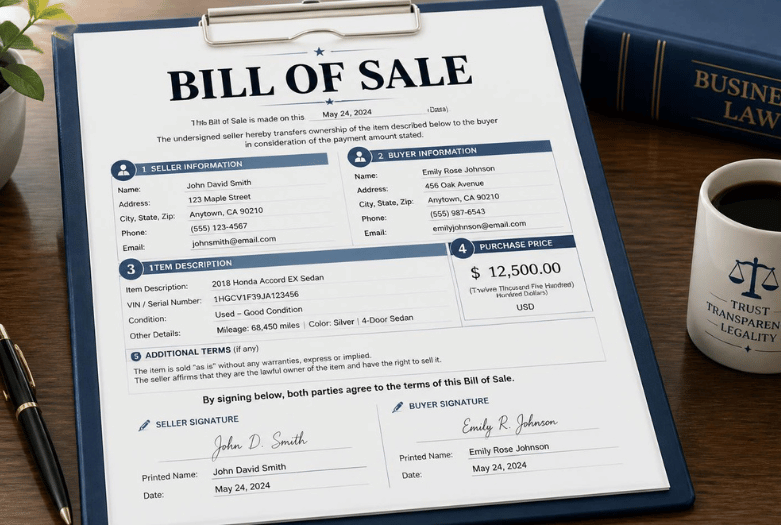
A bill of sale provides buyers and sellers with a written record that personal property has changed hands. It usually identifies the parties, the item, the price, and the transfer date. For vehicles, that document may be only one part of a province’s ownership-transfer process.
Short answer: This document records the identities of the buyer and seller, the item sold, the price, the sale date, and the parties’ signatures. It can help prove the transaction and the terms agreed upon at the time of transfer. For vehicles, it may be only one part of the ownership process, as the province sets registration and transfer rules. Affidavit in Canada is a useful companion read here.
| Question | Practical answer |
| Main purpose | Records the transfer and key terms of a sale |
| Common uses | Cars, equipment, electronics, furniture, trailers, and other personal property |
| Core details | Buyer, seller, item description, price, date, and signatures |
| One Canadian form? | No. Vehicle requirements and registration procedures vary by province. |
| Witness required? | Not universally; the applicable province and transaction determine the requirements |
| Notarization required? | Not as a blanket rule for ordinary private sales |
| Best practice | Keep the signed record, evidence of payment, and any required transfer documents. |
Key Takeaways
- A written sale record can help both sides prove what was transferred and for how much.
- Vehicle transactions require extra care because provincial transfer rules differ.
- Ontario allows an original vehicle sale document to be handwritten.
- Alberta lists witness signatures as recommended but optional for private vehicle sales.
- B.C. requires its Transfer/Tax Form and the seller’s signed vehicle registration for a typical used-vehicle transfer.
- A longer sales agreement may be appropriate for transactions involving warranties, instalments, inspections, or conditions.
What a Bill of Sale Should Include
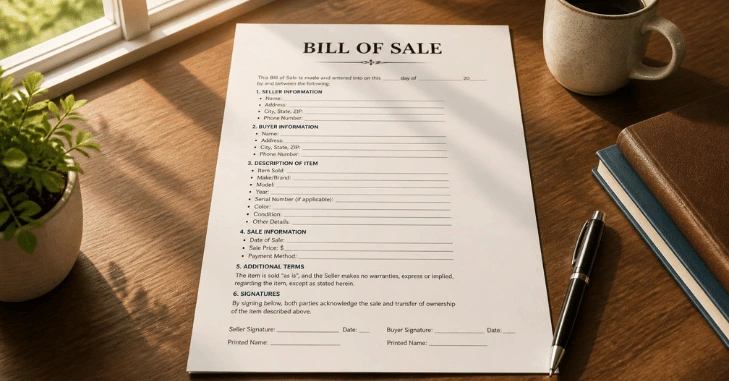
A useful sale record leaves little room for disagreement about the transaction. The exact fields depend on the property and any provincial requirements. You might also like Alberta Bill of Sale PDF.
For an ordinary private sale, include:
- Full legal names and addresses of the buyer and seller
- A precise description of the property
- A serial number, VIN, model number, or another unique identifier, where available
- The agreed purchase price
- The payment method and whether payment is complete
- The date of sale and transfer
- Known liens or encumbrances, where relevant
- Included accessories or parts
- Any agreed condition wording or special terms
- The signatures of both parties
Vehicle records require more detail. The Government of Alberta’s standard bill of sale form requires the names and addresses of the buyer and seller, the VIN, a vehicle description, the cost, and both parties’ signatures. It recommends adding information such as the odometer reading, liens, payment terms, and witness signatures. A generic form should never replace a required provincial transfer document. Check the rules for the property and province before the money changes hands.
Is This Document Legally Required Across Canada?
There is no single nationwide form that governs every private sale of personal property. Ontario’s Sale of Goods Act, for example, says that a contract of sale may be written, oral, partly written and oral, or implied by conduct. Other statutes can add their own requirements.
Vehicles show why this distinction matters. Ontario requires specific documentation for a used-vehicle transfer. Alberta uses its standard vehicle sale form for private transactions. B.C. uses a Transfer/Tax Form alongside registration documents. Readers researching other Canadian legal requirements can also browse Lawverra’s Canadian law guides.
Vehicle Transfer Rules Differ by Province
Three major provinces illustrate how quickly the paperwork can change.
| Province | Main private-sale requirements | Timing or special point |
| Ontario | Sale record, UVIP where required, permit-transfer documents, insurance, and other registration documents | Buyer generally registers the vehicle within 6 days. |
| Alberta | Standard private-sale form with prescribed buyer, seller, vehicle, price, and signature details | Witness information is recommended but not mandatory on the standard form. |
| British Columbia | Transfer/Tax Form plus the seller’s signed original vehicle registration | New owner generally registers the vehicle through ICBC within 10 days |
Ontario’s guidance on buying or selling a used vehicle lists the details the document must include: the VIN, make, year, purchase price, parties, and sale date. The province also says that the original can be handwritten. Alberta’s standard form requires both parties to sign the private-sale record. It separately identifies witness signatures, lien information, and payment details as optional recommendations.
In B.C., the buyer and seller complete the Transfer/Tax Form using original signatures. The buyer then takes that form and the signed vehicle registration to an Autoplan broker. The safest approach is to check with the responsible provincial authority before using a generic vehicle template.
Sales Record, Sales Agreement, or Receipt?
These documents can overlap, but they serve different purposes.
| Document | Best suited to | Typical level of detail |
| Simple sale record | Confirming an immediate transfer of personal property | Buyer, seller, item, price, date, and signatures |
| Sales agreement | A more complex transaction before or during completion | Payment terms, warranties, conditions, inspection rights, and remedies |
| Receipt | Showing that payment was made | Amount, date, seller, and basic purchase description |
Legal Line describes a sales agreement as the more detailed choice when a transaction involves matters such as multiple payments or warranties.
A $300 used desk may require little beyond a clear, signed record. A $25,000 piece of business equipment sold in instalments may justify a detailed agreement. Lawverra’s Business Law section covers contracts, commercial obligations, and related business-law issues.
What “As Is” Really Means
Writing “as is” can help define what the parties agreed to regarding an item’s condition. It should not be treated as a universal waiver of every possible legal right. Ontario’s Sale of Goods Act permits some implied rights or duties to be varied by express agreement. The same statute preserves rules dealing with fraud, misrepresentation, duress, mistake, and other matters that can invalidate a transaction.
Bill of sale: Consumer transactions can carry additional statutory protections. In Ontario, certain implied conditions and warranties cannot be removed from a consumer agreement by contractual wording alone. Private sellers should describe known defects accurately. Buyers should inspect valuable property and record any promises that influenced the purchase.
A Safer Four-Record Proof Stack
One signed document is useful, but a stronger transaction file contains four kinds of evidence.
- The signed sale record. Keep the version that shows the parties, item, price, date, and agreed terms.
- Payment evidence. Keep an e-transfer confirmation, bank record, cheque record, or signed cash receipt.
- Ownership and lien information. Check this information before paying, in case the asset may be subject to registered debt or another ownership interest.
- Transfer confirmation. For a regulated asset such as a vehicle, keep proof that the provincial ownership process was completed.
This four-record approach helps answer separate questions later: what was agreed upon, whether payment occurred, whether third-party interests existed, and whether registration changed. If a private transaction turns into a monetary dispute in Ontario, Lawverra’s Small Claims Court Ontario guide explains the court’s current claim process and evidence considerations.
Simple Private-Sale Template
For ordinary personal property, a basic written record can follow this structure:
- Date of sale: [Date]
- Seller: [Full legal name] [Address]
- Buyer: [Full legal name] [Address]
- Property: [Detailed description, make/model, serial number, or other identifier]
- Purchase price: [Amount]
- Payment: [Method and whether payment has been made in full]
- Condition and disclosed defects: [Describe the agreed condition and any known problems]
- Liens or other interests: [State any known interests or record that none were disclosed]
- Included items: [List accessories, parts, documents, or equipment]
- Special terms: [Any agreed conditions]
- Seller signature and date: [Signature]
- Buyer signature and date: [Signature]
For a vehicle, use the required provincial paperwork rather than relying solely on this generic structure.
Before You Sign
Check the names, item identifiers, price, payment status, and date before either party signs. For vehicles, compare the VIN on the paperwork with the VIN on the vehicle itself and follow the province’s current transfer procedure.
For high-value property, financing arrangements, disputed ownership, unusual warranties, or known liens, consider getting advice from a qualified lawyer or licensed legal professional before completing the transaction. Lawverra provides general legal information rather than individual legal advice. Its full legal disclaimer explains those limits and why jurisdiction-specific advice may be necessary.
Conclusion
A bill of sale in Canada is a practical way to create a clear written record of a private transaction. By identifying the buyer, seller, property, purchase price, date, payment details, and signatures, this document helps both parties establish what was agreed and when ownership or possession was transferred.
However, a bill of sale is not a universal substitute for provincial registration or transfer paperwork, especially when buying or selling a vehicle. Requirements can differ significantly between provinces, so buyers and sellers should confirm the current rules with the appropriate provincial authority before completing the transaction.
Frequently Asked Questions
There is no blanket notarization rule for every ordinary private sale. Alberta’s standard vehicle guidance treats witness signatures as optional, while Ontario’s required vehicle fields do not list notarization. A special transaction, affidavit, financing arrangement, or provincial rule may require different formalities. Check the rules that apply to your asset and jurisdiction.
Yes, in at least some contexts. Ontario expressly states that an original vehicle sale document may be handwritten. The document must still contain all required information. Clear printing matters. Both parties should keep a readable copy after signing.
Not necessarily. Provinces can require separate registration and transfer steps. Ontario buyers generally register the vehicle within six days. B.C. buyers generally have ten days to register it through ICBC.
Yes. Keeping the same signed version gives both sides a record of the date, item, price, and terms. Payment records and required registration documents should be stored with it.