
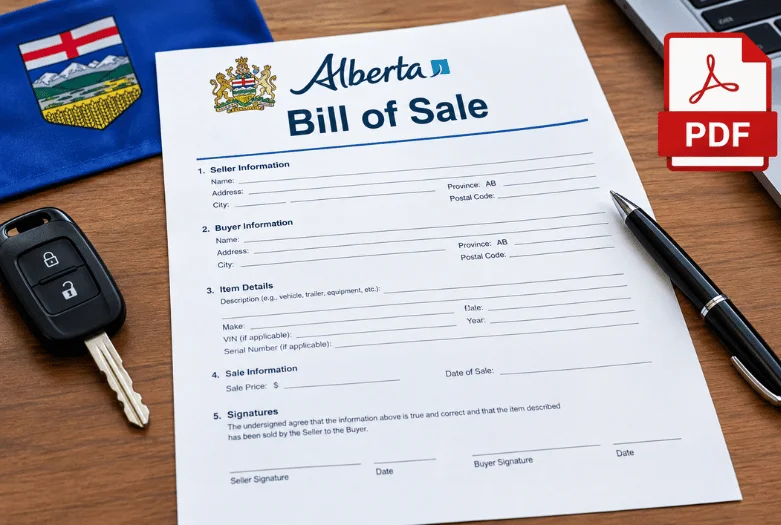
If you need an Alberta bill of sale PDF, start with the province’s official Standard Bill of Sale form. It is designed for private vehicle sales and records the details needed to transfer ownership. Using the government form also reduces the chance that a registry agent will find missing information.
Use Alberta’s official Standard Bill of Sale form for a private vehicle sale. It records the buyer, seller, vehicle, price, and signatures needed for ownership transfer. The government form can be completed online and printed as a PDF. Dealer sales follow Alberta’s separate comprehensive bill of sale requirements.
| Key point | Alberta rule or practical step |
|---|---|
| Main use | Private sales of vehicles |
| Official form | Alberta Standard Bill of Sale |
| Required parties | Buyer and seller |
| Required vehicle details | VIN, make, model or series, style, color, and year |
| Required sale detail | Vehicle cost |
| Required signatures | Buyer and seller |
| Helpful optional details | Odometer, liens, payment method, witnesses, and special conditions |
| After purchase | Arrange insurance and register through an Alberta registry agent |
| Dealer purchase | A comprehensive bill of sale applies instead. |
Key takeaways
- Use the provincial Standard Bill of Sale for a private vehicle transaction.
- Complete every required buyer, seller, vehicle, price, and signature field.
- Add optional details when they help document payment, liens, mileage, or special terms.
- Treat the 14-day plate rule as a temporary registration-transfer rule, not a universal registration deadline.
- Keep your signed sale record with insurance, registration, lien, and vehicle-history records.
Where to get the official Alberta form
The Government of Alberta links its official Standard Bill of Sale form to its vehicle-sale guidance. The online service can generate a printable PDF after the form is completed. Its print screen says the generated copy can be saved, downloaded, or printed.
Search results contain many third-party PDFs, but their wording and fields can vary. A current provincial form helps you follow the information Alberta says a private sale must contain. Lawverra’s Bill of Sale in Canada guide explains how sale-document rules differ between provinces.
What the Alberta bill of sale PDF must include
Alberta lists several mandatory details for a private vehicle sale. These items identify the parties, the vehicle, and the agreed price. Both sides should check every field before signing the document.
Required information:
- Full name and address of each seller.
- Full name and address of each buyer.
- Vehicle identification number, or VIN.
- Vehicle make, model or series, style, color, and year.
- Cost of the vehicle.
- Signature from each buyer and seller.
The VIN deserves special attention because it identifies the specific vehicle being transferred. Compare the number on the vehicle with the number entered on the form. A wrong digit can create an avoidable ownership or registration problem.
Recommended details worth adding
Alberta also recommends several details that are optional on a standard private-sale form. These entries can make the transaction easier to prove if questions arise later. They can also record payment and vehicle information that the mandatory fields do not capture.
Consider including:
- Odometer reading.
- Phone numbers for the parties.
- Identification details for the parties.
- Witness signatures.
- Known liens or encumbrances.
- Whether the vehicle was paid in full.
- Payment method and any payment terms.
- Where the vehicle was last registered.
- Special conditions of the sale.
Optional does not mean useless. For example, noting an outstanding lien can prevent confusion about what the buyer agreed to purchase. Written payment terms can also help when the buyer is not paying the entire price immediately.
Private sale and dealer sale forms are different.
Alberta separates private vehicle sales from sales by automotive businesses. Private sellers use the standard form described above. Automotive businesses must provide a comprehensive bill of sale with additional disclosures and pricing information.
| Sale type | Document | Main focus |
|---|---|---|
| Private sale | Standard Bill of Sale | Parties, vehicle, price, and signatures |
| Automotive business sale | Comprehensive bill of sale | Vehicle, fees, financing, history, trade-in, and business disclosures |
The dealer document includes more than the private-sale form because consumer rules apply to automotive businesses. It can cover fees, deposits, financing disclosures, vehicle history, and trade-in information. Lawverra’s Business Law section has more plain-language coverage of contracts and commercial obligations.
How to complete and use the form
The form works best when both sides verify the vehicle and transaction details together. Do not rely on a copied VIN or an old advertisement without checking the vehicle. Keep the signed record with the other documents connected to the purchase.
- Open the official Alberta Standard Bill of Sale form.
- Enter the seller’s full legal name and address.
- Enter the buyer’s full legal name and address.
- Copy the VIN and vehicle description carefully.
- Record the agreed purchase price.
- Add useful optional details, including liens and payment terms.
- Review the form together and correct errors before signing.
- Have each buyer and seller sign the completed document.
- Keep a signed copy with your transaction records.
A careful review is especially useful when several buyers or sellers are involved. Names and addresses should match the people who are completing the transaction. The price and special conditions should also match what both sides agreed on.
What happens after the vehicle is sold?
A buyer still has registration steps after the document is signed. Alberta says registration requires proof of ownership, valid insurance, and acceptable identification. An inspection may also apply in certain out-of-province, salvage, or commercial situations.
The province tells private buyers to obtain insurance and register through a registry agent as soon as possible. It also recommends keeping lien, vehicle history, and ownership records in a safe place. A registration certificate by itself does not necessarily prove ownership in a private sale.
Alberta has a separate 14-day rule for people transferring an existing plate and registration to another vehicle. During that temporary period, the driver must carry proof of ownership and insurance. Commercial vehicles and insurance coverage do not receive the same 14-day treatment.
Checks to make before paying a private seller
The form records the transaction, but it does not replace basic vehicle checks. Alberta recommends confirming the seller’s identity and ownership before buying. The province also points buyers toward registry, lien, inspection, and stolen-vehicle checks.
Before payment, consider these steps:
- Confirm the seller has valid identification and proof of ownership.
- Obtain a Vehicle Information Report from a registry agent or AMA.
- Search the Personal Property Registry for liens using the VIN.
- Consider a vehicle history report.
- Arrange a safety inspection through a vehicle inspection facility.
- Search the Canadian Police Information Centre database for stolen vehicles.
These checks address risks that the sale form cannot resolve by itself. A signed document does not tell you whether the vehicle has an undisclosed lien or mechanical problem. Use the paperwork as one part of a wider pre-purchase review.
Common mistakes that can delay a clean transfer
Small paperwork errors can become large inconveniences at registration. The safest approach is to compare the document against Alberta’s current list before anyone signs. Buyers should also keep the ownership document available until registration is completed.
Common mistakes include:
- Leaving out a buyer or seller address.
- Entering the VIN incorrectly.
- Omitting the model, style, color, or year.
- Writing an unclear or incomplete purchase price.
- Missing a required buyer or seller signature.
- Assuming witness signatures are mandatory.
- Treating the 14-day plate rule as a general registration deadline.
- Using a dealer-style form for an ordinary private sale.
Alberta Bill of Sale PDF FAQ
Is a bill of sale required for a private vehicle sale in Alberta?
Yes, Alberta says a standard bill of sale must be completed for a private vehicle transaction. The document gathers the information needed for the buyer to license and register the vehicle. A buyer should also follow the province’s insurance and registration requirements after the sale.
Does an Alberta private-sale form need a witness?
A witness signature is recommended but optional under Alberta’s standard bill of sale guidance. The buyer and seller signatures are part of the mandatory information. Adding a witness may still be useful when both sides want another record of signing.
Can I download the official form as a PDF?
The Alberta government provides an online Standard Bill of Sale form. Its form service can generate a PDF copy for saving or printing. Use the provincial link rather than assuming a third-party PDF is current.
What do I need to register the vehicle after buying it?
Alberta requires proof of ownership, valid insurance, and acceptable identification for registration. Some vehicles also need an applicable inspection. A registry agent handles the registration process.
Do I have 14 days to register every vehicle I buy?
The 14-day provision applies to using an existing plate and registration on another newly acquired vehicle. You must carry proof of ownership and insurance during that period. Alberta separately advises private buyers to insure and register the vehicle as soon as possible.
Before you sign
Open the current provincial form, compare the VIN, and verify every required field before signing. Keep the finished document with your payment, insurance, lien, and vehicle-history records.