
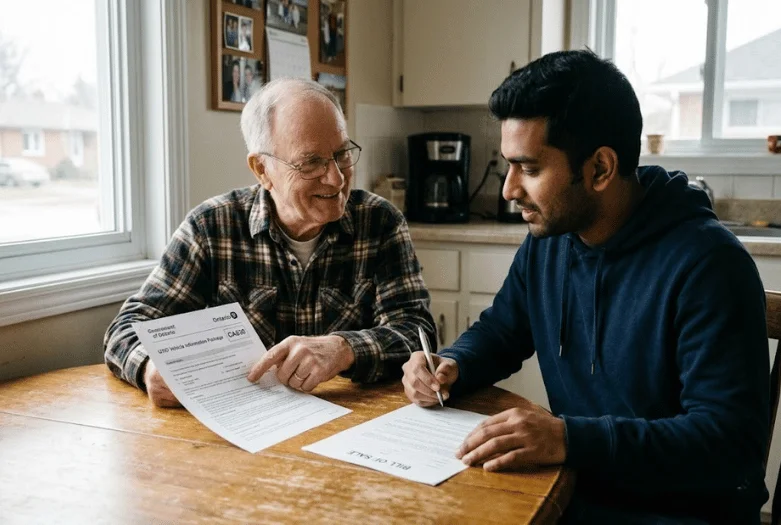
Most private sellers open a form website first and pay for a template. In Ontario, you rarely need one. A bill of sale in Ontario is already included in the Used Vehicle Information Package, and the seller has to buy that package anyway.
It costs CA$20.
Below is the whole paperwork chain for a private sale. You get the fields the record must show, the number the province taxes, and the goods with no package behind them.
Short answer: A private vehicle sale in Ontario needs a signed written record showing the VIN, the vehicle description, the price, the date, and both parties’ names and addresses. The seller buys the CA$20 Used Vehicle Information Package, which already includes that section. Nobody has to witness it, and no notary signs it.
What you pay for, and what you can skip
| What you need | What it costs | Where it comes from |
|---|---|---|
| Used Vehicle Information Package | CA$20 | ServiceOntario, online or over the counter |
| The written sale record | Included in the package | The bill of sale section inside the UVIP |
| Safety standards certificate | Priced by the garage, not the province | Any Vehicle Inspection Centre licensed by the Ministry of Transportation |
| Retail sales tax | 13 per cent of the taxable value | The buyer pays it at registration |
| Vehicle permit transfer | Varies by vehicle class and location | The ServiceOntario counter |
| Paid template from a form website | Whatever the site charges | Not needed for a private vehicle sale |
What CA$20 of UVIP actually contains
This is not a receipt. It is the vehicle’s file, pulled from the province’s own registration database, and the law requires the seller to hand it to the buyer. Skipping it is an offence under the Highway Traffic Act.
Inside you get:
- Vehicle details, including year, make, model, colour, body type, cylinders, plus the power
- The Ontario registration history, listing present and previous owners, their city of residence, and the odometer readings on file
- Lien information, so the buyer can see whether a lender still has a claim on the car
- Retail sales tax information, including the average wholesale value the province will use
- The last known status of the vehicle’s condition, and whether it has been reported as wrecked
- A bill of sale section, ready to fill in
That lien line is the reason to read the package rather than file it. A loan registered against the car follows the car, not the seller, so a buyer who ignores it can lose the vehicle to a lender months later. Hiding a lien or winding back an odometer is fraud. A sentencing judge can then order restitution to the person who paid on top of any other penalty.
What the written record must state
ServiceOntario cares about content, not presentation. Hand over an original rather than a photocopy, and write it out by hand if you like.
Include all of this:
- The vehicle identification number
- Make, year, plus the power source, meaning gas, diesel or electric
- Body type, with colour and model where those are available
- Purchase price, along with any tax collected and an HST or GST number if one applies
- Current owner or dealer: name, address, signature
- Buyer’s name and address
- Date of the sale
Two copies, both signed, one each. That written record settles later arguments about price, mileage or promises. Disputes of that size go to Small Claims Court in Ontario, not anywhere grander.
Selling privately in Ontario, step by step
Seven moves, in order:
- Order the Used Vehicle Information Package before you advertise the car, so you can answer questions about its history.
- Read the lien section yourself and clear any debt still registered against the vehicle.
- Book a safety inspection if the buyer wants to plate the car straight away.
- Fill in the sale section of the package with the buyer, and both of you sign it.
- Hand over the package, the signed record, and the vehicle portion of the permit with the Application for Transfer completed on the back.
- Keep your plates and the plate portion of the permit. Plates travel with the driver, never with the car.
- Send the buyer to ServiceOntario, where the tax is paid and the transfer is registered.
The buyer has six days from the purchase to register as the new owner.
The safety certificate and its 36-day clock
You cannot plate a used vehicle in a new owner’s name without a safety standards certificate, and only a transfer to a spouse escapes that. Any Vehicle Inspection Centre licensed by the Ministry of Transportation can inspect the car and email the certificate once it passes.
Then the clock starts. A safety standards certificate is valid for 36 calendar days after the inspection, which is short enough to matter if a sale drags on.
Sellers often skip it deliberately and price the car accordingly. That is legal. Your buyer simply cannot drive it until a garage inspects it and the province records it as fit.
The tax the buyer pays, and the number it lands on
Here is where a private sale surprises people. According to the Ontario Ministry of Finance’s retail sales tax rules for specified vehicles, a private buyer owes 13 per cent retail sales tax on the vehicle’s fair market value. Fair market value is not simply whatever the two of you agreed.
For cars, vans and trucks up to 2,200 kg, the taxable value is the greater of the purchase price or the amount listed in the Canadian Red Book. That book records the average wholesale value for the same year, make and model. It ignores condition, mileage and options, so the province can tax a rough car as though it were tidy. Where the Red Book figure sits under CA$1,000, ServiceOntario falls back to the purchase price.
So a CA$3,000 car with a CA$5,000 book value attracts tax on CA$5,000. Buyers usually find that out at the ServiceOntario counter, not before.
| Situation | What the 13 per cent is charged on |
|---|---|
| Ordinary car, van or light truck | The greater of the price paid and the Canadian Red Book value |
| Red Book value under CA$1,000 | The price paid |
| Severely damaged or heavily used vehicle | The greater of the price paid and the appraised value |
| Vehicle 20 years old or older | The greater of the price paid, and the insurance replacement value or the appraised value |
| Motorcycle, motorhome, snowmobile, boat, aircraft or trailer | The price paid |
When an appraisal cuts the bill
A sworn valuation is the escape route almost nobody mentions. Where a vehicle carries severe damage or heavy use, the buyer can get an appraisal from a licensed dealer or from an appraiser the ministry approves. Ontario then charges tax on the greater of the price paid and the appraised value, once both sit below the book figure. Older vehicles follow their own rule, and an appraisal remains the practical answer for anything past its twentieth birthday.
Giving a car to a family member
No money changing hands means no retail sales tax, provided the relationship qualifies. That list runs wider than most people expect. It covers spouses, including common-law partners, along with parents, children and siblings. Grandparents, grandchildren, in-laws, step-relatives, adopted relatives and a court-appointed guardian all qualify too.
Both parties then complete the Sworn Statement for a Family Gift of a Used Vehicle in the Province of Ontario. You sign it in front of a Commissioner of Oaths or a Commissioner for Taking Affidavits. That is the one sworn document in the whole chain.
One catch is easy to miss. The province allows only one exempt transfer of the same vehicle between family members in a 12-month period. Passing a car from parent to son and on again inside the same year will not work twice.
Does it need a witness or a notary?
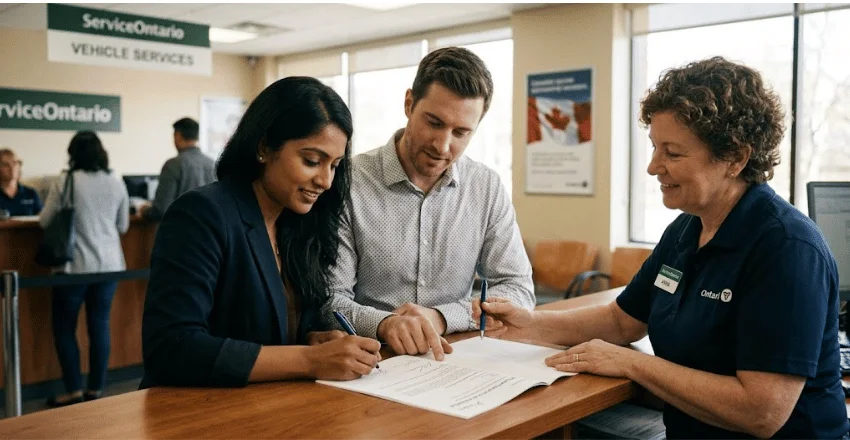
No. Notarization is not part of the requirement list, and neither is a witness signature. Ontario asks for an original document with the right facts on it and two signatures, nothing more.
Form websites that upsell notarization are selling comfort, not compliance. An oath appears in one place only: the family gift statement described above.
Bill of sale Ontario rules for boats, trailers and ordinary goods
No package exists for a boat, a trailer, a snowmobile or an aircraft, because the UVIP is built for road vehicles registered in the province. For those, the seller writes the record from scratch using the same fields, and the province taxes the purchase price rather than a book value.
Boats and aircraft have their own payment route. Buyers pay the retail sales tax at any ServiceOntario centre, or mail it to the Ministry of Finance with the sale document attached.
For everyday goods such as tools, furniture or a piece of shop equipment, Ontario prescribes no form at all. The Sale of Goods Act implies that a seller has the right to sell what they are selling. A signed record naming the parties, the item, the price and the date proves the deal happened. Write “sold as is, where is” if that is the bargain, and say so before the money moves rather than after.
Key takeaways
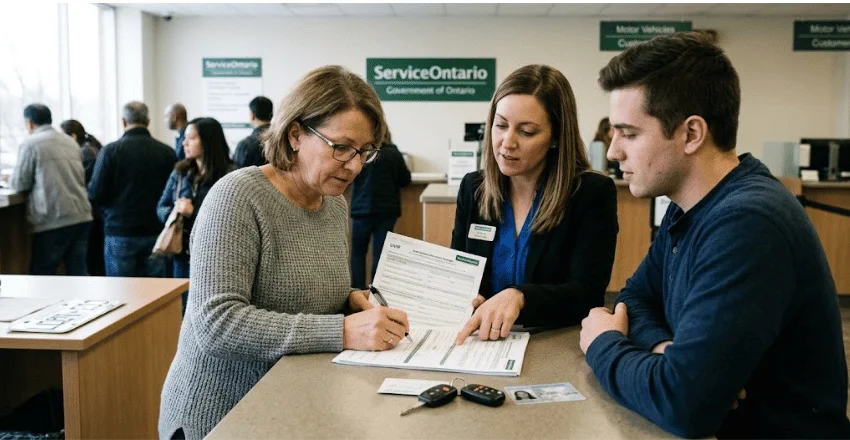
- The seller must buy the CA$20 package, and it already includes the sale form, so a paid template is redundant for a car.
- Handwriting is fine. Missing fields are not.
- The buyer pays 13 per cent tax on the greater of the price and the wholesale value, unless an appraisal says otherwise.
- A safety standards certificate lasts 36 calendar days.
- Gifts inside the family are exempt once a sworn statement is signed, and once per vehicle per year.
Before you hand over the keys
Order the package first, read the lien line, then fill in the section it already gives you. That sequence costs CA$20 and removes almost every argument a private sale can produce.
FAQ
Yes. Bring an original rather than a photocopy, and ServiceOntario will accept handwriting on plain paper as long as every required field is there.
The seller. Providing it is a legal duty, and a seller who refuses is committing an offence.
Tax still lands on the higher wholesale figure. Only an appraisal brings the taxable amount down, and it has to show real damage or heavy use.
Yes. ServiceOntario asks for the package, the signed sale document, proof of insurance, an Ontario driver’s licence, the permit with the transfer application completed, and a safety certificate where one applies.
Six days from the date of purchase.
For a boat, it is the main document, since no vehicle package exists, and the buyer takes it to ServiceOntario or the Ministry of Finance to settle the tax.