

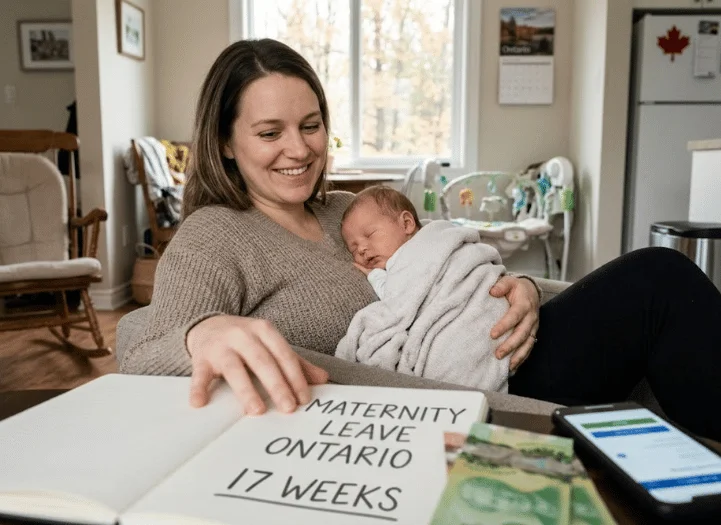
Ask two new parents how long the leave lasts, and you’ll get two different answers. Both can be right. The phrase “maternity leave Ontario” covers two separate entitlements, and they come from two levels of government: Queen’s Park grants the time away, and Ottawa grants the money. Their clocks start on different dates, run for different lengths, and you can qualify for one while failing the test for the other.
Short answer: Ontario’s Employment Standards Act gives a pregnant employee up to 17 weeks of unpaid, job-protected pregnancy leave, then up to 61 more weeks of parental leave. Employment Insurance pays separately: 15 weeks of maternity benefits at 55% of insurable earnings, capped at CA$729 a week in 2026.
Key takeaways
- Ontario grants the leave. The Employment Standards Act gives 17 weeks of pregnancy leave plus up to 61 weeks of parental leave, all of it unpaid.
- Ottawa grants the pay. EI maternity benefits run 15 weeks at 55% of insurable earnings, to a 2026 ceiling of CA$729 a week.
- Eligibility tests differ. Thirteen weeks of employment open the provincial leave. Six hundred insured hours open the federal benefit.
- Standard parental benefits pay more per week. Extended benefits pay slightly more in total, spread across a far longer stretch of the calendar.
- Your employer has to hold your job open and keep paying its share of your benefit premiums while you’re away.
Who grants what, and what it’s worth in 2026

| Entitlement | Granted by | Maximum length | What it pays |
|---|---|---|---|
| Pregnancy leave | Ontario, Employment Standards Act | 17 weeks | Nothing. Unpaid and job-protected |
| Parental leave | Ontario, Employment Standards Act | 61 weeks after pregnancy leave, 63 weeks without it | Nothing. Unpaid and job-protected |
| EI maternity benefits | Federal, Employment Insurance | 15 weeks | 55% of insurable earnings, max CA$729 a week |
| EI standard parental | Federal, Employment Insurance | 35 weeks for one parent, 40 shared | 55% of insurable earnings, max CA$729 a week |
| EI extended parental | Federal, Employment Insurance | 61 weeks for one parent, 69 shared | 33% of insurable earnings, max CA$437 a week |
Ontario gives you the time, not the money
Pregnancy leave is a statutory right, and your employer cannot refuse it. You qualify if you started the job at least 13 weeks before your due date. That test looks at the calendar, not at hours worked, so a part-time employee hired in January qualifies for a June baby just as a full-time one does.
According to the province’s guide to the Employment Standards Act, pregnancy leave runs up to 17 weeks. Parental leave then adds up to 61 weeks for a birth parent who took it. Neither one obliges the employer to pay a cent of wages during the absence.
What the employer does owe you is continuity. Your seniority and length of service keep accruing while you’re off. Your employer keeps paying its share of premiums for pension, life, extended health and dental coverage, unless you tell it in writing that you’re dropping your own share. When you come back, you return to the same job or a comparable one, at your old rate plus any raise that landed while you were gone.
Give at least two weeks’ written notice before the leave starts, and four weeks’ written notice if you decide to come back early. Those two deadlines cause more disputes than any other part of the statute. Before the leave begins, the same employer still owes you a safe workplace, and Ontario’s health and safety duties for employers apply in full through every week of a pregnancy.
Parental leave sits on top of it
A birth parent who takes pregnancy leave can add up to 61 weeks of parental leave. Everyone else, including a birth parent who skipped the pregnancy leave, gets up to 63 weeks. Parental leave has to begin within 78 weeks of the birth, so a phased return has an outer limit.
Employment Insurance gives you the money
EI runs on a completely different eligibility test. You need 600 insured hours in the 52 weeks before your claim starts, and your weekly earnings have to drop by more than 40% for at least one week. Someone hired 14 weeks ago clears Ontario’s test and misses Ottawa’s. Someone who worked long hours for one busy season may clear Ottawa’s test and miss Ontario’s.
Service Canada guidance sets maternity benefits at 15 weeks, paid at 55% of your average insurable weekly earnings, and the 2026 maximum is CA$729 a week. That ceiling comes from the maximum insurable earnings figure of CA$68,900, so anyone earning above roughly CA$69,000 lands on the cap regardless of salary.
Two details catch people out. There’s a one-week waiting period with no payment at all, served once per child even when parents split the parental weeks. And the first deposit usually arrives about 28 days after you apply, which means the money often starts more than five weeks after the last day of work.
Lower-income families get a lift. Where annual net family income sits at CA$25,921 or less, and the household receives the Canada Child Benefit, Service Canada adds a family supplement automatically. Your weekly ceiling still holds at CA$729.
Standard or extended: run the numbers in CA$
This is the one decision you cannot undo. Once the first parental payment goes out, the choice is locked, and both parents have to be on the same option. Here is what each route pays a parent claiming alone at the 2026 ceiling.
| Route | Maternity | Parental (one parent) | Total EI | Weeks paid |
|---|---|---|---|---|
| Standard, 55% | 15 weeks, CA$10,935 | 35 weeks, CA$25,515 | CA$36,450 | 50 |
| Extended, 33% | 15 weeks, CA$10,935 | 61 weeks, CA$26,657 | CA$37,592 | 76 |
Notice what that table says. The extended route is not simply the same pot of money divided more thinly. A parent claiming alone actually collects about CA$1,100 more in total, because 61 weeks at the lower rate outruns 35 weeks at the higher one. What you trade is cash flow: roughly CA$495 a week averaged over the extended route, against CA$729 a week on the standard one.
So the real question is whether your household can absorb the weekly gap. Mortgage payments don’t stretch. If childcare costs less than the income you’d give up by returning at month twelve, extended often wins on the arithmetic alone.
Maternity leave Ontario timeline: notice, start dates and first payment
- Seventeen weeks before the due date. The earliest your pregnancy leave can start under provincial law.
- Twelve weeks before the due date. The earliest EI maternity benefits can begin. Start the leave earlier than this and those weeks pay nothing.
- Two weeks before the leave starts. Written notice to your employer, naming the start date.
- Your last day of work. Apply for EI within four weeks. File late, and you can lose weeks of benefits outright.
- About 28 days later. First payment lands, after the unpaid waiting week is deducted.
- Week 15 of benefits. Maternity benefits end, and parental benefits take over on the same claim.
- Four weeks before you plan to return early. Written notice, if you’re cutting the leave short.
Where the leave and the pay refuse to line up

Nobody designed these two systems to fit together, and the seams show.
- Two unpaid weeks at the front. Ontario gives 17 weeks of pregnancy leave. Ottawa pays 15 weeks of maternity benefits. Add the waiting week and three of those 17 weeks carry no EI at all.
- Five weeks of early leave you fund yourself. Provincial leave can start 17 weeks before the due date; federal benefits only 12.
- The shared weeks need a second claimant. Forty standard weeks and 69 extended weeks sound generous, but a solo claimant is capped at 35 and 61. The extra weeks appear only when the other parent opens their own claim.
- Job protection outlasts the cheques. A birth parent can be off for 78 weeks under provincial law while EI pays for at most 76 of them.
If your job disappears while you’re off
Firing someone for taking pregnancy leave is a reprisal, and the Employment Standards Act prohibits it outright. Your remedy is a claim to the Ministry of Labour, which can order reinstatement and back pay.
Common law severance is a separate route, and it usually pays far more than the statutory minimum. Where the amount at stake sits under CA$50,000, many parents file in Ontario’s Small Claims Court rather than the Superior Court. Filing fees and timelines both run lower there. Get advice before you sign any release your employer hands you on the way out.
Top-ups, tax and the income question later

Plenty of Ontario employers run a top-up plan, and a registered one does not claw back your EI. The rule is simple: the top-up plus the benefit together cannot exceed 100% of your normal weekly gross pay. Ask your human resources contact for the plan document before you pick standard or extended, because a generous top-up often makes the standard route the better deal.
Tax matters too. Service Canada withholds tax at source, but it withholds at the rate for the EI payment alone. Parents who work part of the year at full salary regularly owe money the following April.
Your next step
Map both calendars side by side, on paper, before you name a start date to anyone. Write your due date at the top, mark week 17 and week 12 ahead of it, then add the notice deadline and the application date. Most of the money parents lose here goes missing in those opening weeks, not at the end.
Two more things are worth checking before you file. EI benefits count as income if a court ever sets support, and our guide to how child support amounts are built shows which income lines the tables actually use. And if your employer pushes back on the leave or on the job you return to, talk to an Ontario employment lawyer while the deadlines are still open.
Frequently asked questions
Up to 78 weeks. That’s 17 weeks of pregnancy leave followed by 61 weeks of parental leave, taken consecutively. Job protection covers the whole stretch, even though EI money runs out before it does.
No. The leave itself is unpaid. EI covers 15 of those weeks, minus the one-week waiting period, unless your employer runs a top-up plan that fills the gap.
You keep the provincial leave and lose the federal benefit. The 13-week employment test and the 600-hour test are independent, so failing one leaves the other intact. Self-employed parents can access maternity benefits only through the separate EI special benefits agreement, and that requires registering at least 12 months before claiming.
Yes, and doing so unlocks extra weeks. Standard benefits rise from 35 weeks to 40 when both parents claim; extended benefits rise from 61 to 69. Both parents have to choose the same option.
Only before the first parental payment is issued. After that, Service Canada treats the choice as final for that child. Model both routes against your household budget before you submit the application.