
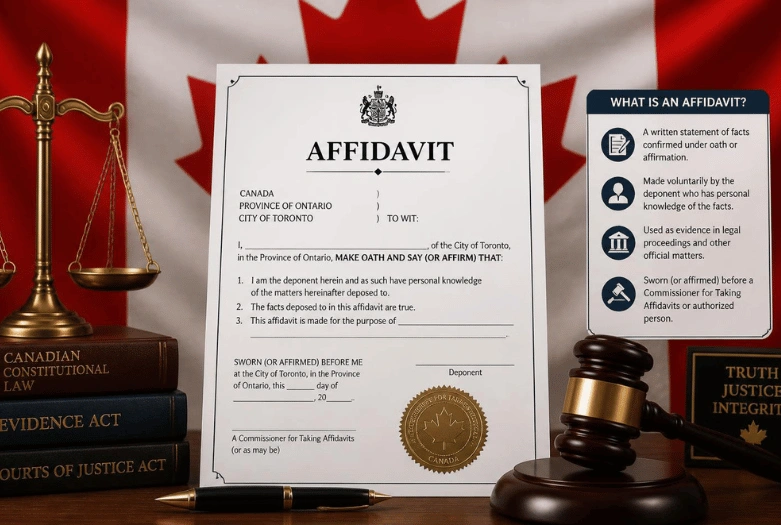
An affidavit is a written statement of fact that its author signs and then swears or affirms to be true in front of someone the law authorizes to receive an oath. The oath, and the jurat recording it, are what turn ordinary paper into evidence a court will read.
Here is what almost every page on this subject omits: no Ontario or federal statute actually defines the word “affidavit.” Not the Ontario Evidence Act, not the Commissioners for Taking Affidavits Act, not the Legislation Act, 2006, not the federal Interpretation Act. The law regulates who may administer the oath, what the document must contain, and what happens when it is false.
Two things changed on 1 March 2026. Ontario roughly doubled the list of people who are commissioners because of the job they hold, adding police officers, articling students and ServiceOntario counter staff among others. The same day, the remote commissioning regulation was rewritten so a video session is no longer framed as a two-party link. Since 1 January 2026 a commissioner appointment also lasts ten years instead of three.
Key facts about Ontario affidavits at a glance
| Item | Current position |
|---|---|
| Statutory definition of “affidavit” | None, in either Ontario or federal law |
| Governing rule and form, civil | Rules of Civil Procedure r. 4.06, Form 4D |
| Governing form, family | Family Law Rules Form 14A |
| Commissioners by virtue of office | O. Reg. 386/12, expanded 1 March 2026 by O. Reg. 20/26 |
| Video-conference swearing | Permanent under O. Reg. 431/20, amended 1 March 2026 |
| Court fee to swear an affidavit | $22 at the Superior Court of Justice and Court of Appeal |
| Commissioner appointment | $75 new, $50 renewal, ten-year term since 1 January 2026 |
| Maximum sentence for perjury | 14 years on indictment |
No statute defines an affidavit, so what makes a document one?
Four things must be true. The document states facts in the first person, the deponent signs it, someone with legal authority administers an oath or affirmation, and that person completes and signs a jurat recording where and when. Remove any one and the paper is a letter.
The nearest thing to a definition in federal law is s. 35 of the Interpretation Act, which defines “oath” to include a solemn affirmation or declaration, and provides that “sworn” then includes affirmed or declared. Anyone with a religious or conscientious objection to oath-taking loses nothing by affirming.
| Instrument | Legal authority | Sworn or affirmed? | Prescribed form? |
|---|---|---|---|
| Affidavit | Commissioners for Taking Affidavits Act s. 6; Rules of Civil Procedure r. 4.06 | Yes, before a commissioner | Yes: Form 4D civil, Form 14A family |
| Statutory or solemn declaration | Ontario Evidence Act s. 43; Canada Evidence Act s. 41; CTAA s. 7 | Not an oath, a declaration in statutory words | Yes, wording set by statute |
| Affirmation | Ontario Evidence Act s. 17(1); Canada Evidence Act s. 14 | Substitute for the oath, identical force | No separate form |
| Unsworn letter | None | No | No, and no force as evidence |
Section 43 of the Ontario Evidence Act fixes the declaration wording, and its closing phrase is the whole point:
and I make this solemn declaration conscientiously believing it to be true and knowing that it is of the same force and effect as if made under oath.
The difference is procedural context, not solemnity: the affidavit is the court-facing instrument, the declaration the administrative one, and Criminal Code perjury reaches both. Anyone working through a separation agreement in Ontario or an immigration file will meet declarations far more often.
Who can commission an affidavit in Ontario, by office rather than appointment
Two routes create a commissioner. Section 4 of the Commissioners for Taking Affidavits Act lets the Attorney General appoint any person aged 18 or over, normally tied to their employer. Section 1 makes anyone holding a prescribed office a commissioner automatically, with no application and no stamp requirement. Those offices are listed in O. Reg. 386/12, consolidated from 1 March 2026.
| Office | Where the authority runs | Added 1 March 2026? |
|---|---|---|
| Members of Provincial Parliament | Anywhere in Ontario | No |
| MPP constituency staff who assist constituents | Only in connection with that work | Yes |
| Judges of the Court of Appeal, Superior Court and Ontario Court of Justice | Anywhere in Ontario | No |
| Justices of the peace | Anywhere in Ontario | No |
| Licensed Ontario lawyers and paralegals | Anywhere in Ontario | No |
| Articling students and law practice program candidates | Only in connection with the clerkship or program | Yes |
| Registrars and court clerks under Courts of Justice Act s. 73 | Ontario court work and filed documents only | No |
| Police officers and First Nation Officers under the Community Safety and Policing Act, 2019 | Only as part of duties at their own police service | Yes |
| Members of a First Nation band council | Only where the reserve is situated | Yes |
| Park superintendents, conservation reserve managers and park wardens | Only in that role | Yes |
| ServiceOntario public servants serving the public directly | Only when serving the public | Yes |
| Municipal clerks, deputy clerks, treasurers and deputy treasurers | Their own municipality | No |
| Heads of council, and councillors of municipalities of 15,000 or more | Their own municipality | No |
Before 1 March 2026 the list held only MPPs, judges, justices of the peace, lawyers, paralegals, registrars, court clerks and the municipal officers. The municipal group is geographically confined, so a Kingston clerk cannot commission in Windsor, and notaries public are not on the list at all: their commissioner powers come from s. 3(1)(c) of the Notaries Act.
An appointment under s. 4 is not a general public licence. The applicant must work at a registered Ontario business where commissioning is part of current operations, and processing takes four to six weeks. Fees under R.R.O. 1990 Reg. 76, consolidated from 1 January 2026, are $75 new and $50 on renewal, with government, municipal, children’s aid society and First Nation band employees exempt.
When a commissioner is not enough and a notary public is required
A commissioner can administer oaths, affirmations and declarations. That is the entire power. Under s. 3(1) of the Notaries Act a notary can do that too, plus witness and attest the execution of a document, certify and attest a true copy, and exercise any additional powers set by regulation.
The certified true copy is the practical dividing line. Ontario’s guide for newly appointed commissioners states the Act does not itself authorize commissioners to certify true copies, and tells them not to do it without separate legal authority. A certified copy of a passport, a degree or a birth certificate in Ontario needs a notary.
Documents leaving the country are the second line. Canada joined the Hague Apostille Convention effective 11 January 2024 and Ontario now issues apostilles, charging $16 for a notarized legal document and $32 for an Ontario government, court or postsecondary document, with processing within 15 business days. Documents in a language other than English or French must be notarized by an Ontario notary public first.
Notary appointments expire after three years under s. 5(1), but s. 5(1.1) exempts Law Society Act licensees, so a lawyer or paralegal appointment does not expire while the licence stays in good standing. The Crown fee is $145 once for lawyers and paralegals and $110 for a new non-lawyer appointment, and non-lawyer notaries may only notarize documents relating to the employment named in their notice of approval.
Affidavits sworn outside Ontario, and by a party’s own lawyer
Section 45 of the Ontario Evidence Act validates oaths, affidavits, affirmations and declarations made outside Ontario before a listed office holder, or before an Ontario notary or commissioner, and s. 45(3) makes the document admissible without proof of the signature, office or seal where the office is shown below the signature. Section 47 settles a widely misunderstood point: an affidavit is not inadmissible merely because it was sworn before the solicitor of a party, or that solicitor’s partner, associate, clerk or agent.
The anatomy of a valid affidavit, clause by clause
Rule 4.06 of the Rules of Civil Procedure is the code for civil affidavits and Form 4D is the template it requires. The rule came through the September 2026 consolidation unamended in substance.
Heading, style of cause and page format
Rule 4.02(1) requires a heading in Form 4A for an action or Form 4B for an application, showing the court name, the court file number and the title of the proceeding, with a Form 4C backsheet under r. 4.02(3). Rule 4.01 sets the physical standard: paper 216 by 279 millimetres, double spaced, a left margin of about 40 millimetres, type no smaller than 12 point or 10 pitch.
Identifying the deponent and stating capacity
Rule 4.06(1)(c) requires the deponent’s full name, and if the deponent is a party or a lawyer, officer, director, member or employee of a party, the affidavit must say so. Form 4D opens accordingly: “I, (full name of deponent), of the (City, Town, etc.) of ___, in the (County, Regional Municipality, etc.) of ___ … MAKE OATH AND SAY (or AFFIRM)”. A concealed capacity is a standard line of attack on the other side’s evidence.
First person, numbered paragraphs, one fact each
Rule 4.06(1)(b) requires the first person and r. 4.06(1)(d) requires consecutively numbered paragraphs, each confined as far as possible to a particular statement of fact. Single-fact paragraphs let an opposing party admit some and dispute others, and let a judge strike one without losing the rest.
Exhibits, and who is allowed to mark them
Rule 4.06(3) is explicit: an exhibit referred to in an affidavit shall be marked as such by the person taking the affidavit, not by the deponent and not at the filing counter afterwards. Described as attached, an exhibit is attached and filed with the affidavit. Described as produced and shown to the deponent, it is not attached or filed but left with the registrar for the court’s use and returned after disposition.
Ontario’s recommended stamp wording is: “This is exhibit ‘A’ referred to in the affidavit of (name of the deponent) sworn/affirmed before me this (date) day of (month), (year).” Many commissioners also initial every page so none can be substituted later.
The jurat, the place and the date
Form 4D asks the commissioner to select in person or by video conference, then record the city or town, the county or regional municipality where the swearing happened, and the date. Section 9(3) requires the commissioner, before signing, to be satisfied of the genuineness of the signature. Ontario’s guide sets the sequence: confirm the signature, request proof of identity, administer the oath, complete the jurat, sign and affix the stamp. Where two or more people swear the same affidavit, r. 4.06(4) requires a separate jurat for each unless they all swore before the same person at the same time.
Alterations must be initialled by the commissioner
This rule ruins more filed affidavits than any other. Rule 4.06(9) provides that any interlineation, erasure or other alteration shall be initialled by the person taking the affidavit, and unless so initialled the affidavit shall not be used without leave of the presiding judge or officer. A correction pencilled in on the way to the courthouse converts a good affidavit into one needing a judge’s permission.
Deponents who cannot read the document
Under r. 4.06(7), where a deponent is illiterate or blind the commissioner must certify in the jurat that the affidavit was read to the deponent in the commissioner’s presence, that the deponent appeared to understand it, and that it was signed or marked there. Rule 4.06(8) covers a deponent who does not understand the language, requiring the jurat to certify that a named interpreter first took an oath before the commissioner to interpret correctly. Skipping the interpreter’s own oath is a common and fatal shortcut.
Family court uses Form 14A, and rule 4.06 does not apply
The Family Law Rules, consolidated from 1 May 2026, run a separate system. The general affidavit is Form 14A, opening far more plainly than Form 4D: “My name is (full legal name) / I live in (municipality and province) / and I swear/affirm that the following is true:”.
Those rules contain no equivalent to rule 4.06’s code on exhibits, alterations and format, so citing rule 4.06 in a family proceeding is an error, and a common one in templates circulating online. Form 14A carries two instructions of its own: where a fact was learned from someone else the affidavit must name that person and state the deponent’s belief that it is true, and any blank space left on the page must have a line drawn through it. Rule 1.2(1) then catches people filing divorce papers, requiring every identifying financial account number and personal identification number to be redacted after service but before filing.
Swearing by video conference is permanent in Ontario
Remote commissioning is not a pandemic measure that expired. Section 9(2) of the Act came into force on 1 August 2020 and contains no sunset clause, and neither does the regulation under it. O. Reg. 431/20, Administering Oath or Declaration Remotely, was amended in 2026, not repealed. Its five conditions are cumulative.
- An electronic method of communication that allows participants to see, hear and communicate with one another in real time throughout the entire transaction.
- The person administering confirms the identity of the deponent or declarant.
- A modified jurat indicating that the oath was administered under the regulation, and the location of both the person administering it and the deponent.
- Where the commissioner holds a limited appointment under s. 5, the stamp information appears on or in the document being signed.
- Reasonable precautions are taken, including ensuring the deponent understands what is being signed.
Section 2 adds a duty to keep a record of every remote transaction, and the jurat is longer because it must show two places: “Sworn (or Affirmed or Declared) remotely by (client’s name) stated as being located in the (City, Town, etc.) of ___ … before me at the (City, Town, etc.) of ___ … on (date), in accordance with O. Reg 431/20.”
What O. Reg. 21/26 changed on 1 March 2026
O. Reg. 21/26 was made on 29 January 2026, published on e-Laws on 4 February 2026 and came into force on 1 March 2026, revoking and replacing the first condition. The old wording required a method in which the person administering the oath and the deponent could see, hear and communicate with each other. The new wording requires a method that allows participants to see, hear and communicate with one another. The link is no longer strictly two-party, which accommodates interpreters, witnesses, co-deponents and a second commissioner in the same session.
Remote notarization is a different question, and the answer is no
Section 3(3) of the Notaries Act permits remote notarial acts only if a regulation says so, and none has been made. Ontario states that remote notarization is not permitted and that documents notarized remotely will not be authenticated or apostilled. Administering an oath, though, is a commissioner’s act, expressly covered by O. Reg. 431/20, and may be done by video even by a notary.
Electronic signatures on affidavits
Section 11(1) of the Electronic Commerce Act, 2000 provides that a requirement to sign is satisfied by an electronic signature. The s. 31(1) exclusion list covers wills and codicils, trusts created by them, powers of attorney for property or personal care, and negotiable instruments. Affidavits are not excluded, though anyone preparing a power of attorney in Ontario should note that it is.
Practice is narrower than that suggests. Section 3 makes electronic documents optional, so a receiving body may insist on paper, and within the civil rules r. 4.01.1(2) permits an electronic signature only for documents signed by the court, a registrar, a judge or an officer, which on its face does not reach a deponent. The claim that the Rules authorize electronically signed affidavits is therefore not established, and Ontario’s guidance adds that nothing obliges a receiving organization to accept a remotely commissioned document at all.
Personal knowledge, information and belief: the rule that gets affidavits struck
Rule 4.06(2) is the restriction, and it is strict: an affidavit shall be confined to facts within the personal knowledge of the deponent, or to other evidence the deponent could give if testifying as a witness in court, except where the rules provide otherwise. “My sister told me he never paid” is not personal knowledge. The exception is not in rule 4.06 at all, which is where most secondary writing goes wrong. It lives in rule 39.01, and it works differently depending on what is before the court.
| Proceeding | Rule | What the affidavit may contain |
|---|---|---|
| Any affidavit, general rule | r. 4.06(2) | Personal knowledge, or evidence the deponent could give as a witness |
| Motion | r. 39.01(4) | Information and belief, if the source and the fact of the belief are specified. No contentiousness limit |
| Application | r. 39.01(5) | Information and belief on non-contentious facts only |
| Summary judgment motion | r. 20.02(1) | Information and belief allowed, but the court may draw an adverse inference where no witness with personal knowledge is produced |
| Family motion | Family Law Rules r. 14(18) and 14(19) | Personal knowledge as much as possible; hearsay only if the source is identified by name and belief is stated |
| Trial | r. 53.01(1) and 53.02(1) | Oral evidence is the default; affidavit evidence needs an order and can be refused where cross-examination is reasonably required |
On a motion, the words “I am informed by X, and verily believe” are not decoration: omitting the source is what makes the paragraph objectionable. On a family contempt motion under rule 31, r. 14(19) additionally requires that the hearsay not be likely to be disputed.
Deadlines attach as well. Rule 39.01(2) requires a founding affidavit filed with proof of service at least seven days before the hearing, and r. 39.01(3) requires responding and reply affidavits at least four days before. On a without-notice motion, r. 39.01(6) requires full and fair disclosure of all material facts and states that failure is in itself sufficient ground to set the order aside, which matters to anyone seeking a restraining order on short notice.
What a false affidavit actually costs
Perjury under Criminal Code s. 131(1) is committed by a person who, with intent to mislead, makes a false statement under oath or solemn affirmation, by affidavit, solemn declaration or deposition or orally, before someone authorized by law to receive it, knowing the statement is false. Section 131(2) applies it whether or not the statement was made in a judicial proceeding, so an affidavit sworn for an insurer or a government office is squarely in range.
| Provision | Conduct | Maximum penalty |
|---|---|---|
| Criminal Code s. 131, punished under s. 132 | Perjury: knowingly false sworn statement made with intent to mislead | Indictable, 14 years |
| Criminal Code s. 137 | Fabricating evidence | Indictable, 14 years |
| Criminal Code s. 134 | False statement under oath by a person not specially authorized to make it, outside a judicial proceeding | Summary conviction |
| Criminal Code s. 138 | Signing a jurat for an oath never administered, using a document known not to be properly sworn, or signing as deponent when it never was | Hybrid: up to 2 years on indictment |
| CTAA s. 10 | Commissioner or notary signing a jurat without duly administering the oath | Fine up to $2,000 |
| CTAA s. 11 | Using an affidavit knowing it was not taken in conformity with s. 9 | Fine up to $2,000 |
| Notaries Act s. 6 | Acting as a notary public without an appointment | Fine up to $10,000 |
Section 132 sets the punishment for perjury at 14 years on indictment, and CTAA s. 12 allows a commissioner’s appointment to be revoked on conviction. Civil consequences arrive faster: an affidavit with uninitialled alterations cannot be used without leave; a court may draw an adverse inference under r. 20.02(1), and under Family Law Rules r. 16(5) may draw conclusions unfavourable to a party whose evidence does not come from someone with personal knowledge; an order obtained without notice can be set aside outright.
Contempt is the sharp end. Under r. 60.11(5) a judge may order imprisonment, a fine, payment of such costs as are just and any other necessary order, and may grant leave to issue a writ of sequestration; r. 60.11(6) extends the order to an officer or director where the contemnor is a corporation.
Technical defects are treated differently from lies. Section 46 of the Ontario Evidence Act provides that informality in the heading or other formal requisites is no objection if the court thinks proper to receive the document, and r. 2.01(1) treats non-compliance with the Rules as an irregularity rather than a nullity. A wrong margin is curable. A false statement is not.
The affidavits ordinary people are actually asked to swear
Most people never draft an affidavit from scratch. They are handed a numbered form and shown where to sign, and knowing the number is the fastest way to find the right one.
| Form | Authority | What it is for |
|---|---|---|
| Form 4D | Rules of Civil Procedure r. 4.06(1)(a) | The general civil affidavit |
| Form 14A | Family Law Rules | The general family affidavit |
| Form 16B | r. 16.09(1) | Affidavit of service, civil. A lawyer may use Form 16B.1, a sheriff Form 16C |
| Form 6B | Family Law Rules r. 8 | Affidavit of service, family, with Form 6C as the lawyer or paralegal certificate |
| Forms 30A and 30B | r. 30.03 | Affidavit of documents, individual and corporate. These numbers mean something entirely different in family court |
| Forms 13 and 13.1 | Family Law Rules r. 13(1.1) and 13(1.2) | Financial statement for support claims, and for property and support claims |
| Form 36 | Family Law Rules | Affidavit for divorce |
| Form 74.1A | Rules of Civil Procedure Rule 74.1 | Application for a small estate certificate, $150,000 or less |
| Statutory declaration 007-11155 | ServiceOntario | Adult legal name change |
| IMM 5409 | Immigration, Refugees and Citizenship Canada | Statutory declaration of common-law union |
The affidavit of documents deserves particular care. Rule 30.03(1) requires disclosure of all relevant documents that are or were in the party’s possession, control or power, split by r. 30.03(2) into three schedules: held with no objection to producing, privileged with grounds stated, and formerly held with an account of how possession was lost. Rule 30.03(4) then requires the party’s lawyer to certify on the affidavit that the necessity of full disclosure was explained. The Rules of Civil Procedure are organized around exactly this sequence.
In family matters, r. 13(1) requires a financial statement filed with the claim document wherever a claim is made for support, for property, or for exclusive possession of the matrimonial home, and the responding party must file one whether or not they respond. Rule 13(1.3) exempts a claim for table-amount child support alone, and r. 27(2) gives a payor 15 days to send a completed Form 13 after a Form 27 request.
Small estates run through Rule 74.1. Section 1 of O. Reg. 110/21 sets the threshold at $150,000, unamended since it came into force on 1 April 2021. Section 35(3) of the Estates Act generally removes the administration bond, with s. 35(5) withdrawing that relief if newly discovered property pushes the estate over the line. Larger estates stay in the ordinary probate stream, with Form 74D affidavit of execution and Form 74E affidavit of condition.
An adult legal name change in Ontario requires a statutory declaration signed before a commissioner of oaths. ServiceOntario’s page, updated 2 July 2026, lists who may take it: an MPP, a municipal clerk, deputy clerk or treasurer, a licensed Ontario lawyer or paralegal, a provincial judge or justice of the peace, or a notary public. The fee is $137 and processing can take up to 24 weeks.
Federally, IMM 5409, Statutory Declaration of Common-Law Union, remains at its January 2023 version and requires the name, title and signature of whoever administered it. People documenting a common-law relationship for immigration should expect this declaration rather than an affidavit.
Where to get an affidavit commissioned, and what it costs
Only one commissioning fee is published in a regulation. Under O. Reg. 293/92, the fee schedule for the Superior Court of Justice and the Court of Appeal, the charge for taking an affidavit or declaration by a commissioner is $22, consolidated from 19 December 2025. The Small Claims Court fee regulation contains no such item, which matters to anyone filing in Small Claims Court in Ontario. A fee waiver is available under the Fee Waiver regulation made under the same Act.
Ontario points people to four places: the courthouse where the document is being filed, a ServiceOntario centre offering commissioner of oaths services, a municipal office for municipal business, and private providers. Its guidance says only that “a fee may be charged” at the first three, and adding ServiceOntario public-facing staff to the commissioner list on 1 March 2026 is the regulatory backing for that counter service.
There is no regulated maximum for what a commissioner or notary may charge the public. Section 13(1)(a) of the Commissioners for Taking Affidavits Act and s. 8(1)(a) of the Notaries Act both allow such a regulation, but none setting a maximum could be located and no official price data exists for private services. Any dollar range quoted elsewhere is informal market observation, not a regulated price.
What changed for Ontario affidavits in 2026
| Change | Instrument | In force |
|---|---|---|
| Commissioner appointments and renewals run ten years instead of three | O. Reg. 337/25 amending R.R.O. 1990 Reg. 76, s. 3 | 1 January 2026 |
| Police officers, First Nation Officers and band council members added as commissioners by virtue of office | O. Reg. 20/26 amending O. Reg. 386/12 | 1 March 2026 |
| Articling students, law practice program candidates and MPP constituency staff added | O. Reg. 20/26 | 1 March 2026 |
| ServiceOntario public-facing staff, park superintendents and wardens added | O. Reg. 20/26 | 1 March 2026 |
| Remote commissioning condition reworded from a two-party link to participants communicating with one another | O. Reg. 21/26 amending O. Reg. 431/20 | 1 March 2026 |
| Court fee schedule reconsolidated, affidavit taking at $22 | O. Reg. 395/25 amending O. Reg. 293/92 | 19 December 2025 |
| Rules of Civil Procedure reconsolidated, r. 4.06 unamended in substance | O. Reg. 275/26 | 1 September 2026 |
The ten-year term has the widest practical reach, removing a renewal cycle that used to catch out commissioners at small businesses every three years. The expanded office list is the change most likely to surprise: many people became commissioners on 1 March 2026 without applying for anything.
Frequently asked questions
Is an affidavit defined anywhere in Canadian law?
No. The Ontario Evidence Act, the Commissioners for Taking Affidavits Act, the Legislation Act, 2006 and the federal Interpretation Act all use the word without defining it. Section 35 of the Interpretation Act defines only “oath,” which it says includes a solemn affirmation or declaration.
Can a police officer commission my affidavit in Ontario?
Yes, but only since 1 March 2026. O. Reg. 20/26 added police officers and First Nation Officers as defined in the Community Safety and Policing Act, 2019 to the list of commissioners by virtue of office, and only as part of their duties at the police service of which they are a member. Before that date they had no such authority.
What is the difference between an affidavit and a statutory declaration?
Context, not solemnity. An affidavit is sworn or affirmed and is the court-facing instrument under rule 4.06 and Form 4D. A declaration uses wording fixed by s. 43 of the Ontario Evidence Act and is used outside court. That wording states the declaration has the same force and effect as if made under oath, and perjury covers both.
Can I swear an affidavit over a video call?
Yes, permanently. Section 9(2) of the Act and O. Reg. 431/20 have been in force since 1 August 2020 with no expiry date. Five conditions apply, including real-time audio and video throughout, identity confirmation, a modified jurat naming both locations, and a record of the transaction. Receiving organizations remain free to insist on an in-person document.
Can a document be notarized remotely in Ontario?
No. Section 3(3) of the Notaries Act would permit remote notarial acts only if a regulation authorized them, and none has been made. Ontario states remote notarization is not permitted and that documents notarized remotely will not be authenticated or apostilled. Administering an oath is a commissioner’s act and may be done by video.
What if I change my affidavit after it is sworn?
Rule 4.06(9) requires any interlineation, erasure or other alteration to be initialled by the person who took the affidavit. Without those initials it shall not be used without leave of the presiding judge or officer. Swearing a fresh affidavit is usually safer, because the commissioner has often gone by the time the error is noticed.
Who marks the exhibits attached to an affidavit?
The commissioner, not the deponent. Rule 4.06(3) states an exhibit referred to in an affidavit shall be marked as such by the person taking the affidavit. Ontario’s guidance recommends stamping each exhibit with wording identifying the affidavit, the deponent and the date of swearing, and notes many commissioners also initial every page.
Can my affidavit repeat what someone else told me?
Only in specific situations. Rule 4.06(2) confines an affidavit to facts within the deponent’s personal knowledge. On a motion, r. 39.01(4) allows information and belief if the source and the fact of the belief are specified. On an application, r. 39.01(5) allows it only for facts that are not contentious. In family motions, r. 14(19) requires the source to be identified by name.
What is the penalty for lying in an affidavit?
Perjury under Criminal Code s. 131 carries a maximum of 14 years on indictment under s. 132, whether or not the statement was made in a judicial proceeding. Section 138 reaches anyone who signs a jurat for an oath never administered or uses a document known not to be properly sworn, with a two-year maximum on indictment.
How much does it cost to swear an affidavit?
At the Superior Court of Justice and Court of Appeal the regulated fee is $22 under O. Reg. 293/92. The Small Claims Court fee regulation has no such item. Ontario says only that a fee may be charged at ServiceOntario centres and municipal offices, and no maximum is regulated for private commissioners or notaries, so confirm the price in advance.
Does a commissioner need a stamp?
Only some. A commissioner appointed under s. 4 with a limited appointment must show that limitation by a stamp approved by the Attorney General and affixed under the signature, per s. 5. Commissioners who hold authority by virtue of office are not required to use one. Under s. 3(4) of the Notaries Act, no seal is needed to validly administer an oath in Ontario.
Can a lawyer commission an affidavit for their own client?
Yes. Section 47 of the Ontario Evidence Act provides that an affidavit is not inadmissible merely because it was sworn before the solicitor of a party, or that solicitor’s partner, associate, clerk or agent. Many firms avoid the practice where the affidavit is contentious, but the document is not invalid on that ground alone.
Do I need a financial statement in a family case?
Under Family Law Rules r. 13(1), yes, wherever a claim is made for support, for property, or for exclusive possession of the matrimonial home and its contents. Form 13 covers support-only claims, Form 13.1 property claims. Parties resolving custody and parenting arrangements may also be ordered to file one.
Before you rely on this
This page is legal information, not legal advice, and Lawverra does not provide legal services or represent anyone. Whether a particular affidavit is accepted depends on the rule governing the proceeding, on the receiving institution’s requirements, and on facts no article can see. For anything with a deadline, including a travel consent form for a minor or a court filing, confirm the current form version before swearing anything.
Last reviewed: September 2026. Primary sources checked: the Commissioners for Taking Affidavits Act and O. Reg. 386/12 (from 1 March 2026), O. Reg. 431/20 and O. Reg. 21/26, R.R.O. 1990 Reg. 76 (from 1 January 2026), the Notaries Act, the Rules of Civil Procedure (from 1 September 2026), the Family Law Rules (from 1 May 2026), the Ontario Evidence Act, the Estates Act and O. Reg. 110/21, O. Reg. 293/92, the Electronic Commerce Act, 2000 and the Criminal Code (current to 21 June 2026). No case law is cited on this page.