

Most drug charges in Canada turn on two questions. What substance did police find, and what does the Crown say you meant to do with it? Those answers set the ceiling on the penalty long before anyone talks about sentencing. There is more on this in Understanding the Role, Estate Administration Duties, Legal Obligations, and Important Responsibilities.
Almost every one of those drug charges comes from the Controlled Drugs and Substances Act. That statute sorts substances into schedules and gives each schedule its own maximum. Prosecutors still have to prove a short list of elements, and that list is where most files are won or lost.
Key takeaways
- Section 4 covers simple possession. Section 5 covers trafficking and possession for the purpose.
- The schedule a substance sits in sets the maximum, which runs from 3 years up to life.
- Bill C-5 repealed every mandatory minimum in the Act on November 17, 2022.
- Police must consider a warning or a treatment referral before laying a simple possession charge.
- British Columbia’s exemption expired on January 31, 2026. The province did not seek a renewal.
- A conviction can close the United States border and follow you through immigration and hiring.
What the Crown must prove on a CDSA charge
On a possession count, the Crown must prove three things beyond a reasonable doubt. First, that you knew the substance was there. Second, that you had some measure of control over it. Third, that the item really was a controlled substance, which an analyst’s certificate from Health Canada normally settles.
Knowledge and control do the heavy lifting. Police pull a bag from a shared car, and the fight turns into a dispute over whose bag it was. Constructive possession reaches anyone who knowingly keeps a substance somewhere, for their own use or for someone else.
Section 5 adds one more element: purpose.
The Crown has to show you held the substance to pass it on rather than to use it. Purpose rarely comes from an admission; it is built from the surrounding facts.
The CDSA offences and the penalties they carry
Four offences account for almost the entire caseload. Hybrid means the Crown chooses between summary and indictable procedure, and that single choice shapes bail, disclosure, the court you sit in, and how long the file runs.
| Section | Offence | Maximum penalty | Hybrid or indictable |
|---|---|---|---|
| s. 4(1) | Possession, Schedule I | 7 years | Hybrid |
| s. 4(1) | Possession, Schedule II | 5 years less a day | Hybrid |
| s. 4(1) | Possession, Schedule III | 3 years | Hybrid |
| s. 5(1), 5(2) | Trafficking, or possession for the purpose, Schedule I or II | Life | Indictable only |
| s. 5(1), 5(2) | Trafficking, or possession for the purpose, Schedule III or V | 10 years | Hybrid |
| s. 6(1) | Importing or exporting, Schedule I or II | Life | Indictable only |
| s. 6(1) | Importing or exporting, Schedule III, V or VI | 10 years | Hybrid |
| s. 7(1) | Production, Schedule I or II | Life | Indictable only |
| s. 7(1) | Production, Schedule III or V | 10 years | Hybrid |
A first summary conviction for possession draws a fine of up to CA$1,000, six months in jail, or both. Those figures come from section 4, as published on the federal Justice Laws Website. Indictment lifts the Schedule I ceiling to 7 years.
Why the schedule sets the ceiling
Schedule I holds the opioids and cocaine: heroin, fentanyl, morphine, oxycodone. Amphetamine and psilocybin sit in Schedule III. Prescription medicines such as benzodiazepines and anabolic steroids fall under Schedule IV. Same conduct, three different ceilings.
Schedule II is a piece of quiet history. Item 1 of that schedule, cannabis, was repealed in 2018 when the Cannabis Act took over the field. What sits there now is a list of synthetic cannabinoid receptor agonists, plus nabilone.
Ceilings are not predictions.
Real sentences land far below them, and the gap between the statutory maximum and the usual result mirrors how the courts sentence aggravated assault.
Possession versus possession for the purpose
This is the line that decides how bad a file gets. Simple possession of a Schedule I substance tops out at 7 years. Move the same substance under section 5(2) and the ceiling jumps to life imprisonment. Nothing else in the Act swings that hard.
Possession is no longer the bulk of the caseload. Statistics Canada’s Juristat study of police-reported drug crime, published on October 29, 2025, counted 53,002 drug offences in 2024. Possession made up 42% of them, down from 75% in 2014.
Purpose is an inference, and judges draw it from circumstances. These are the factors that carry the most weight:
- Quantity, measured against what one user would realistically hold at a time.
- Packaging, such as many small deal bags rather than a single lump.
- Scales, score sheets, debt lists, and cash in mixed denominations.
- Two or three phones, or one phone full of purchase texts.
- Cash that no declared income explains.
- The absence of a pipe, needle, or any other personal-use item.
- Police expert opinion on how local dealing works.
No single factor decides it. A judge weighs the whole picture, and quantity alone can carry the inference when it is large enough.
Mandatory minimums: struck down, then repealed
Minimum sentences once ran through the Act for trafficking, for importing, and for production. Courts took them apart one at a time. The Supreme Court of Canada killed the one-year trafficking minimum in R v Lloyd in 2016, because that floor could catch an addict sharing with a friend.
Parliament finished the job. Bill C-5 received royal assent on November 17, 2022. It repealed every remaining mandatory minimum in the CDSA. The same statute expanded conditional sentence options, so house arrest is back on the table, where a jail term once seemed automatic.
None of that makes the offence small. It hands discretion back to the judge, which is different.
Warnings, referrals and the duty to consider diversion
Bill C-5 also wrote a policy into the statute itself.
Section 10.1 says problematic substance use belongs first to health and social services. Section 10.2 tells a peace officer to consider taking no action, giving a warning, or referring the person to a treatment program, before laying an information for simple possession.
There is a catch. Section 10.2 says that an officer’s failure to consider those options does not invalidate the charge, so the section shapes police practice without handing you a remedy in court.
What happened in British Columbia
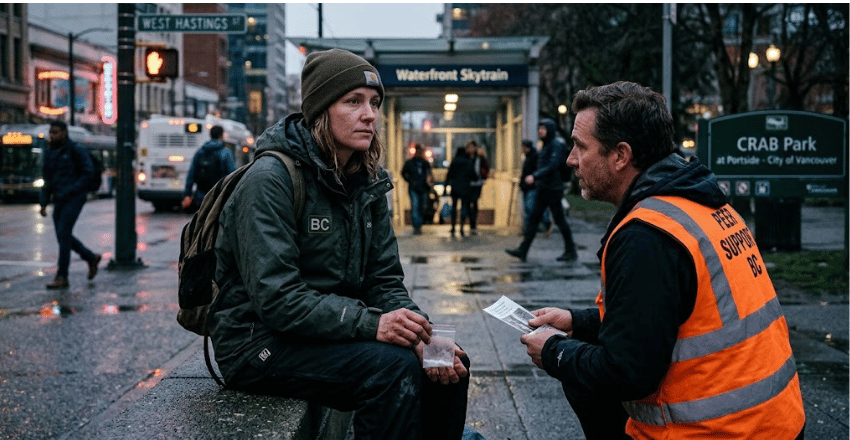
British Columbia ran the only decriminalization experiment of its kind in Canada. As of January 31, 2023, adults there could carry up to 2.5 grams of certain substances without facing a criminal charge, under a federal exemption granted by Health Canada.
It narrowed fast. Ottawa removed public use from the exemption on May 7, 2024, following complaints about parks and transit stations. That exemption then expired on January 31, 2026. British Columbia never asked to renew it, so ordinary section 4 rules apply right across the country again.
Provincial policy moved; the statute never did. For how other offences work across the provinces, browse our Canadian criminal law explainers.
Charter section 8 and how the search happened
Section 8 of the Charter protects everyone in Canada from unreasonable search and seizure. In a CDSA prosecution, the search is often the whole case, because the substance is the evidence. Take the substance out and nothing is left to prove.
Judges work through two questions. Did a law authorize the search, and did police carry it out in a reasonable way? A traffic stop that slides into a pat-down, a sniffer dog deployed on a hunch, a warrant resting on stale information: any of those can fail.
A breach does not end the prosecution by itself. Under section 24(2) of the Charter, the judge decides whether to exclude the evidence. That call weighs the seriousness of the police conduct, how badly your rights were violated, and society’s interest in a decision on the merits. Sometimes the evidence stays in. On a bad breach, often it does not.
Cannabis follows a different Act
Cannabis left the CDSA in 2018. Adult possession and home cultivation now run under the Cannabis Act and provincial rules, with limits on public amounts and plant counts. Crossing those limits is still a criminal matter, but the sections and penalties described here do not govern it. If you want to go deeper, read The Complete Guide to Sexual Interference Under s.151.
What a conviction costs beyond the sentence
The sentence is often the smaller problem.
- A criminal record that surfaces on vulnerable sector checks and most employment screening.
- Refusal at the United States border, where officers treat a controlled substance conviction, and sometimes an admission alone, as a bar to entry.
- Immigration exposure for permanent residents, up to a removal order, where the offence constitutes serious criminality.
- Loss of a professional licence, and in some provinces a hit to your driver’s licence.
- A five-year wait after a summary conviction, or ten years after an indictable one, before you can apply for a record suspension. The Parole Board of Canada charges CA$50 to apply.
Much of this stays negotiable at the charge stage rather than after a plea. If police have arrested you, or a court date is coming, contact a defence lawyer before you say anything else.
Frequently asked questions about drug charges
Yes. British Columbia’s exemption expired on January 31, 2026. No other province has one. Police may still warn you, or refer you to a service, instead of laying a charge.
Trafficking is the act itself: selling, giving, transporting, delivering, or offering to do any of those. Possession for the purpose means holding the substance with that plan in mind. Both carry the same maximum.
A conviction will. A discharge is not a conviction, though the RCMP keeps the entry for one year after an absolute discharge and three years after a conditional one.
Only with a lawful power behind them. Stopping a car for a traffic violation does not, by itself, allow a search for substances. Police need consent, a warrant, a search incident to a lawful arrest, or some other recognized authority.
The Jordan framework caps most provincial court files at 18 months from charge to the end of trial, and superior court files at 30 months. Most possession matters finish well inside that.