
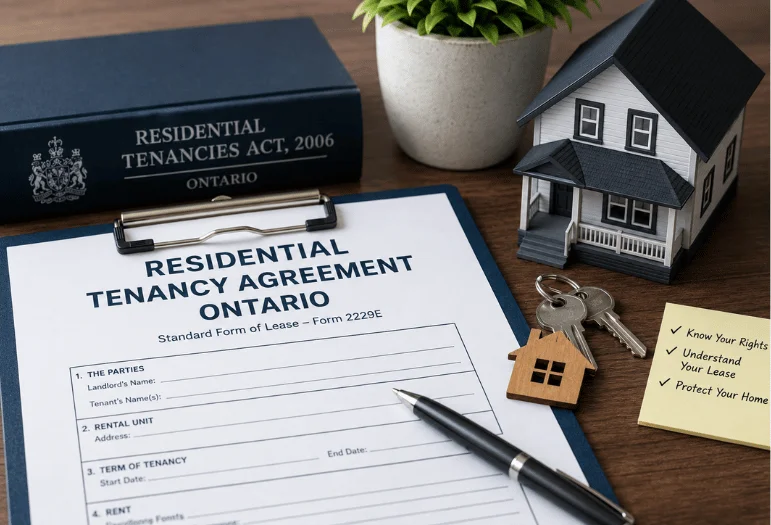
Ontario took the drafting pen out of landlords’ hands in 2018. Most private rentals in the province now run on one government template, and the Residential Tenancies Act, 2006, as Residential Tenancy Agreement Ontario, sits above that template, quietly cancelling anything that conflicts with it. Knowing which lines of your lease are real and which are decoration is worth actual money.
A residential tenancy agreement that Ontario landlords sign for most private units must be the province’s standard lease, Form 2229E. Any clause that strips a tenant of a statutory right is subject to the Act. If your landlord never handed you one, you can demand it in writing and withhold a month’s rent.
| Clause you might see | Does it hold up? | What governs instead |
| “No pets allowed in the unit.” | No, void. | The Act: only a condominium’s own rules can restrict animals. |
| “Damage deposit: half a month’s rent” | No, and refundable | Only a rent deposit and a refundable key deposit are permitted. |
| “Deposit may be applied to repairs.” | No | The deposit covers the final rental period, nothing else. |
| “The tenant is responsible for all repairs.” | No, void. | The repair duty stays with the landlord. |
| “Rent rises 5% at renewal.” | Only up to the guideline | The 2026 guideline of 2.1%, on 90 days’ written notice |
| “Tenancy ends on the last day of the term.” | Not on its own | The tenancy rolls into a month-to-month arrangement. |
Key Takeaways
- Form 2229E is mandatory for most private tenancies first entered into on or after April 30, 2018.
- Care homes, mobile home park sites, land lease communities, co-operative housing, and most social and supportive housing sit outside the requirement.
- A written demand starts a 21-day clock. Miss it, and the tenant may withhold one month’s rent.
- Thirty days later, with still no lease, that withheld month becomes the tenant’s to keep.
- Rent deposits pay for the last rental period. They never pay for damage, and they earn interest every year.
- Nothing on the additional terms page can take away a right the Act grants.
The Residential Tenancy Agreement Ontario Landlords Must Use
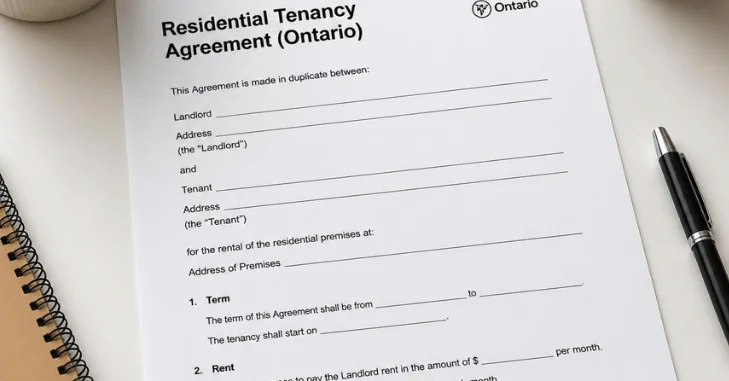
Form 2229E carries the plain title “Residential Tenancy Agreement (Standard Form of Lease).” Ontario’s Ministry of Municipal Affairs and Housing publishes it in English and French, with translated guides in roughly twenty other languages. It runs to seventeen numbered sections covering the parties, the unit, the term, rent, services, the rent deposit, the key deposit, smoking, insurance, maintenance, subletting, and the additional terms page.
Version matters. Agreements signed on or after March 1, 2021, need the December 2020 edition, so a landlord working from a 2018 printout is already offside. Once both parties sign, the landlord has 21 days to give the tenant a copy. After signing, neither side can rewrite a term alone; section 16 of the form requires the landlord and tenant to agree to any change in writing.
One line near the top of the document deserves reading twice: this agreement cannot take away a right or responsibility under the Residential Tenancies Act, 2006. That single sentence is why so much of what follows works the way it does.
Who Is Covered, and Who Is Exempt?
Most private residential tenancies first entered into on or after April 30, 2018, fall under the requirement. Apartments, houses, basement units, and condominium units rented out by their owners—all of them fall under it.
Ontario carves out several categories. Care homes are exempt. So are sites in mobile home parks and land lease communities, most social and supportive housing, co-operative housing, and a handful of other special tenancies. Living in an exempt unit does not mean living outside the Act, though. Ontario’s Act still governs that tenancy, and the landlord still owes new tenants the government’s information package about rights and responsibilities.
One point trips people up constantly. A unit first occupied for residential purposes after November 15, 2018, escapes the annual rent increase guideline, and tenants often assume it escapes the standard lease, too. It does not. Rent control and the standard form are separate rules, and a brand new condominium tower needs Form 2229E just as much as a 1960s walk-up.
The Rent Deposit: One Month, Last Month, Interest Every Year
Section 8 of the form lets the landlord collect a rent deposit, and the Act caps it hard. Where rent is monthly, the deposit cannot exceed one month’s rent. Where rent is weekly, it cannot exceed one week’s rent. The collection has to happen at or before the start of the tenancy, so a demand for a deposit six months in advance carries no force.
What the money can do is narrow. It pays the rent for the last rental period of the tenancy, full stop. It cannot cover a scratched floor, a missing blind, unpaid utilities, or an arrears balance from March. A landlord seeking compensation for damage applies to the Landlord and Tenant Board during the tenancy. Once a former tenant has moved on, that claim usually belongs in Ontario’s Small Claims Court process instead.
Interest is the part landlords forget, and tenants rarely ask about. Your landlord owes you interest on the deposit every year, and the Act pegs that rate to the rent increase guideline. According to the Government of Ontario, the rent increase guideline for 2026 is 2.1%, down from 2.5% in 2025. On a CA$2,400 deposit, that is CA$50.40 owed for the year. Landlords may apply the interest to top up the deposit when rent rises, but they cannot simply pocket it.
Section 9 permits one more payment: a refundable key deposit, and only to cover the cost of replacing keys, remote entry devices, or cards that come back missing. Charge more than the replacement cost, and it stops being a key deposit. A tenant chasing an illegal charge or unpaid interest files a T1, the Tenant Application for a Rebate. Filing costs CA$53, or CA$48 through the Tribunals Ontario Portal, and the Act allows one year from the day the money changed hands.
Clauses That Are Void Even Though You Both Signed
Signatures do not rescue an illegal term. Ontario’s Act voids it, and the Board treats it as though it were never written.
No-pet terms
A tenancy agreement cannot prohibit animals in the rental unit or in or around the residential building. That wording comes straight from the government’s own appendix to the form. Two qualifications apply. Condominium declarations and rules can restrict animals, and the landlord passes those rules along rather than inventing them.
The Board can also order an eviction where an animal does real harm. Property damage counts, as does serious interference with other residents, a severe allergic reaction, or an inherently dangerous breed. The clause is dead. The behavior still counts.
Deposits, fees, and penalties
Ontario permits the rent deposit and the refundable key deposit. Everything else is an illegal charge. Damage deposits, security deposits, and pet deposits all fail. So do cleaning fees, redecorating fees, late-payment penalties, and a charge for signing the lease itself. None of them survives contact with the Act, whatever the paperwork says. Landlords also cannot require post-dated cheques or automatic debit as a condition of renting, though a tenant may offer them. Our guide to Renew Security License in Ontario 2026 covers this in more detail.
Anything that contracts out of the Act
This is the catch-all, and it swallows the creative terms. A clause making the tenant responsible for the landlord’s repair obligations is void. So is one banning guests or overnight visitors, one banning roommates, one waiving the tenant’s right to a hearing, and one letting the landlord enter whenever it suits. Entry rules come from the Act, not from the lease, and they normally mean 24 hours of written notice.
No Standard Lease? The 21-Day Demand and What Follows
Tenants who never received the form have a specific remedy, and it rewards doing things in order.
- Ask in writing. Email or a text message works, but keep the copy. A verbal request does not start the clock.
- Count 21 calendar days. That is the landlord’s window to produce the standard lease.
- Withhold one month’s rent. If nothing arrives, you may hold back a single month, never more, and you must keep paying rent normally after that.
- Count 30 more calendar days. Still nothing? The withheld month is yours to keep.
- Consider leaving early. Where no standard lease appears, special rules let a tenant end a fixed term on 60 days’ notice. If the landlord does eventually produce the form and you dislike its terms, give that notice within 30 days of receiving it.
Two limits are worth naming. This remedy belongs to tenancies that qualify for the standard lease, so an exempt tenant cannot use it. And it does not reach back to agreements entered into before April 30, 2018.
Section 15: What Legitimately Goes on the Additional Terms Page
This page is not a trap. It exists for genuine specifics that the template cannot anticipate, and a well-drafted page saves arguments later. Useful entries name specifics. Which parking space belongs to the unit? Who clears snow from the driveway of a rented house? Quiet hours in a shared building, the laundry schedule, and the condition the landlord will leave the unit in before move-in. Smoking rules have their own home in section 10, so they need no repeating here.
Some units touch other legislation, from short-term rental licensing to accessibility duties. Landlords sometimes reference those obligations on this page, and our Ontario law explainers cover several of them. The test is simple. Does the term add a specific thing, or does it subtract a right? Adding is fine. Subtracting is void, and the term simply falls away while the rest of the lease survives.
When the Term Ends, the Tenancy Carries On
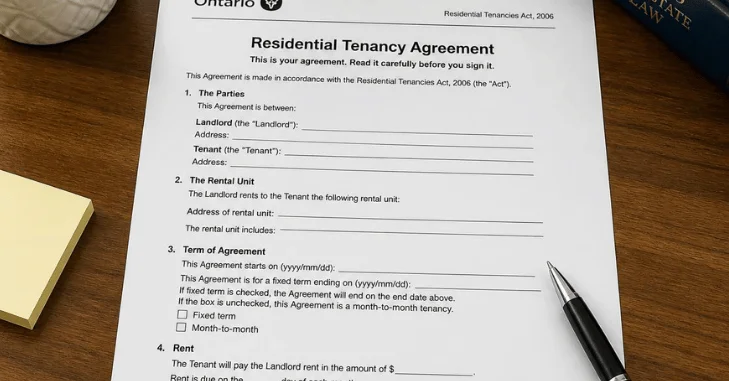
This is the most misunderstood rule in Ontario rental law. Reaching the end of a one-year term does not end the tenancy, and it obliges nobody to move out or sign anything. Unless the parties agree otherwise, the tenancy automatically becomes month-to-month on the same terms, at the same rent, with the same rights.
No landlord can demand that a tenant sign a fresh fixed term as a condition of staying, and a tenant who declines has not done anything wrong. Both sides may agree to a new fixed term if they genuinely want one. Rent can still move. Your landlord may raise it once every twelve months, using form N1, with at least 90 days’ written notice before the increase takes effect. A tenant who wants out gives 60 days’ written notice on form N9, timed to end on the last day of a rental period. Neither side needs the lease’s expiry date to do any of this.
Conclusion
A Residential Tenancy Agreement Ontario landlords use is more than a signed piece of paper. The standard lease must work within the Residential Tenancies Act, 2006, and any term that conflicts with a tenant’s statutory rights may be unenforceable. Before signing, check that you have the correct Form 2229E, review the rent and key deposits, and read the additional terms carefully. For a closer look at this, see BC Tenancy Agreement.
If your landlord has used an outdated form, added an illegal clause, or failed to provide the standard lease after a written request, document the issue and Act within the applicable deadlines. Because every tenancy can involve different facts, exemptions, and legal risks, seek legal advice for your specific tenancy before withholding rent, ending a fixed-term agreement, challenging a lease term, or taking other formal action.
Before You Sign or Send That Demand
Read the lease against the Act rather than against your expectations. Check the version date, count the deposits, and treat the additional terms page as the only place where surprises can hide. If a clause worries you or a landlord has ignored a written demand for the standard form, get advice before the money moves. Reach the Lawverra team here to talk through your situation.
Frequently Asked Questions
Homemade leases can still create a valid tenancy, and you cannot ignore rent obligations because the paperwork is wrong. What it cannot do is beat the Act. Demand the standard form in writing and run the 21-day process.
Yes. An oral agreement creates a real tenancy with full protection under the Act. You can still demand the standard lease in writing, and the same timelines apply.
No. Neither exists in Ontario law. If you already paid one, you can ask for it back and apply to the Board if the landlord refuses.
Raise it in writing. The December 2020 version applies to agreements signed on or after March 1, 2021. A landlord who cannot produce a compliant standard lease within 21 days of your written request faces the withholding remedy.
No. Your tenancy continues month to month automatically. Only a Board order or your own 60-day notice ends it.