
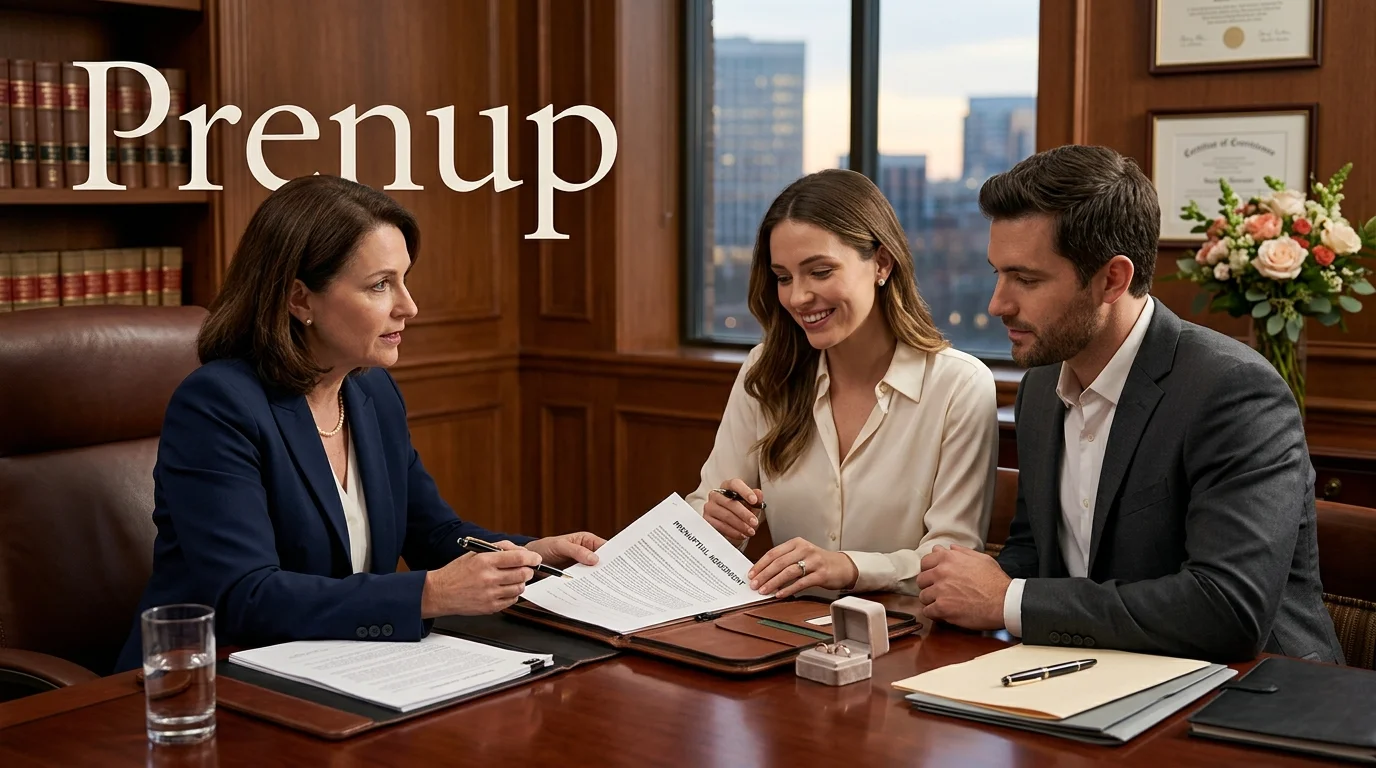
A prenup is a written agreement that lets a couple set financial rules before marriage rather than relying only on provincial family law after separation. In Ontario, the legal term is “marriage contract”. It can address property and support, but strict limits apply to children and matrimonial-home rights. Our guide to What Is a Prenup in Canada covers this in more detail.
Because family property rules are primarily provincial, the details differ across Canada. This guide focuses on Ontario and explains the principles Canadian couples should review before signing. For the full picture, read NDA in Canada.
| Question | Practical answer |
|---|---|
| What is it called in Ontario? | A marriage contract under the Family Law Act |
| When can it be signed? | Before or during marriage |
| What can it cover? | Property ownership, division of property, debts, and spousal-support terms |
| What formalities are required in Ontario? | It must be written, signed by both parties, and witnessed |
| Is separate legal advice mandatory? | It is not a formal signing requirement, but it can make a later challenge harder. |
| Can it permanently decide parenting or child support? | No. Courts retain authority over children and can disregard unsuitable terms |
| Can it remove matrimonial-home possession rights? | No. Ontario law limits that power |
Key takeaways
- Ontario treats the agreement as a marriage contract under section 52 of the Family Law Act.
- The contract must be written, signed, and witnessed to meet Ontario’s statutory form requirements.
- Full financial disclosure matters because serious non-disclosure can support a later application to set the agreement aside.
- Each partner should consider obtaining separate legal advice before signing.
- Parenting arrangements and child support cannot simply be locked in years in advance.
- Couples should start the process early enough to allow time for disclosure, negotiation, and independent review.
What a marriage contract means in Canada
Canadian couples sometimes assume there is one national set of rules for prenuptial agreements. There isn’t. Property division and domestic contracts are largely governed by provincial or territorial law.
Ontario uses the term marriage contract. Section 52 allows people who are married or intend to marry to agree on their rights and obligations during marriage, on separation, on divorce, or on death.
That distinction matters if you move between provinces. A document prepared under Ontario rules should not automatically be deemed suitable for British Columbia, Alberta, Quebec, or any other jurisdiction.
People who are not married face a different starting point. Lawverra’s guide to common-law rights in Ontario explains why unmarried partners do not receive the same automatic property treatment as married spouses.
What can a prenup cover?
The agreement is primarily a financial planning document. In Ontario, couples can use a marriage contract to address property ownership and division, as well as support obligations. The Act also permits agreement on other matters related to their financial affairs.
Common subjects include:
- A home one person owned before marriage
- Savings and investment accounts
- Business interests or professional corporations
- Existing debts
- Future inheritances
- How jointly purchased property will be handled
- Whether certain property stays separate
- Spousal-support rights or limits
The contract can also help couples record what each person owned at the beginning of the marriage. That record may become valuable years later when memories are less reliable, and paperwork is less complete.
If you are living together but are not married, a different contract may be a better fit. Lawverra’s cohabitation agreement guide explains the Ontario rules for unmarried couples.
What it cannot safely decide

A marriage contract gives couples substantial freedom, but it does not place every future family law issue under private control. Ontario law states that a marriage contract cannot deprive a spouse of rights under Part II of the Family Law Act regarding possession of the matrimonial home.
Children are another important consideration. Courts can disregard domestic contract provisions concerning children when a child’s best interests require a different result. They can also disregard unreasonable child-support terms.
For that reason, don’t treat the document as a permanent parenting plan. A couple cannot reliably decide today what custody, decision-making responsibility, parenting time, or child support must look like years from now.
What makes an Ontario agreement more likely to hold up
Section 55 of Ontario’s Family Law Act sets the basic formal requirements. A domestic contract must be in writing, signed by the parties, and witnessed. Meeting those three requirements is only the starting point.
Section 56 gives courts the power to set aside a domestic contract in certain circumstances. Important concerns include failure to disclose significant assets or debts and a party’s failure to understand the nature or consequences of the agreement. Ordinary contract-law grounds can also matter.
Four practical safeguards reduce those risks:
- Exchange meaningful financial disclosure. List major assets, debts, income sources, businesses, pensions, investments, and real estate.
- Use separate legal advice. Each person should have the opportunity to discuss the document privately with their own lawyer.
- Avoid last-minute signing. Starting too close to the wedding can create pressure and leave too little time for review.
- Write clear terms. The contract should explain how the rule works, not merely state that an asset is “protected.”
Independent legal advice is not listed as a formal requirement in section 55. Still, it can provide strong evidence that each person understood the agreement and signed it voluntarily.
A practical asset map before you draft
One useful step is to classify your finances before discussing contract language.
| Asset or obligation | Question to answer before drafting | Issue to discuss |
|---|---|---|
| Condo owned before marriage | Who owns it now, and is there a mortgage? | Future equity and matrimonial-home rules |
| Private business | Who owns the shares, and how is the value measured? | Growth in business value |
| Inheritance | Has it been received, or is it expected later? | Separate-property treatment and tracing |
| Student or consumer debt | Whose name is on the debt? | Responsibility after separation |
| Joint savings | Who contributes, and for what purpose? | Ownership and division |
| Pension or investments | What is the current value? | Growth during marriage |
This exercise often reveals where the real disagreement lies. The contract can then focus on those issues rather than filling pages with clauses neither person needs.
Costs and timing in Ontario
There is no single government-set fee for preparing a marriage contract. Legal costs depend on asset complexity, negotiation, financial disclosure, and the amount of work each lawyer must do.
Published Ontario cost guides from 2026 show a wide range of fees. Some place lawyer-drafted agreements in the low thousands, while complex arrangements involving businesses or extensive negotiations can cost far more. Those figures are market estimates, not regulated prices.
Ask each lawyer what the quoted fee includes. Check whether drafting, revisions, financial-disclosure review, signing, and independent legal advice are charged separately.
There is also no statutory deadline requiring a contract to be signed a fixed number of days before the ceremony. Still, starting weeks or months ahead gives both partners more time to review the terms without wedding-day pressure.
Couples who are still planning the ceremony can also review Lawverra’s guide to getting a marriage licence in Ontario.
Which agreement fits your relationship?
| Your situation | Agreement commonly used in Ontario | Key point |
|---|---|---|
| You plan to marry | Marriage contract signed before marriage | Sets financial rules before the wedding |
| You are already married | Marriage contract signed during marriage | Section 52 permits agreements during marriage |
| You live together unmarried | Cohabitation agreement | Designed for unmarried partners |
| You are separating | Separation agreement | Deals with rights after the relationship has broken down |
Ontario law says that a cohabitation agreement normally becomes a marriage contract if the couple later marries.
If separation has already started, drafting a pre-marriage agreement is no longer the right task. Lawverra’s guide to a separation agreement in Ontario covers the rules that become relevant at that stage.
Before you sign: five checks that matter
First, make a full list of assets and debts. Include real estate, accounts, loans, pensions, corporate interests, and valuable property. Second, decide what outcome you want for each major asset. “Protect my business” is too vague. Ask what happens to its current value, future growth, income, and the interests of any spouse who works in the company.
Third, exchange financial information before final terms are settled. A hidden account can create a much larger problem than an awkward conversation today. Fourth, give each person enough time to obtain separate advice. The purpose is not to create two opposing teams. It is to make sure both people understand what they are accepting.
Fifth, keep the signed agreement and supporting disclosure records in a secure location. A contract is much easier to rely on when the documents used to create it still exist.
Your next step
Start with documents, not contract wording. Create a current list of property, accounts, debts, businesses, pensions, and expected inheritances. Then write down which items you want treated differently from Ontario’s default rules.
Take that list to an Ontario family lawyer and ask what the proposed terms would mean in practice. Your partner should have a genuine opportunity to obtain separate advice before anything is signed.
Frequently asked questions
It can be enforceable when it complies with Ontario law. The basic statutory requirements are that it be in writing, signed, and witnessed. Courts can still set an agreement aside in circumstances such as serious financial non-disclosure or a lack of understanding.
There is no fixed legal fee. Published 2026 estimates range from the low thousands for simpler lawyer-drafted agreements to much higher amounts for complex assets or prolonged negotiations. Get a written quote explaining exactly what is included.
Ontario’s statutory signing rules do not expressly require two lawyers. Separate independent legal advice is still strongly recommended because it helps show that each party understood the contract and had an independent opportunity to assess its consequences.
Yes. Ontario’s Family Law Act allows a marriage contract between two people who are already married or intend to marry.
Under section 53 of the Ontario Family Law Act, a cohabitation agreement is generally deemed to become a marriage contract after the partners marry each other.