

The search term “lease agreement Ontario” usually refers to Ontario’s Residential Tenancy Agreement, also called the Standard Form of Lease. For most private residential tenancies, landlords must use the government form rather than replace it with a homemade contract. The terms must also comply with the Residential Tenancies Act, 2006, and Lawverra’s Ontario and Canadian law guides set out how that statute frames a tenancy.
Short answer: For most private residential rentals in Ontario, landlords must use the province’s Standard Form of Lease, Form 2229E. The lease cannot remove rights under the Residential Tenancies Act, 2006. Check the rent, deposits, utilities, additional terms, and renewal rules before signing because an illegal clause does not become enforceable simply because both sides signed it.
| Key point | Ontario rule |
| Main residential form | Residential Tenancy Agreement, Form 2229E |
| Current form for new agreements | December 2020 edition for agreements entered into on or after March 1, 2021 |
| Governing law | Residential Tenancies Act, 2006 |
| Rent deposit | Up to one rental period, capped at one month |
| Damage or pet deposit | Not permitted as a security deposit |
| Copy after signing | Landlord must provide the tenant with a copy within 21 days. |
| Fixed-term expiry | Tenancy normally continues rather than ending automatically. |
| 2026 rent guideline | 2.1% for covered units |
Ontario’s government guide confirms that most residential tenancy agreements made since April 30, 2018, must use the standard form. The updated December 2020 edition applies to most new agreements entered into on or after March 1, 2021.
Lease Agreement Ontario: Which Form Do You Actually Need?
Lease agreement Ontario: The document most landlords need is Ontario’s Residential Tenancy Agreement (Standard Form of Lease), Form 2229E. Ontario’s guide to the standard lease confirms that the December 2020 edition of Form 2229E applies to tenancy agreements entered into on or after 1 March 2021.
The form is mandatory for most private residential rentals. Common examples include apartments, rented houses, basement units, and individually rented condominium units.
Several types of housing fall outside the standard-form requirement. These include care homes, mobile-home park sites, land-lease communities, most social and supportive housing, certain special tenancies, and co-operative housing.
A tenancy can still exist when the correct form was not used. Ontario tenancy law may apply even when an agreement is oral or a landlord uses different paperwork. The missing form does not erase the tenant’s duty to pay lawful rent.
The Standard Lease and OREA Form 400 Are Not the Same Document
This distinction can be confusing when a real estate agent handles the rental.OREA Form 400 is called an Agreement to Lease. It can be used during the offer and negotiation stage to record proposed terms between a landlord and a prospective tenant.
Guidance explaining OREA Form 400 describes the government lease as the formal document that follows the negotiated agreement. It does not replace Ontario’s government Standard Form of Lease where that form is legally required.
If a realtor gives you Form 400, read its conditions carefully. Then confirm that the tenancy will also be documented using Form 2229E when Ontario law requires it.
What Goes Into the Ontario Standard Lease?
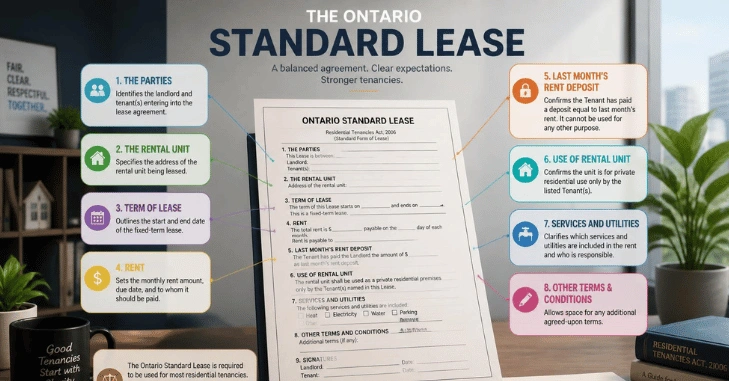
Form 2229E contains 17 numbered sections. They cover the parties, rental unit, landlord contact details, tenancy term, rent, services, utilities, discounts, deposits, smoking, tenant insurance, maintenance, assignment, subletting, additional terms, changes, and signatures.
Pay close attention to the total lawful rent. Parking, storage, or another landlord-provided service may be included in the total amount recorded in the lease.
The utilities section should also state who pays for electricity, heat, and water. A vague promise made before signing can lead to a dispute later if the written lease says something different.
Section 15 deserves a second reading. It allows additional terms specific to the property. Those terms still cannot take away a right or responsibility created by the Residential Tenancies Act.
Clauses That Can Be Invalid Even After You Sign
A signature does not make every rental clause enforceable.
| Clause or charge | General Ontario position |
| Blanket “no pets” clause | Generally void, subject to issues such as condominium rules and other lawful restrictions |
| Pet deposit | Not permitted as a security deposit |
| Damage or security deposit | Not permitted |
| Tenant must pay for every repair. | Cannot transfer the landlord’s statutory maintenance duties |
| No guests or roommates | A blanket term that removes statutory rights is unenforceable. |
| Landlord may enter whenever desired. | Entry remains governed by Ontario tenancy law. |
| Mandatory post-dated cheques | Cannot be required as a condition of the tenancy |
Ontario’s standard-lease guide specifically identifies terms banning pets, guests, roommates, or additional occupants as examples of terms that may be void. It also identifies prohibited deposits and clauses that shift the landlord’s repair responsibilities to the tenant.
The Residential Tenancies Act also states that neither a landlord nor a tenancy agreement can require post-dated cheques or automatic account debiting as the required method of paying rent.
Rent Deposits, Key Deposits and Rent Increases
Ontario allows a rent deposit, but the amount is subject to a strict ceiling.Section 106 of the Residential Tenancies Act caps it at the lesser of one rental period or one month’s rent. The landlord must apply that money to the final rental period rather than treating it as a damage fund.
Interest is payable on a rent deposit each year at the applicable rent-increase guideline rate. For rent increases taking effect in 2026, Ontario’s guideline is 2.1%. The government has listed a 1.9% guideline for 2027.
A refundable key deposit may also be permitted. It should relate to the expected replacement cost of the keys, remote, or entry device rather than operate as another security deposit.
Rent increases follow rules that are separate from lease renewal. For covered units, a landlord must normally wait at least 12 months between increases and provide the required notice. Some newer units are exempt from the annual guideline cap, but that does not automatically exempt them from the standard-lease requirement.
What If the Landlord Never Gives You the Standard Lease?
Tenants who qualify for the standard form must follow a specific process when the landlord has not provided it.
Step 1: Request it in writing. Keep a copy of the request.
Step 2: Wait 21 days. The landlord has 21 calendar days from receipt of the written request to provide the standard lease.
Step 3: Withhold one month’s rent if the lease is still missing. You cannot keep withholding rent month after month.
Step 4: Watch the next 30 days. If the landlord supplies the lease within 30 days after you withhold the rent, you must repay the withheld amount.
Step 5: If the form still does not arrive, the rules may allow you to keep that one month of withheld rent. Certain tenants may also gain the right to end a fixed-term tenancy with 60 days’ notice.
Because withholding rent can create serious consequences when the rules are applied incorrectly, confirm that your tenancy qualifies before using this remedy.
A One-Year Lease Does Not Usually Mean You Must Leave After One Year
A fixed end date often causes unnecessary concern.Ontario’s standard lease guide states that the end of a fixed term does not automatically require the tenant to move out or sign another agreement. If the original agreement was for a fixed term, the tenancy normally continues on a month-to-month basis after that term ends.
The existing terms continue, subject to lawful changes such as a valid rent increase.A landlord cannot treat the printed expiry date alone as an eviction order. Ending a tenancy requires one of the lawful routes under Ontario tenancy legislation.
Seven Things to Check Before Signing
- Confirm that you received the current government Standard Form of Lease when it applies.
- Check all landlord and tenant names for accuracy.
- Confirm the unit, parking space, storage, and other included areas.
- Review the total rent, payment date, utilities, and included services.
- Check that deposits are limited to amounts Ontario law permits.
- Read every additional term and question anything that appears to remove a statutory right.
- Keep a complete signed copy, including attached schedules and additional terms.
This simple review is often more useful than reading only the first page.For broader legal information, Lawverra maintains its Ontario and Canadian law guides.
What Happens When a Rental Dispute Becomes a Money Claim?
Most residential tenancy disputes are heard by the Landlord and Tenant Board rather than the ordinary civil courts.
The Board now has Form L10 for certain claims against former tenants. A landlord may use it for rent, utilities, property damage, and certain other amounts when the former tenant moved out within the permitted filing period. The LTB currently states that it can order up to CA$50,000 on an L10 claim.
A larger claim may have to proceed through the courts instead. Lawverra’s guide to Small Claims Court in Ontario explains the current CA$50,000 ceiling.
Claims that exceed that ceiling or fall outside the LTB’s jurisdiction can raise different procedural questions. Lawverra also explains Ontario’s Rules of Civil Procedure for Superior Court matters.
Before You Sign
Use the government form, read every additional term, and keep a complete copy of everything everyone signed. If a proposed clause affects deposits, pets, entry, repairs, eviction, or the right to remain after a fixed term, compare it with the Residential Tenancies Act before relying on it.
Conclusion
A lease agreement Ontario is more than a private contract between a landlord and tenant. For most residential rentals, the Residential Tenancy Agreement (Standard Form of Lease) must be used, and the terms of the agreement must comply with Ontario’s Residential Tenancies Act, 2006. Signing a lease does not make an otherwise unlawful clause enforceable.
Before signing, both parties should carefully review the rent, utilities, deposits, included services, additional terms, maintenance responsibilities, entry provisions, and tenancy dates. Tenants should also understand that a fixed-term lease generally does not automatically mean they must move out when the stated term ends. In many situations, the tenancy continues on a month-to-month basis.
Frequently Asked Questions
Use Ontario’s official Central Forms Repository and look for Residential Tenancy Agreement, Form 2229E. For most new residential tenancies covered by the standard-lease rules, the December 2020 edition is the current government form.
A landlord may agree on property-specific additional terms, but most covered residential tenancies require the government Standard Form of Lease. Extra terms cannot override the Residential Tenancies Act.
A tenancy may still exist without a written standard form. The tenant can request the required standard lease in writing when the tenancy qualifies for it.
Ontario law permits a rent deposit of up to one rental period, capped at one month. That deposit is applied to the final rental period. Rent that is currently due is separate from the deposit.
A blanket no-pet term is generally void under Ontario residential tenancy law. Condominium rules and situations involving safety, allergies, damage, or serious interference can create separate issues.
Usually, no. A fixed-term tenancy generally continues on a month-to-month basis after the fixed period ends unless it is lawfully terminated or the parties choose another arrangement.