
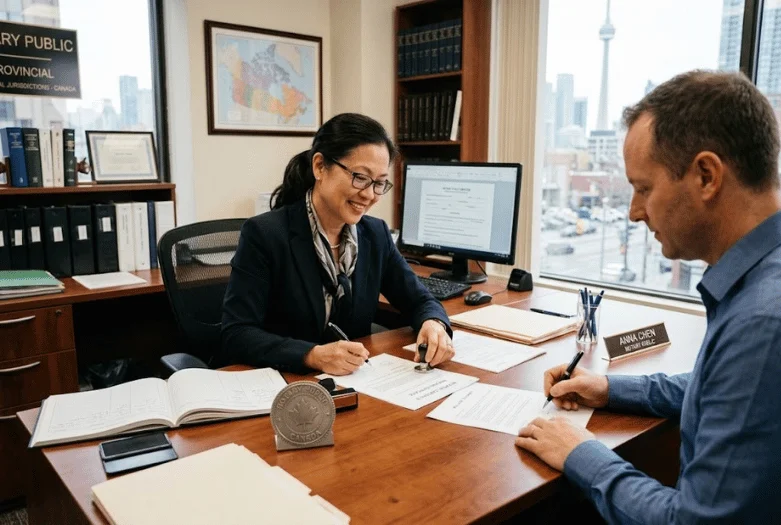
If you are asking what is a notary public, the answer depends partly on where you live in Canada. A notary is legally authorized to witness certain signatures, receive sworn statements, and certify copies of original documents. Provincial and territorial law controls the appointment, powers, and limits of the role.
| Question | Short answer |
|---|---|
| Main role | Verify signatures, witness documents, receive sworn statements, or certify copies where authorized |
| Common documents | Affidavits, statutory declarations, consent letters, powers of attorney, contracts, and certified copies |
| Same as a commissioner? | No. A commissioner usually has narrower powers |
| Same as a lawyer? | Not always. The answer varies by province |
| Rules across Canada | Provincial and territorial rules differ |
| International use | Notarization may be followed by authentication or an apostille |
A Canadian notary is an authorized legal witness who performs specific acts required for documents. These acts can include witnessing signatures, administering oaths, receiving affidavits, and certifying true copies. Their exact authority depends on provincial or territorial law, so the receiving organization’s instructions should guide your choice.
Key Takeaways
- Notarization confirms a legal formality, not whether every statement in a document is true.
- A commissioner for oaths can handle many sworn documents but may have narrower authority.
- British Columbia gives its notaries a broader legal-services role than many provinces.
- Quebec notaries are members of a distinct civil-law profession.
- Documents used abroad may need an apostille after notarization.
- Always check the receiving organization’s wording before booking an appointment.
What Is a Notary Public in Canada?
A notary public is a person authorized under provincial or territorial law to perform defined notarial acts. Canada’s federal glossary describes the role as an official witness for legal documents. It also states that a notary can certify copies of original documents.
The appointment does not give unlimited legal authority. What they can do depends on the province, the person’s appointment, and the document involved. This is why a service available in Vancouver may differ from one available in Toronto.
What Does a Notary Do?
A notary checks identity, observes required signatures, and completes the formal certificate or seal for the act. The officer may also administer an oath or affirmation when the document requires one. The purpose is to create reliable evidence that the required signing process occurred.
Common services include the following.
- Witnessing signatures on contracts, declarations, and consent documents.
- Administering oaths or affirmations for affidavits.
- Receiving statutory declarations where authorized.
- Certifying a photocopy as a true copy of an original.
- Completing notarial certificates for documents intended for another jurisdiction.
- Notarizing supporting documents before an authentication or apostille request.
A seal does not prove that every factual claim inside the document is correct. The notary is usually verifying identity, execution, copying, or another stated formality. Anyone needing advice about legal consequences should speak with a qualified legal professional.
Which Documents Commonly Need Notarization?
The receiving organization decides whether notarization is required for a particular transaction. Government agencies, schools, banks, courts, foreign authorities, and private organizations may each set their own rules. Read the form instructions before paying for a service you may not need.
Typical examples include certified passport copies, academic records, affidavits, statutory declarations, and some powers of attorney. You may also notarize travel consent letters when a child travels without both parents. Lawverra’s Canadian travel consent letter guide explains that situation in more detail.
Not every important document needs a notarial seal. Ontario powers of attorney, for example, rely on statutory witness rules rather than mandatory notarization. Lawverra’s Ontario power of attorney guide explains the separate witness requirements.
Notary, Commissioner for Oaths, or Lawyer?
These roles overlap, but they are not interchangeable. A commissioner usually focuses on oaths, affirmations, affidavits, and declarations within the authority granted by law. A lawyer may provide legal advice and representation, while notarial authority is a separate legal function.
| Role | Typical function | Can certify true copies? | Gives legal advice? |
|---|---|---|---|
| Notary | Witnessing, oaths, certified copies, notarial acts | Often, where authorized | Only if separately authorized to practise law |
| Commissioner for oaths | Oaths, affidavits, affirmations, declarations | Usually not under commissioner authority alone | Not because of commissioner status |
| Lawyer | Legal advice, drafting, representation | Depends on notarial appointment and local law | Yes, within professional scope |
Ontario makes the distinction especially clear. Its government says a notary has commissioner powers and can also verify signatures and certify true copies. Lawverra’s Ontario affidavit guide explains when that broader authority matters for sworn documents.
How Provincial Differences Change the Answer
Canada has no single national notary statute. Provinces and territories determine who can be appointed and what each appointment allows. Three examples show why national summaries need careful wording.
Ontario
Ontario separates notaries from commissioners for taking affidavits. A notary can perform commissioner functions and can also certify true copies and verify signatures. Current provincial guidance also limits non-lawyer appointments.
Ontario changed several appointment rules in 2026. Non-lawyer and non-paralegal appointments now generally run for ten-year terms. The province also states that remote notarization is not permitted under current notarial rules.
British Columbia
British Columbia has a distinct profession of notaries governed by provincial legislation. Members can provide several non-contentious legal services within their authorized scope. Those services can include real-estate transfers, wills, powers of attorney, and notarization work.
This makes the B.C. role broader than the basic witnessing model many Canadians expect. Section 18 of British Columbia’s Notaries Act, RSBC 1996, c. 334, sets out those rights and powers for members in good standing. Litigation and courtroom advocacy remain outside the ordinary B.C. notarial practice.
Quebec
Quebec notaries belong to a separate civil-law legal profession. They provide legal advice, draft authentic acts, and act as public officers recognized by the province. Their work can include real estate, succession, family, and other non-contentious legal matters.
A Quebec notary should not be treated as the same as a common-law provincial notarial officer. Their training, professional status, and legal functions differ. Anyone dealing with Quebec documents should follow Quebec-specific instructions.
Notarization, Authentication, and Apostilles Are Different
Notarization is the act performed by the notary. Authentication verifies a public official’s signature or seal for international recognition. An apostille is a specific authentication certificate used under the Hague Apostille Convention.
Canada joined the Apostille Convention effective January 11, 2024. Alberta, British Columbia, Ontario, Quebec, and Saskatchewan issue apostilles for documents within their assigned jurisdiction. Global Affairs Canada handles eligible documents from other listed jurisdictions and federal sources.
The destination country decides whether authentication is needed. A notarized document does not automatically need an apostille, and an apostille does not replace every local requirement. Check the receiving authority before starting the process.
What to Bring to a Notary Appointment
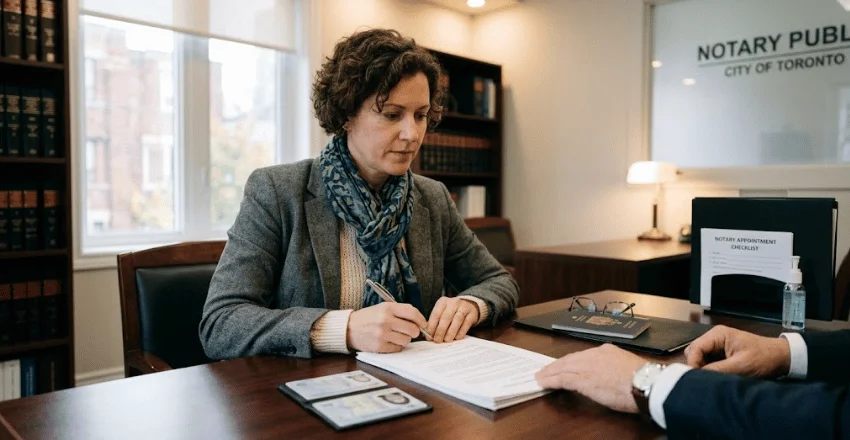
Preparation can prevent a second appointment. Bring the document, valid identification, and any instructions provided by the receiving organization. Do not sign early when the document requires the official to witness your signature.
Appointment checklist:
- Confirm whether the form requires a notary, commissioner, lawyer, or other official.
- Bring the original document when a true-copy certification is required.
- Bring valid government-issued identification that matches the name on the document.
- Keep signature lines blank when the signature must be witnessed.
- Bring any destination-country instructions for documents you will use abroad.
- Ask about fees before the appointment, because Canada has no single national notary fee.
The officer may refuse to proceed if required identity or signing conditions are not met. The receiving organization can also reject a document that uses the wrong type of certificate. Following the form’s exact language is usually the safest approach.
How Much Does Notarization Cost?
There is no single Canada-wide price for notarial work. Fees can vary by province, provider, document type, number of signatures, and number of certified copies. International-document work can also involve a separate authentication or apostille fee.
Ask for the total price before the appointment. Confirm whether taxes, extra copies, travel, after-hours service, or apostille assistance cost more. A low advertised stamp price may not represent the full transaction.
Can Notarization Be Done Online?
Remote rules depend on the province and the legal act involved. Do not assume that remote commissioning and remote notarization are the same service. A province may allow one while restricting the other.
Ontario is a clear example in 2026. Commissioners can perform qualifying remote commissioning under provincial rules, but Ontario says notaries cannot notarize documents remotely. Other provinces may use different rules, so check the current provincial authority.
Frequently Asked Questions
What is a notary public allowed to do compared with a lawyer?
The two roles are not the same across Canada. Some lawyers also hold notarial authority, while some jurisdictions recognize notaries through separate appointments or professions. Quebec and British Columbia are important examples of distinct notarial structures.
Does a notary make a document legally valid?
Not automatically. Notarization confirms the specific act described in the notarial certificate, such as witnessing or copy certification. The underlying document must still satisfy every law and rule that applies to it.
Can a notary certify a photocopy of my passport?
Often, yes, when provincial law and the receiving organization allow certified true copies. The notary normally compares the copy with the original before certifying it. Some authorities may still demand an original or a government-issued certified copy.
Do I need a notary for an affidavit?
Sometimes, but a commissioner may be enough. The correct official depends on the governing law and the wording on the form. For Ontario-specific affidavit rules, Lawverra’s affidavit guide explains them in detail.
Do Canadian documents always need an apostille for use abroad?
No. The destination authority decides whether an apostille or another authentication step is necessary. Global Affairs Canada recommends confirming the requirement before submitting documents.
Before You Book an Appointment
Start with the wording on the document and the receiving organization’s instructions. Then confirm the current rules in the province or territory where the act will occur. This approach reduces the risk of paying for the wrong service.
This article provides general legal information for Canada and is not legal advice. Rules can differ by province, territory, document, and receiving institution. Seek qualified advice when the document affects significant rights, property, immigration status, or a legal dispute.