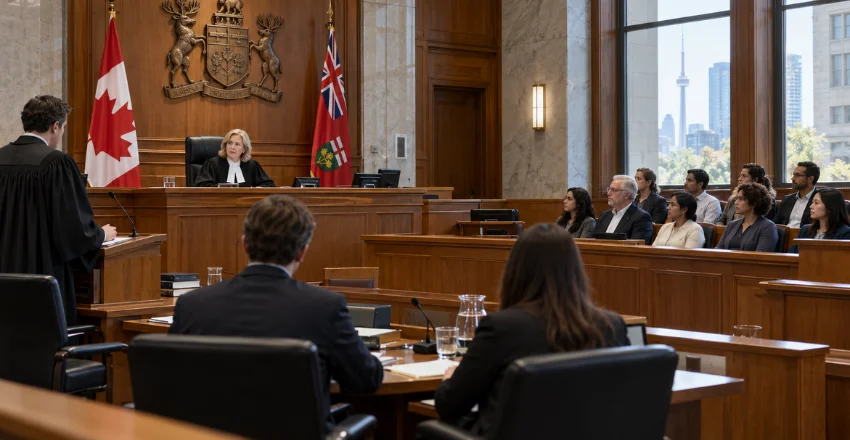

The rule of law is a basic principle of Canada’s constitutional system. It means governments, public officials, organizations, and individuals are all subject to law. No person or government can legally exercise unlimited or arbitrary power.
This principle affects far more than constitutional disputes between governments. It supports predictable laws, independent courts, legal accountability, and meaningful remedies when government exceeds its authority. For Canadians, it helps turn legal rights from written promises into enforceable protections.
Direct answer: The rule of law means everyone in Canada, including governments and public officials, is subject to the law. Government power must have legal authority and remain within constitutional limits. Courts can review government action, and clear, stable laws help people understand their rights, responsibilities, and available remedies.
| Key question | Canadian position |
|---|---|
| What does it mean? | Everyone, including government, is subject to law |
| Is it constitutional? | Yes. The principle is expressly recognized in the Charter’s preamble |
| Is the Constitution supreme? | Yes. Section 52(1) confirms its supremacy |
| Can governments act without legal authority? | Government action must remain within lawful authority |
| Who interprets and applies the law? | Independent courts and tribunals perform central roles |
| Does it protect individuals? | It helps protect people against arbitrary state action |
| Why does access to courts matter? | Rights are less effective when people cannot seek legal remedies |
Key Takeaways
- The law applies to private individuals and governments.
- Canada’s Constitution is the country’s supreme law.
- Government decisions must have lawful authority.
- Courts can review legislation and government conduct.
- Independent courts help prevent arbitrary exercises of state power.
- Predictable laws allow people and businesses to plan their affairs.
- Access to justice helps people enforce their legal rights.
- Constitutional rights can still have lawful and justified limits.
What Does the Rule of Law Mean in Canada?
At its simplest, the principle means that law governs the exercise of power. A public official cannot rely solely on personal preference or political authority. Government action must have a lawful foundation and respect applicable constitutional requirements.
The Supreme Court of Canada has described the principle as fundamental to Canada’s constitutional structure. It has also connected the concept with order, known legal rules, and government accountability. These features help protect people against arbitrary state action.
Predictability is another important part of the concept. People should generally be able to identify the rules governing their conduct before making important decisions. Consistent legal rules also help businesses, families, and organizations plan their affairs with greater certainty.
Where Does This Principle Appear in Canada’s Constitution?
The preamble to the Canadian Charter of Rights and Freedoms states that Canada is founded on principles recognizing this constitutional concept. That language places the principle directly within Canada’s constitutional framework. It also provides context for understanding how constitutional government operates.
Section 52(1) of the Constitution Act, 1982 adds another important protection. It states that the Constitution of Canada is the supreme law of Canada. A law inconsistent with the Constitution has no force or effect to the extent of that inconsistency.
This structure means ordinary legislation does not outrank the Constitution. Parliament and provincial legislatures exercise significant law-making powers, but those powers exist within constitutional boundaries. Courts can determine whether challenged legislation complies with those boundaries.
Three Core Parts of the Principle
Canadian courts have considered the principle in several major constitutional cases. Those decisions show that the concept involves more than the simple existence of written legislation. Three ideas are especially useful for understanding how it works.
1. Everyone Is Subject to Law
Government officials must follow the law alongside individuals and organizations. Holding public office does not create a general exemption from legal requirements. Government authority must come from a lawful source.
This protection matters when a public body makes a decision that affects someone’s rights or interests. Courts can review government decisions in circumstances recognized by law. Judicial review can examine whether the government exercised its legal authority properly.
2. Canada Needs an Actual System of Laws
A functioning legal order requires more than limiting government power. Society also needs laws to govern relationships, obligations, disputes, and public institutions. The Supreme Court addressed this issue directly in the Manitoba Language Rights Reference.
The Court found Manitoba’s unilingual legislation constitutionally defective because it failed to follow constitutional language requirements. Immediately invalidating the province’s laws, though, would have created a serious legal vacuum. The Court temporarily preserved their effect while Manitoba brought its legislation into constitutional compliance.
That solution shows an important dimension of the principle. Constitutional supremacy matters, but an effective system also needs a functioning legal order. Courts may therefore need remedies that protect both constitutional requirements and legal stability.
3. Government Must Remain Constitutionally Accountable
Canada does not operate under unlimited legislative or executive authority. The Constitution distributes powers and protects specific rights and institutional arrangements. Government decisions must remain within those legal boundaries.
Section 52(1) gives constitutional supremacy practical force. Courts can declare inconsistent legislation ineffective to the extent of its constitutional conflict. Other constitutional remedies can address unlawful government conduct in appropriate cases.
How the Charter and Constitutional Supremacy Work Together
The Charter protects freedoms and rights involving areas such as expression, religion, equality, democratic participation, and legal proceedings. Those rights form part of the Constitution rather than ordinary federal legislation. This gives them a special position within Canada’s legal structure.
Charter rights are not always absolute. Section 1 allows reasonable limits prescribed by law when the government can demonstrably justify them in a free and democratic society. Courts examine challenged limits through established constitutional tests.
This distinction is important for understanding constitutional government. A protected right does not automatically decide every dispute involving it. Courts consider the applicable constitutional text, legal tests, facts, and available evidence.
Why Independent Courts Matter

Judicial independence supports lawful decision-making by separating courts from improper government or outside influence. Judges must decide cases using the applicable facts and law. They cannot properly decide cases based on instructions from political officials.
Independent courts also give constitutional limits practical meaning. A constitutional restriction would offer weaker protection if the government controlled how it was applied. Judicial independence therefore supports public confidence and legal accountability.
Court decisions also create precedent within Canada’s common-law system. Earlier decisions from higher courts can govern legal questions considered by lower courts. Lawverra’s guide to common law in Canada explains how precedent creates consistency while allowing courts to distinguish materially different cases.
Rule of Law Versus Rule by Law
The phrases sound similar, but they describe different ideas. Rule by law can mean using legislation as an instrument of government power. The stronger constitutional concept asks whether power itself remains legally constrained.
Imagine that a government agency has authority to issue licences under a statute. Officials cannot necessarily refuse an application for an unrelated personal or political reason. Their decision must remain connected to the authority and legal framework governing the licensing power.
This distinction helps explain why written rules alone are not enough. Legal accountability also requires limits on arbitrary decision-making and meaningful ways to challenge unlawful exercises of authority. Courts and administrative review processes can provide those safeguards.
How the Principle Affects Everyday Canadians
Constitutional principles can sound distant from ordinary legal problems. Their effects become clearer when someone challenges a government decision, seeks access to court, or questions legislation affecting protected rights. The underlying issue is often whether public authority has been exercised lawfully.
Consider someone affected by an administrative decision involving immigration, professional licensing, benefits, or another regulated activity. Different statutes and review procedures may apply to each situation. Yet decision-makers generally must stay within the authority law gives them.
The same concern appears when legislation conflicts with constitutional requirements. A person affected by that legislation may challenge its validity through an appropriate legal proceeding. The exact remedy depends on the constitutional issue, facts, jurisdiction, and procedural context.
Access to Justice and Legal Accountability
A legal right has limited practical value when a person cannot realistically seek a remedy. Access to justice supports the practical enforcement of lawful rights and government accountability. Canadian courts have also connected meaningful court access with constitutional principles.
Access does not mean every legal service must always be free. Court procedures, legal costs, jurisdiction, and available remedies still depend on applicable law. For Ontario civil disputes, Lawverra’s guide to the Rules of Civil Procedure explains important filing, deadline, discovery, and court-process requirements.
This issue demonstrates the connection between legal rules and legal institutions. Written rights require procedures that can enforce them. Courts, tribunals, legal aid programs, and accessible legal information can each contribute to that broader system.
How the Principle Fits With Parliamentary Democracy
Canada combines constitutional supremacy with representative democracy. Parliament and provincial legislatures make laws within the powers the Constitution assigns. Courts interpret those laws and decide constitutional questions when properly asked.
These roles can create disagreement without creating a constitutional breakdown. Legislatures make policy choices, while courts determine legal questions within their jurisdiction. Governments may also amend legislation after a court decision while still meeting constitutional requirements.
The result is a system where democratic authority operates within a legal framework. Elections provide political accountability, while constitutional law provides legal limits. Neither concept makes the other unnecessary.
Why Predictable Laws Matter to People and Businesses
Stable legal rules help people understand the likely consequences of their actions. A business can structure contracts, employees can understand workplace rights, and families can organize their affairs. Predictability reduces dependence on personal favour or arbitrary decisions.
Canada’s system of precedent contributes to that stability. Lower courts generally follow applicable decisions from higher courts, subject to established exceptions. This hierarchy gives lawyers, courts, businesses, and individuals a clearer basis for assessing how established legal rules may apply.
Predictability does not mean laws never change. Legislatures can amend statutes, and courts can develop legal principles through later decisions. Changes still occur through recognized legal institutions and processes, not personal command.
Frequently Asked Questions
What is the rule of law in simple terms?
In simple terms, it means everyone is subject to law, including governments and public officials. Public power must have a lawful basis and respect constitutional requirements. Courts provide an important mechanism for reviewing legal disputes and government action.
Is this principle written in the Canadian Constitution?
Yes, the preamble to the Canadian Charter expressly recognizes the principle. Section 52(1) also declares that Canada’s Constitution is the supreme law. Supreme Court decisions have further explained the principle’s place within Canada’s constitutional order.
Is the government above the law in Canada?
No government institution has unlimited legal authority simply because it exercises public power. Federal and provincial governments must operate within the Constitution and other applicable laws. Courts can review constitutional disputes when those questions properly come before them.
Can Canadian courts strike down laws?
Courts can find legislation inconsistent with the Constitution. Section 52(1) says inconsistent law has no force or effect to the extent of the inconsistency. The precise remedy depends on the constitutional issue and the circumstances before the court.
Why is judicial independence important?
Independent judges can decide disputes according to facts and law rather than political instructions. That independence helps courts review government action impartially. It also supports confidence that legal disputes will be determined through lawful processes.
Does the principle mean everyone receives the same outcome?
No, because different facts and legal rules can produce different outcomes. Equality before the law does not require courts to ignore legally relevant differences between cases. Consistency means applying governing legal principles fairly to the circumstances before the decision-maker.
Why the Rule of Law Matters in Canada
This idea helps connect constitutional principles with everyday government accountability. It requires public authority to operate under the law while supporting a stable, predictable legal system. Independent courts help determine whether those legal boundaries have been respected.
For Canadians, the principle matters whenever government power affects rights, duties, property, liberty, or access to legal remedies. Understanding the basic framework can make court decisions and constitutional disputes easier to follow. Readers dealing with lower-value civil disputes in Ontario can also review Lawverra’s Small Claims Court Ontario guide to understand filing rules, court stages, and enforcement.
Lawverra provides general legal information to help Canadians understand legal concepts and processes. Its guides are educational and do not replace advice tailored to your circumstances. For a matter affecting your rights or deadlines, consider speaking with a qualified lawyer or licensed legal professional.