
Jury duty Ontario rules can feel confusing because three different stages are often mixed together. A questionnaire checks eligibility, while a summons orders attendance for jury selection. Selection itself still does not guarantee you will sit on a trial.
Ontario changed juror compensation on October 1, 2025. Eligible jurors selected for criminal or civil trials now receive $120 per sitting day from day one. People who attend only jury selection are not paid for that day.
Jury Duty Ontario: Quick Answer
If you receive a jury summons, you must attend unless the court defers or excuses you. Selected jurors may receive $120 per sitting day if their employer is not paying them. Employers must provide enough leave for jury service, but Ontario law does not require regular wages during that leave.
| Question | Current Ontario rule |
|---|---|
| Eligibility | Ontario resident, Canadian citizen, age 18+, and able to understand English or French |
| Questionnaire | Must be completed when received; it is not a summons |
| Summons | Requires attendance for jury selection unless changed or excused |
| Selection pay | No pay for attending jury selection |
| Juror pay | $120 per sitting day for eligible selected jurors |
| Employer | Must allow leave and protect the employee’s position |
| Travel | Allowance may apply if you live more than 40 km from the courthouse. |
| Deferral or excusal | Available by request, subject to court approval |
Key takeaways
- A Mandatory Jury Eligibility Form does not require you to attend court.
- A summons requires you to attend jury selection at the stated place and time.
- Jury selection can take one day and may continue for up to one week.
- A selected trial juror can receive $120 per sitting day when employer income is not continuing.
- Serious hardship, religion, illness, schooling, travel, or distance may support a request.
- Ignoring a summons without a reasonable excuse can amount to contempt of court.
The questionnaire, summons, and jury service are different.
Ontario sends Mandatory Jury Eligibility Forms to people drawn from an OHIP-based source list. The form asks questions used to decide whether someone belongs on a future jury roll. Receiving this questionnaire does not mean you must report to a courthouse. You must normally complete the form within 30 days.
Failing to complete it without a reasonable excuse can create penalties under the Juries Act. The statute allows a fine up to $5,000, imprisonment up to six months, or both. A jury summons is the next possible stage. It gives a date, time, and courthouse for jury selection. You are only a potential juror until the court selects and swears you for a particular trial.
Who is eligible to serve in Ontario?
The Juries Act sets four basic eligibility requirements. A person must live in Ontario, be a Canadian citizen, and be at least 18. The person must also be able to speak, read, and understand English or French. Some people are ineligible because of their occupation or another statutory rule.
Examples include judges, practicing lawyers, certain doctors, police officers, and some correctional or court officers. Recent prior jury attendance can also make someone ineligible for a later jury roll. A serious criminal conviction can also affect eligibility when no pardon or record suspension applies.
Disability is handled differently under the current law. A person is not ineligible if a reasonable accommodation would allow them to perform juror duties.
What happens after you receive a summons?
Read the summons first, as it sets your reporting date and courthouse. The document includes the courthouse contact details. Keep your juror number and panel number available when contacting court staff. On selection day, bring the summons and government-issued identification. Ontario says a health card is not accepted as the required government identification for this purpose.
You can use electronic devices while waiting, but you must put them away during courtroom selection. Plan for the full day even if you hope to leave early. Ontario says jury selection can last from one day to one week. People who are not selected may be dismissed or asked to return.
How much do jurors get paid in Ontario?
Under Ontario’s juror fee regulation, the current rate is $120 for each day an eligible juror must attend. The flat rate applies to people selected on or after October 1, 2025. It replaced the older system that used lower-tiered payments after longer service.
The payment has an important condition. A juror does not receive the provincial fee on days when they receive income from an employer. People attending only for selection are not entitled to the $120 daily payment. Travel support is separate from the daily juror fee.
A person living more than 40 kilometers from the courthouse may qualify for a travel allowance. Ontario does not provide an allowance for parking or childcare expenses.
What are your employment rights during jury service?
An employer must give an employee enough leave to respond to a summons and serve if selected. The employer must also reinstate the worker afterwards. Seniority and benefits accrued before the leave cannot be lost because of that absence.
Ontario law does not require the employer to keep paying regular wages during the leave. A contract, workplace policy, or collective agreement may provide better terms. Check those documents before assuming the leave will be unpaid.
An employer also cannot punish an employee for responding to a summons or serving as a juror. The Juries Act creates penalties for prohibited reprisals. Lawverra’s Ontario Employment Standards Act guide explains the broader minimum workplace standards that may also matter.
Can you request a deferral or excusal?
A deferral moves the reporting date to a later time. An excusal releases you from the current summons if the court accepts the reason. Neither option is automatic. Ontario lists sickness, vacation, and schooling as examples that may support a deferral request. Serious hardship, religious conflict, or an unreasonable travel distance may support an excusal request.
Judges decide requests case by case and can require supporting documents. Submit the request through the official juror service or contact the courthouse listed on your summons. If your date is less than seven days away, Ontario tells prospective jurors to contact the courthouse directly. Attend as instructed if you do not receive a decision before the reporting date.
What if you need an accommodation?
Prospective jurors can request accommodations such as assistive devices or sign-language interpretation. Make the request as early as possible after receiving the summons. Ontario says it will make efforts to provide supports needed for full participation.
The eligibility questionnaire also asks whether health affects your ability to serve. The answer is based on your own assessment, assuming reasonable accommodation can be provided. You do not need medical documentation to answer that questionnaire question.
A later summons can still create a new need for assistance. Contact the courthouse rather than assuming an earlier questionnaire answer prevents a request. The court can address the accommodation where service would occur.
What happens if you ignore a jury summons?
A summons is a legal requirement, not an invitation. Section 39 of Ontario’s Juries Act treats non-attendance without a reasonable excuse as contempt of court. If you miss the date, Ontario directs you to contact the courthouse immediately.
Do not confuse this rule with the separate questionnaire penalty. The up-to-$5,000 fine and six-month imprisonment provision applies to questionnaire offenses. The legal consequences of contempt depend on the court and the circumstances.
If an emergency keeps you from attending, document what happened and contact the courthouse promptly. Do not assume that silence will be treated as a request for deferral. The court needs to know why you did not attend.
What is jury service like after selection?
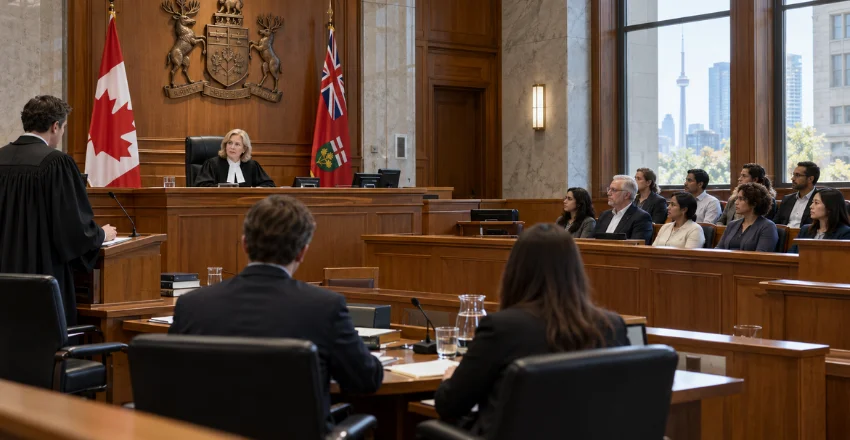
A trial may begin on the same day that the jury is selected. Ontario says trials can last from a couple of days to several weeks. The judge or court staff will usually give an estimated length. Jurors generally go home at the end of each day. Sequestration is mainly relevant once deliberations begin and the jury has not reached a verdict.
Hotel expenses can be covered when an overnight stay is required. Jurors must follow strict instructions about outside information. They cannot research the case, post about it online, or follow related news. These limits protect the parties’ right to a fair trial.
Lawverra’s Rules of Civil Procedure guide explains how Ontario civil cases move through Superior Court. Its Daily Court Lists guide explains how public hearing schedules work. A juror should still follow the summons and the judge’s instructions instead of relying on a public listing.
What to do next
Start with the document you received, because the next step depends on whether it is a questionnaire or a summons. Use the official Ontario jury pages for deadlines, forms, and contact details. Keep copies of anything you send when requesting a change or accommodation.
If your employer threatens your job or penalizes you for attending, document the communication. Lawverra’s Ministry of Labour guide explains Ontario workplace enforcement routes. A licensed Ontario lawyer can advise you when the issue depends on your specific facts.
This article provides general legal information and is not legal advice. Rules and court procedures can change, so confirm the current instructions on your summons. When your own court document conflicts with general information, follow the court’s directions.
Sources and review note
This guide was reviewed on September 24, 2026. It relies primarily on current Ontario jury guidance, the Juries Act, and the juror fee regulation. Readers should check their own summons and official provincial instructions before acting.
Frequently Asked Questions
What are the current jury duty pay rules in Ontario?
People eligible for criminal or civil trials receive $120 for each required sitting day. They do not receive that fee on days when an employer continues paying income. People who attend only for jury selection receive no selection pay.
Can my employer refuse to let me attend?
No employer can simply require you to ignore a valid summons. Ontario’s Juries Act requires sufficient leave for jury service and reinstatement afterwards. The employer does not have to pay regular wages unless another agreement provides that benefit.
How long does jury selection take?
Ontario says selection can last at least one day and up to one week. Plan to spend the full day at the courthouse when you first report. If selected, the trial itself may last several days or several weeks.
Can I get permanently excused from future service?
Ontario says there are no permanent excusals from future jury service. A person may receive another eligibility form in a later year. Any later deferral, excusal, or accommodation request is assessed on the circumstances at that time.