
SABS: The letter usually arrives about a week after the crash. It thanks you for reporting the accident, encloses a stack of forms, and mentions a guideline you have never heard of. That one word, “minor,” is often the most expensive thing in the envelope.
Benefit limits by injury category
| Category | Who tends to land here? | Treatment and care limit | What the money realistically buys |
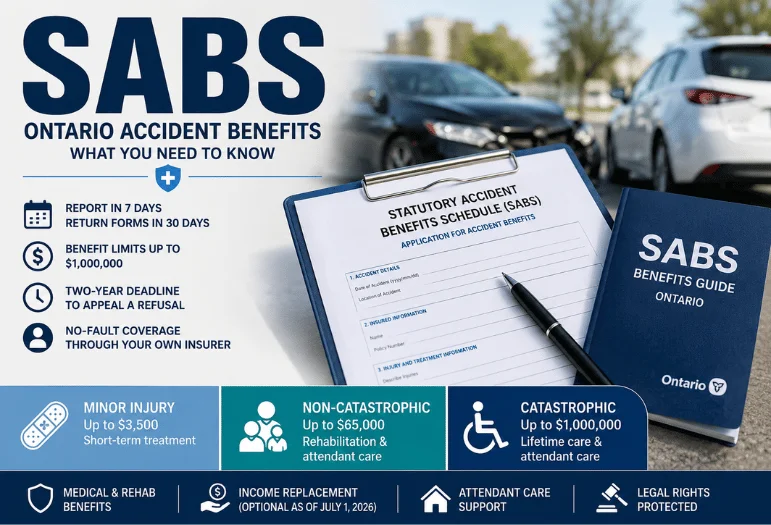
| Minor injury guideline | Sprains, strains, whiplash, bruising, cuts | CA$3,500 | Roughly 12 weeks of physiotherapy or chiropractic care |
| Non-catastrophic | Fractures, surgery, concussion with lasting symptoms, psychological injury | CA$65,000 standard, CA$130,000, or CA$1,000,000 if purchased | Longer rehabilitation, assessments, and attendant care to CA$3,000 a month |
| Catastrophic | Amputation, paraplegia, blindness, severe brain injury, very high whole-person impairment | CA$1,000,000 standard, CA$2,000,000 if purchased | Lifetime care, home modifications, attendant care to CA$6,000 a month |
Key Takeaway
- Report the accident to your insurer within 7 days, and return the completed application within 30 days of receiving it.
- Most soft tissue claimants start inside the minor injury guideline, which caps treatment at CA$3,500.
- Non-catastrophic claims share CA$65,000 across treatment and attendant care. Catastrophic claims get CA$1,000,000.
- Income replacement pays 70 percent of gross weekly income, to a standard maximum of CA$400 a week.
- Since July 1, 2026, that income benefit is optional coverage, not automatic.
- You can take a refusal to the License Appeal Tribunal for two years after the denial letter.
What SABS covers, and who pays for it

Ontario runs a no-fault system for injury benefits. You claim from your own insurer, even when the other driver ran the red light and admitted it at the roadside. Fault still shapes your premium and any civil claim, but it does not decide whether the treatment checks start.
Passengers, cyclists, and people struck while walking can also claim, usually through the insurer of a household policy. Benefits themselves fall into two groups: care benefits, which pay for treatment, assessments, and help at home, and money benefits, which replace lost earnings or unpaid work.
Three injury categories, three very different ceilings
Everything in an accident benefits file follows from the category your insurer assigns. Roughly 285 times the money separates the top rung from the bottom one.
The minor injury guideline and its CA$3,500 cap
A minor injury means a sprain, strain, whiplash-associated disorder, contusion, abrasion, laceration or subluxation, plus anything that follows clinically from one of those. Ontario has published the ceiling in section 18(1) of the Statutory Accident Benefits Schedule: CA$3,500 for medical and rehabilitation goods and services. That figure survived the July 1, 2026, amendments untouched.
Inside that cap, the guideline pre-approves a set schedule. Your provider can bill roughly CA$215 for the initial assessment. Three treatment blocks of about CA$775, CA$500, and CA$225 follow across twelve weeks, plus up to CA$400 for supplementary items such as a brace. Nobody has to approve those amounts. That is the trade: fast access, low ceiling.
Non-catastrophic impairment and the CA$65,000 pot
Step outside the guideline, and the standard limit rises to CA$65,000. One detail catches people out. That figure is a single pot shared by treatment and attendant care, so a few months of in-home support can swallow the budget a surgeon’s rehabilitation plan needs later. Attendant care is separately capped at CA$3,000 a month. Drivers who bought optional coverage at renewal may hold CA$130,000 or even CA$1,000,000 here instead.
Catastrophic impairment and the CA$1,000,000 limit
Catastrophic status unlocks CA$1,000,000, with attendant care allowed up to CA$6,000 a month and no five-year cut-off on treatment. Qualifying is technical. Your physician or psychologist completes an OCF-19. The file must meet defined criteria: amputation, total blindness, paraplegia, or a severe brain injury measured on accepted scales. Whole-person impairment above the threshold in the regulation also qualifies. Insurers often contest these findings, and the tribunal decides many of them.
Why most SABS claims start inside the guideline
Here is the part that page one rarely says out loud. That guideline is the default landing spot, not a considered conclusion. An adjuster reads the first disability certificate and the initial clinic notes, sees soft tissue language, and codes the file as minor within days. Nobody has examined you at that point.
Getting out of it takes evidence, not argument. In practice, three things move a file.
- Objective findings. Imaging, a specialist’s diagnosis, or documented cognitive symptoms carry far more weight than a pain questionnaire.
- Pre-existing conditions on record. If your health record shows a condition that will stop you from recovering inside the cap, the guideline does not apply. That record has to predate the crash and say so in writing.
- An OCF-18 that does real work. Your provider submits the treatment plan, and the insurer has 10 business days to answer. Refusal is not the end of the road. It is the document that opens the tribunal.
Claimants who accept the first coding often exhaust CA$3,500 in three months, then pay privately for care they were entitled to all along.
How the income replacement benefit is calculated

The formula is simple, and the cap does the damage. You get 70 percent of your gross weekly income before the accident, up to a standard maximum of CA$400 a week, after a one-week waiting period. Higher limits of CA$600, CA$800, or CA$1,000 are sold as optional coverage.
| Gross weekly income before the crash | 70 percent calculation | Paid under standard coverage |
| CA$500 | CA$350 | CA$350 |
| CA$800 | CA$560 | CA$400 |
| CA$1,500 | CA$1,050 | CA$400 |
Anyone earning above about CA$570 a week hits the ceiling. After 104 weeks, the test tightens: you must show a complete inability to hold any job you are reasonably suited for by education, training, or experience. People who were not working can claim a non-earner benefit of CA$185 a week, after a four-week wait. Caregiver benefits pay CA$250 weekly for the first dependant, plus CA$50 for each additional one.
Was the crash part of your job? Workplace coverage may apply instead, and you may face an election between the two systems. Our guide to employer duties under OSHA covers the safety side of driving for work.
What changed on July 1, 2026?
The regulator split the package into two. Medical, rehabilitation, and attendant care benefits stay mandatory on every policy. Almost everything else became optional, which means a driver has to choose it and pay for it:
- income replacement, non-earner, and caregiver benefits
- housekeeping and home maintenance
- death and funeral benefits
- visitor expenses, lost educational expenses, and damage to personal items
Those optional benefits also reach fewer people. They apply to the named insured, a spouse, dependents, and listed drivers. Cyclists and passengers outside those categories keep the mandatory care benefits and lose the rest. Pull out your declaration page and check what you actually elected at your last renewal, because a blog post written in 2024 will tell you the income benefit is automatic. It no longer is.
Every deadline in one table
| What has to happen? | Deadline | Who acts |
| Report the accident to your broker or insurer. | 7 days, or as soon as practicable | You |
| The insurer sends the application package. | Promptly after you report | Insurer |
| Return the completed OCF-1 application | 30 days after you receive the package | You |
| Answer a treatment plan (OCF-18). | 10 business days | Insurer |
| Apply to the Licence Appeal Tribunal. | 2 years from the denial letter | You |
| Start a civil claim against the at-fault driver. | 2 years from the crash, in most cases | You |
The forms carry their own shorthand. An OCF-1 is your application, and an OCF-2 confirms your income through your employer. Your health practitioner signs the OCF-3 disability certificate. Treatment plans travel on an OCF-18, catastrophic applications on an OCF-19, and clinic invoices on an OCF-21. Missing the 30-day mark does not automatically end a claim, though you must explain the delay. File the form and attach the reason.
When your insurer says no

Disputes go to the Automobile Accident Benefits Service, a branch of the Licence Appeal Tribunal. You have two years from the denial to apply; the filing fee is CA$106, and the tribunal usually acknowledges an application within four days. Scheduling the first case conference takes about 35 days, and it happens three to five months in. Hearings follow four to eight months later, with a written decision 60 to 120 days after that.
Keep one distinction clear. The tribunal handles benefits from your own insurer. Compensation for pain and suffering beyond the benefit limits comes from a separate civil claim against the at-fault driver. That claim runs in the courts, and smaller matters can proceed through the Small Claims Court in Ontario instead.
Conclusion
SABS benefits can provide essential financial and medical support after an Ontario accident, but the amount available depends heavily on how your injury is classified and what coverage you purchased. The CA$3,500 minor injury cap, CA$65,000 non-catastrophic limit, and CA$1,000,000 catastrophic limit can make the difference between having treatment covered and paying out of pocket.
Deadlines matter just as much, particularly the two years for challenging a denied benefit claim. If your insurer has denied treatment, limited your claim, or classified a significant injury under the minor injury guideline, reviewing your options early can help protect your benefits and prevent an avoidable deadline from closing the door.
Apart from that, if you want to know about the article Complete Guide to Restitution Meaning in Canada: Who Gets Paid in 2026, then please visit our Personal Injury Category.
Your next step
Write down the date of your accident, the date you reported it, and the date the package landed in your mailbox. Those three dates control your file. If a denial has already arrived, or your insurer coded a serious injury as minor, reach the team at Lawverra before the two-year clock runs out.
Frequently asked questions
No. Accident benefits come from your own policy regardless of fault. Suing the other driver is a separate claim, and many injured people pursue both.
A sprain, strain, whiplash, contusion, abrasion, laceration, or subluxation, together with clinically related symptoms. Fractures and documented brain injuries fall outside it.
Not on a policy issued after July 1, 2026, without that optional coverage. Check the declaration page, then check whether another household policy responds.
Treatment funding for a non-catastrophic injury generally runs for five years, and attendant care has its own monthly ceiling. Catastrophic entitlement continues for life.
Not for a clean minor claim. Once your file involves a denied treatment plan, a disputed category, or a catastrophic application, representation usually pays for itself.