
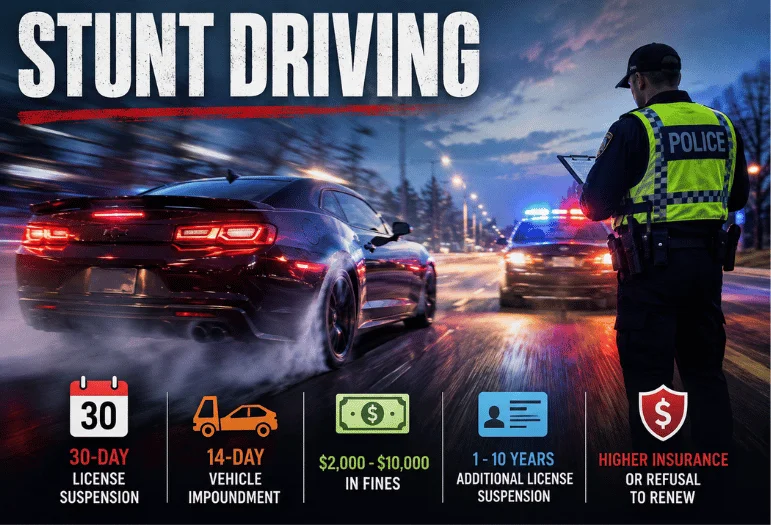
The lights come on, and twenty minutes later, you are standing on the shoulder with no license and no car. Most stunt driving charges in Ontario begin exactly like that. Those roadside penalties land before a judge has heard a word, and that is the part page one keeps burying. Here is the sequence, from the gravel beside the highway through to the courtroom.
The penalty timeline, stage by stage
Most guides give you a long list of penalties. That is not how you experience them. They arrive in three separate waves, months apart, and each wave hits a different part of your life.
| Stage | Your license | Your vehicle | Money | Insurance |
| Roadside, day 0 | Suspended for 30 days immediately | Impounded for 14 days, even if borrowed | Towing and storage, often CA$800 to CA$1,500 | No change yet. Your insurer does not know. |
| Days 1 to 30, before court | Still suspended, then CA$281 to reinstate | Released after 14 days once the lot is paid | Reinstatement fee, plus legal fees if you hire help | Still no change. A charge is not a conviction. |
| On a first conviction | A further 1 to 3 years off the road, six demerit points | No further impoundment | Fine of CA$2,000 to CA$10,000, plus a 25% victim fine surcharge | Large increase at renewal, or a refusal to renew |
| On a repeat conviction | 3 to 10 years for a second, lifetime for a third or fourth | No further impoundment | The same fine range and a jail term of up to six months is available | High-risk market only, or no offer at all |
Key takeaways
- The 30-day suspension and the 14-day impoundment are automatic, and you cannot argue them at the roadside.
- A conviction, not the charge, triggers the fine, the demerit points, and the long suspension.
- A first conviction costs at least CA$2,500 in fines and surcharges, before towing, storage, and the CA$281 reinstatement fee.
- Your insurer usually learns about it at renewal, not on the day you are charged.
- Prosecutors reduce and withdraw these charges often enough that pleading guilty by default is rarely the smart move.
What counts as stunt driving in Ontario

Speed is the common trigger, and the threshold changed in 2021. Everything now turns on the posted limit of the road you were using.
| Posted speed limit | The speed that triggers the charge |
| Less than 80 km/h | 40 km/h or more over the limit |
| 80 km/h and above | 50 km/h or more over the limit |
| Any road in the province | 150 km/h or more, whatever the limit |
Ordinary drivers get caught by that first row. On a 50 km/h residential street, 90 km/h is enough. No race. No audience. Just a heavy foot on a wide road, and a charge whose minimum fine starts at CA$2,000 before any surcharge is added.
O. Reg. 455/07 lists the behavior that qualifies without any speed reading at all:
- burnouts, doughnuts, drifting, or any driving meant to break traction
- wheelies, or lifting tires off the road on purpose
- chasing another vehicle, or racing beside one
- deliberately blocking a driver who is trying to pass
- cutting someone off on purpose, or tailgating them deliberately
- driving with a passenger in the trunk, or driving from outside the driver’s seat
None of these numbers is arbitrary. Ontario’s Ministry of Transportation puts the risk of death or serious injury 11 times higher in a crash at 50 km/h or more over a 100 km/h limit. Compare that with a crash at or below the posted limit, using provincial collision data from 2013 to 2017.
The first thirty minutes at the roadside
An officer measures your speed or watches your driving, then makes a decision at the side of the road. If the reading clears the threshold, you are not getting a ticket. You get a summons instead. That summons carries a court date, plus two penalties that take effect before you leave the shoulder.
Your license goes into the officer’s hand. The clock starts. It runs for 30 days. A tow truck takes the vehicle for 14 days. It happens whether the car is yours, your partner’s, or your employer’s, and the person who owns it pays the towing and storage bill. You find your own ride home.
Here is the detail almost nobody prints: Section 172 says there is no appeal from the roadside suspension or impoundment, and there is no right to be heard before either one. Court proceedings stay open, but the 30 days and the 14 days run regardless. Even if a prosecutor withdraws the charge four months later, you do not get those days back. Everything after the roadside moves into the Ontario Court of Justice under the Provincial Offences Act. Related explainers sit across the rest of our law section.
Getting your license and your vehicle back.
Two clocks run at once, and they end on different days. Miss that, and you will show up at the impound lot with no way to drive the car home.
- Day 14: the vehicle. Pay the towing and storage bill, and the lot releases it. Bring a driver who holds a valid license, because yours is still suspended for another two weeks.
- Day 30: the license. Your suspension expires. Reinstatement costs CA$281, according to the Ministry of Transportation, and you should check your status online before you drive again.
- Your court date. This usually falls weeks or months after the roadside, and it decides everything in the third row of the table above.
Driving while suspended is its own offense, with its own suspension and its own impoundment. Nothing turns one bad afternoon into two charges faster.
The insurance consequence, which arrives last and lasts longest
A fine hurts once. Your premium hurts every month for years, and that is the part the penalty lists on page one glosses over in a single line.
The Ministry of Transportation states plainly that drivers convicted of aggressive, careless, or stunt offenses will face a substantial increase in their rates or may become uninsurable. Insurers treat a section 172 conviction as a major conviction, the same tier as impaired driving, not as a speeding ticket with extra zeros.
Timing surprises people. Your insurer does not get a call from the ministry. They pull your driver’s abstract at renewal, so a conviction in March may not touch your premium until your policy comes up in November. Ontario insurers generally count convictions for three years from the conviction date, so one bad reading follows you through three renewals.
Standard insurers frequently decline to renew after a major conviction. You then land with a high-risk insurer or with the Facility Association, the industry pool that exists, so no Ontario driver goes without coverage. Premiums there are far above standard rates, and getting back into the regular market takes years of clean driving.
The charge can be reduced, and it can be withdrawn.

A stunt driving summons is not a ticket. There is no fine amount printed on it, no box to check, and no option to pay and move on. Somebody has to appear, either you or a representative, and the prosecutor decides how the case resolves.
Three outcomes are realistic:
- Withdrawal. A prosecutor drops the charge, often because of an evidence problem.
- Reduction. You plead to a speeding charge under section 128 instead. That carries a set fine and demerit points, but no long suspension and no CA$2,000 floor.
- Trial. Prosecutors must prove the offense beyond a reasonable doubt.
The pressure points are technical. Radar and lidar equipment needs testing and calibration, and the officer needs the training, the certification, and the contemporaneous notes to stand behind a reading months after the stop. For non-speed allegations, the driving has to fit the wording of the regulation, and an officer’s impression of aggressive behavior does not always survive that test.
One warning about reduction. Dropping to a lesser charge protects the fine, the suspension, and your insurance rating. What it cannot touch are the 30 days and the 14 days you already served. Those are gone the moment the officer signs the notice, which is why the first phone call after the roadside matters.
Conclusion
A stunt driving charge in Ontario can change your situation within minutes, with an immediate 30-day license suspension and 14-day vehicle impoundment followed by potentially serious court, financial, and insurance consequences. The charge itself is not a conviction, and the outcome can range from withdrawal or a reduced charge to a trial.
Because the roadside penalties cannot be undone after they are imposed, the most important step is to understand the summons, protect your court options, and get informed legal advice before deciding how to respond. Acting early can help you avoid turning a temporary roadside stop into years of higher costs and driving restrictions.
Apart from that, if you want to know about the article Complete Guide to Restitution Meaning in Canada: Who Gets Paid in 2026, then please visit our Personal Injury Category.
What to do next
Read the summons and diary of the court date first. Do it today. Then collect what you will need later: the location, the posted limit, the weather, the traffic, and the name and badge number of the officer. Memory fades fast, and the details you write down in week one are the ones that matter in month six.
Frequently asked questions
No. It falls under the Highway Traffic Act, not the Criminal Code, so a conviction leaves no criminal record. Penalties are still severe, and a court can impose jail of up to six months.
Six, applied on conviction rather than at the roadside. Ontario applies the same count to careless driving and to speeding 50 km/h or more over the limit.
Three years from the conviction date for insurance purposes. A court can look back further than that when it decides on a penalty for a later offense.
Novice drivers face at least a 30-day suspension on conviction, on top of the court penalty, and the ministry can cancel the license outright. A cancelled novice license means starting the graduated system again.
No. Ontario offers no hardship permit or work exemption for a roadside suspension, no matter what your job depends on.
Police impound the vehicle either way, and the registered owner pays the towing and storage. Worth knowing before you lend anyone the keys.