

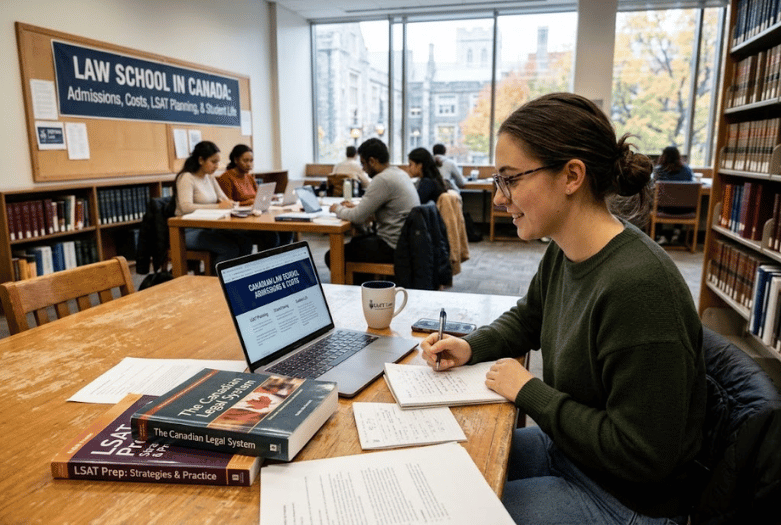
Law school in Canada usually follows several years of university study and leads to a professional legal degree. Admission standards vary by university, so there is no single national GPA, LSAT score, or application process. Applicants should compare each faculty’s academic requirements, deadlines, costs, and admission categories before applying.
A Canadian Juris Doctor, or JD, normally requires three years of full-time study after admission. Most common-law programs consider undergraduate grades, LSAT results, written submissions, and other evidence of an applicant’s suitability. Quebec and bilingual programs can follow different educational and testing requirements.
Canadian Legal Education at a Glance
| Question | Practical answer |
|---|---|
| Main professional degree | Usually a three-year JD at common-law faculties |
| Direct entry from high school | Generally no for Canadian JD programs |
| Previous university study | Commonly two or three years minimum, depending on the faculty |
| Undergraduate major required | No specific major is normally required |
| LSAT required | Required by many common-law JD programs, but not every Canadian legal program |
| Typical application materials | Transcripts, LSAT results where required, personal statements, and school-specific documents |
| Ontario application system | OLSAS for participating common-law programs |
| Main cost categories | Tuition, university fees, books, housing, transportation, and living expenses |
Direct answer
Canadian applicants generally complete university study before entering a three-year professional JD. Requirements vary considerably between faculties. Many programs weigh strong grades and an LSAT score, while written applications provide context about experience, goals, and achievements. Applicants should always check current requirements directly with each university.
Key Takeaways
- You do not need a particular undergraduate major to pursue a Canadian JD.
- Some faculties accept applicants after two university years, while others normally expect three.
- Many common-law programs require the LSAT.
- Admission is competitive, and minimum eligibility does not guarantee acceptance.
- Ontario applicants generally apply through OLSAS.
- Tuition differs substantially between institutions and student categories.
- Location, clinics, career goals, and total living costs matter alongside rankings.
How Law School Admissions Work in Canada

Canadian faculties set their own eligibility standards and admission methods. That means an applicant can qualify at one university but not another. The LSAC directory provides current profiles for Canadian JD programs and links applicants to individual faculties.
Numerical factors remain important at many institutions, especially undergraduate grades and LSAT performance. Yet several faculties also assess personal statements, work history, community involvement, references, or applicant categories. Read each admissions page instead of relying on a single national benchmark.
How Much University Education Do You Need Before Applying?
Canada has no universal requirement for a completed four-year bachelor’s degree. Saskatchewan accepts applicants with at least 60 university credit units, which equals two full academic years. The university also states that no particular pre-law program or undergraduate field is required.
Other institutions expect more university study before entry. Osgoode generally requires three years, or 90 credits, in a degree-leading university program. Ottawa’s English JD also normally requires at least three years of undergraduate study before enrolment.
Even where earlier application is technically permitted, completing a bachelor’s degree can still strengthen your position. Alberta describes two-year applicants as exceptional candidates and applies demanding academic and LSAT standards to that group. At Calgary, all members of the 2026 entering class held bachelor’s degrees.
Do You Need the LSAT in Canada?
Many English-language common-law JD programs require the Law School Admission Test. Osgoode, Saskatchewan, Victoria, Alberta, and Ottawa are among the faculties requiring it for their regular programs. The exam therefore remains central to many Canadian applications.
No single score guarantees admission across Canada. Ottawa says it has no formal minimum, although it looks for scores above the 70th percentile. Calgary reported an average LSAT score of 166 among students entering in 2026.
Applicants should also avoid assuming every Canadian legal degree follows identical testing rules. McGill’s BCL/JD has a distinctive bijural structure, and Canadian programs can differ by language and legal tradition. Check the current requirements for every program on your shortlist before scheduling tests.
How the Application Process and Deadlines Work
Start by building a shortlist and recording each faculty’s requirements in one document. Track academic prerequisites, accepted LSAT dates, written submissions, references, fees, and application deadlines. This approach reduces the risk of missing a school-specific requirement.
For Ontario’s participating common-law programs, applicants use the Ontario Law School Application Service. The deadline for first-year English programs entering in 2027 is November 1, 2026. Required transcripts and reference forms are also due by that date where applicable.
A practical application sequence is:
1. Compare programs and confirm that you meet their eligibility rules.
2. Plan your LSAT date where the test is required.
3. Request transcripts and contact referees early.
4. Draft each required personal statement or supplementary submission.
5. Review application categories that may apply to your circumstances.
6. Submit before the relevant deadline and confirm every document was received.
Outside Ontario, application systems and dates can differ. For example, Victoria accepts applications through its own process and closes first-year applications on December 1. Saskatchewan opens applications for September 2027 entry on October 15.
How Competitive Are Canadian JD Admissions?
Meeting minimum eligibility standards is not the same as being competitive. Osgoode reported 4,230 applications for 355 available places in its 2026 admission statistics. Its entering profile reported a median CGPA of 3.78 and a median LSAT at the 86th percentile.
Calgary reported 1,717 applications and 139 incoming first-year students for 2026. Its entering class had an average GPA of 3.80 and an average LSAT score of 166. These figures illustrate competition, but they are not universal admission cut-offs.
Written submissions can also strengthen an application. LSAC advises applicants to use personal statements to highlight concrete experiences, achievements, and the value they bring to a program. Authentic detail usually provides more useful information than broad claims about future ambitions.
What Does a Canadian JD Cost?
Tuition depends on the university, residency status, course load, and academic year. Applicants should also budget for mandatory university fees, books, housing, transportation, food, and professional expenses. Comparing tuition alone can therefore produce a misleading picture of total cost.
Saskatchewan estimates first-year 2026-27 tuition and university fees at $20,051 for Canadian students. It separately estimates books and related expenses at about $2,500. Housing is not included in those figures.
Calgary lists 2026-27 domestic tuition at $1,407.51 for each three-unit course. It also lists general, student union, health, transportation, and career-services fees separately. Applicants should calculate expected annual totals using their actual course requirements.
Application costs matter before classes even begin. OUAC currently charges a $200 application fee plus a separate university fee for each Ontario choice. Those fees are non-refundable, so applicants should factor them into their planning.
How to Choose a Program That Fits Your Goals
Rankings provide context, but they shouldn’t make the decision for you. Consider tuition, living costs, clinical opportunities, course offerings, city size, career markets, and student support. Lawverra’s 2026 comparison can help you compare leading Canadian law programs across several of these factors.
Location matters because Canadian legal practice is closely tied to provincial licensing and regional employment markets. Your preferred practice area may also make certain clinics, courses, or government placements more useful. A student interested in public law may value different opportunities than someone focused on corporate practice.
Understanding Canada’s legal traditions can also guide program selection. Lawverra explains how common-law precedent works in Canada and why Quebec’s private-law tradition differs. Its guide to jurisdiction in the Canadian court system provides further context about courts and legal authority.
Create your own scorecard before accepting an offer. Give meaningful weight to affordability, academic interests, career geography, experiential learning, and personal circumstances. Your highest-ranked option may not best fit your priorities.
What Happens After the JD?
Graduating with a JD is an important educational milestone, but it does not automatically authorize legal practice. Licensing requirements are administered by provincial and territorial legal regulators. Requirements can include experiential training, licensing exams, character requirements, and other professional steps.
The exact route depends on where you plan to practise. Students should therefore review their intended regulator’s current licensing process before graduation. Planning early can help with articling searches, experiential programs, examination dates, and associated costs.
A Canadian legal education can also support careers outside traditional private practice. Graduates work in government, business, policy, compliance, academia, public-interest organizations, and other fields. Your choice of courses and practical experiences can help prepare you for those paths.
Frequently Asked Questions
How long does law school take in Canada?
A standard full-time Canadian JD usually takes three academic years to complete. Saskatchewan and Manitoba both describe their JD programs as three-year degrees. Combined programs, extended options, and other arrangements can take longer.
Can you enter a Canadian JD directly from high school?
Generally, no. Canadian professional JD programs normally require university education before admission. The University of Toronto specifically advises students that Canadian JD programs do not accept direct entry from high school.
What undergraduate degree is best for legal studies?
There is no required pre-law major for most Canadian JD programs. Students enter from arts, sciences, business, engineering, and many other academic backgrounds. Choose a subject where you can excel while building reading, writing, research, and analytical skills.
Do you need a perfect GPA to get admitted?
No universal GPA guarantees admission, and requirements vary by faculty. Competitive programs often admit students with strong academic records, but many also review the broader application. Compare your record with recent class profiles instead of treating one GPA as a national threshold.
Plan Your Application Around the Programs You Actually Want
Start with a realistic shortlist, then verify every requirement directly with each university. Work backwards from deadlines when scheduling tests, transcripts, references, and written submissions. Recheck official admissions pages before submitting because requirements and dates can change between cycles.